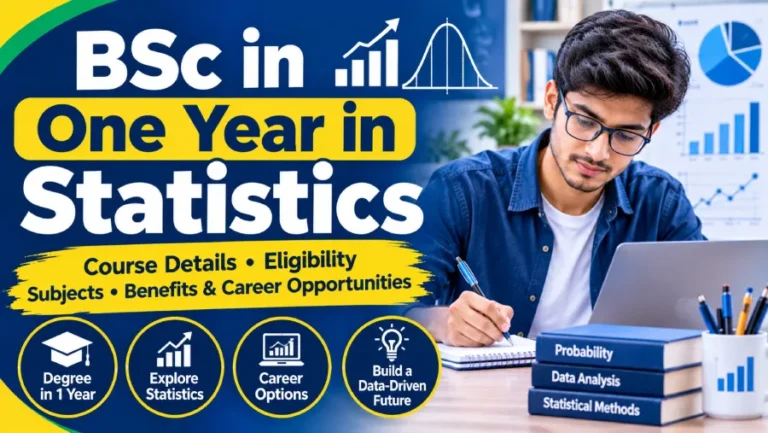
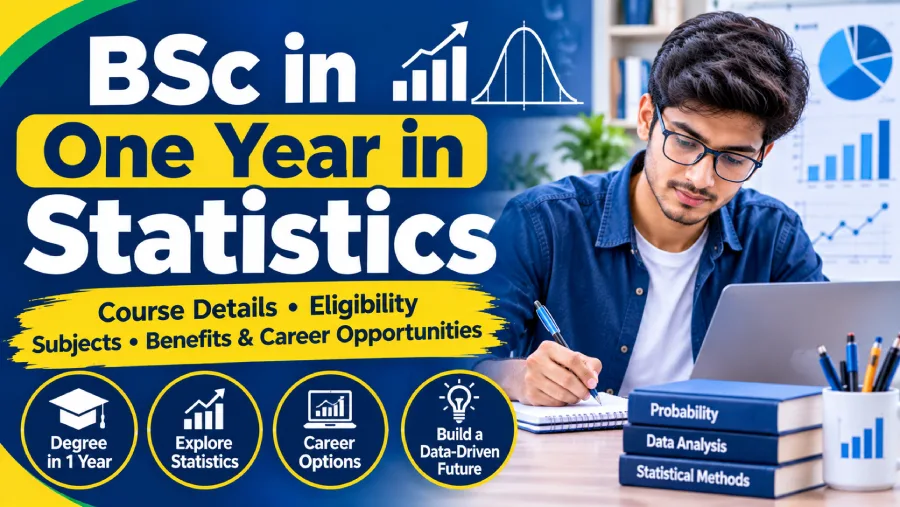
What Is a BSc in Statistics?
A Bachelor of Science (BSc) in Statistics is an undergraduate programme that focuses on the mathematical and analytical methods used to understand data and solve problems. It teaches students how to collect information, organise datasets, analyse trends, interpret results and draw meaningful conclusions.
The programme combines mathematical concepts with practical applications in statistical analysis, probability, data modelling and research.
Depending on the university, related programmes may be offered under names such as:
- BSc Statistics
- BSc Applied Statistics
- BSc Statistical Science
- BSc Mathematics and Statistics
- BSc Statistics and Data Analytics
The course curriculum and specialisations may differ between institutions.
BSc in Statistics: Course Overview
| Course Detail | Information |
|---|---|
| Degree | Bachelor of Science (BSc) |
| Specialisation | Statistics |
| Academic Level | Undergraduate |
| Field | Mathematics and Data Science |
| Standard Duration | Usually 3–4 years, depending on the programme |
| Eligibility | Class 12 or equivalent |
| Preferred Subjects | Mathematics |
| Learning Areas | Probability, data analysis, statistical modelling |
| Study Format | Regular, online or distance, where officially permitted |
| Career Sectors | Banking, finance, research, analytics and technology |
Can You Complete a BSc in Statistics in One Year?
The possibility of completing a BSc in Statistics in one year depends on a student’s previous education, academic credits and the university’s approved academic policies.
A conventional undergraduate degree cannot automatically be completed in one year simply by enrolling in an online or distance programme.
Students may explore the following academic pathways:
1. Credit Transfer
Students who have already completed relevant university-level subjects may be eligible to transfer credits. The receiving university evaluates previous coursework, grades and credit requirements before approving exemptions.
2. Recognition of Prior Learning
Some institutions may assess previously acquired academic learning against programme requirements. The eligibility and amount of recognised learning depend on the institution’s policies.
3. Accelerated Degree Pathways
Certain universities may offer approved accelerated study arrangements to eligible students. These pathways have specific academic and credit requirements and do not automatically guarantee one-year completion.
4. Flexible Learning Options
Online and distance learning can offer flexibility to students who need to balance education with employment or other responsibilities. However, the university and programme must be officially permitted for the relevant academic session and mode of delivery.
Before enrolling in a programme advertised as a one-year BSc in Statistics, verify the degree-awarding institution, recognition, programme approval, credit requirements, duration and qualification validity.
Eligibility for BSc in Statistics
Eligibility requirements vary between universities, but common admission criteria include:
- Completion of Class 12 or equivalent from a recognised board.
- Mathematics is generally required or strongly preferred.
- Minimum qualifying marks as specified by the university.
- Admission through merit or entrance examinations, depending on the institution.
- Previous academic records for credit-transfer or alternative pathways.
Students should check the official eligibility requirements before applying, especially if they did not study Mathematics at the Class 12 level.
Subjects Covered in BSc Statistics
The curriculum introduces students to mathematical concepts and statistical techniques used in data analysis, research and decision-making.
1. Descriptive Statistics
Descriptive Statistics focuses on organising, summarising and presenting data. Students learn about mean, median, mode, variance, standard deviation, frequency distributions, tables and graphical representations.
2. Probability Theory
Probability Theory studies the likelihood of different outcomes. Students learn probability rules, conditional probability, independence, random events and probability distributions.
3. Statistical Inference
Statistical Inference helps students draw conclusions about larger populations using sample data. Topics include estimation, confidence intervals, hypothesis testing and statistical significance.
4. Regression Analysis
Regression Analysis examines relationships between variables and helps explain or predict outcomes. Students learn linear regression, multiple regression, correlation and model interpretation.
5. Sampling Techniques
This subject explores methods of selecting samples from populations. Students study random sampling, stratified sampling, systematic sampling, sampling distributions and sampling errors.
6. Mathematical Statistics
Mathematical Statistics applies mathematical methods to statistical problems. It covers distributions, estimators, statistical properties, mathematical probability and theoretical foundations of analysis.
7. Statistical Computing
Statistical Computing introduces the use of software and programming tools for data analysis. Depending on the university, students may learn R, Python, Excel or other statistical applications.
8. Design of Experiments
This subject focuses on planning experiments and analysing results. Students explore experimental design, variables, treatments, control groups and methods for drawing reliable conclusions.
9. Time Series Analysis
Time Series Analysis examines data collected over time. Students learn trend analysis, seasonal patterns, forecasting methods and applications in business, economics and finance.
10. Operations Research
Operations Research uses mathematical and quantitative techniques to solve planning, optimisation and resource-allocation problems. Topics may include linear programming, decision models and optimisation methods.
Practical Learning in BSc Statistics
Practical learning is an important part of Statistics education because students need to apply mathematical methods to real datasets.
Depending on the university, students may participate in:
- Data collection and survey design.
- Statistical calculations and analysis.
- Spreadsheet-based data management.
- Statistical software exercises.
- Probability and simulation experiments.
- Regression and correlation projects.
- Data visualisation.
- Forecasting and time-series projects.
- Research assignments.
- Interpretation and presentation of statistical findings.
Students can also strengthen their practical knowledge by learning Excel, Python, R, SQL and data visualisation tools alongside their academic programme.
Benefits of Studying BSc Statistics
1. Strong Analytical Foundation
The programme develops mathematical and analytical thinking, helping students understand data and solve complex problems systematically.
2. Data-Driven Decision-Making
Students learn how statistical methods can support business planning, research, forecasting and evidence-based decisions.
3. Opportunities Across Industries
Statistical knowledge is useful in banking, insurance, healthcare, government, market research, technology and many other sectors.
4. Research Skills
The course introduces sampling, experiments, hypothesis testing and data interpretation, which can be useful in scientific and business research.
5. Foundation for Data Careers
Statistics can provide a strong foundation for further learning in data analytics, data science, business intelligence and quantitative research.
6. Higher Education Opportunities
Graduates can explore specialised postgraduate programmes in statistics, mathematics, analytics, economics and related areas, subject to eligibility.
Career Opportunities After BSc Statistics
After completing a recognised BSc in Statistics, graduates may explore various entry-level roles. Actual eligibility depends on the employer, additional skills, experience and job-specific requirements.
1. Statistical Assistant
Statistical assistants help collect, organise, process and analyse numerical data for research, business or administrative projects.
2. Data Analyst
Data analysts work with datasets to identify trends, prepare reports, visualise information and support decision-making. Additional training in Excel, SQL, Python or BI tools can be beneficial.
3. Research Assistant
Research assistants support research projects through data collection, survey analysis, statistical calculations, literature reviews and documentation.
4. Business Analyst
Business analysts examine business information, performance metrics and operational data to help organisations understand problems and improve processes.
5. Market Research Analyst
Market research analysts study customer behaviour, market trends, survey results and competitor information to support marketing and business strategies.
6. Quality Analyst
Quality analysts analyse performance data, identify inconsistencies, monitor quality indicators and support quality-improvement processes.
7. Operations Analyst
Operations analysts use data and quantitative techniques to evaluate business processes, efficiency, productivity and resource utilisation.
8. Financial Data Analyst
Financial data analysts support the analysis of financial information, trends, performance metrics and reports. Specialised finance roles may require additional qualifications.
9. Survey Research Assistant
Survey research assistants help design surveys, collect responses, organise data and analyse findings for research organisations or institutions.
10. Junior Data Scientist
Students who develop additional skills in programming, machine learning, data analysis and modelling may explore junior data-related roles. Such positions often require skills beyond the bachelor’s curriculum.
Industries That Employ Statistics Graduates
Statistics graduates may explore opportunities across several sectors, including:
- Banking and financial services.
- Insurance and risk management.
- Information technology.
- Data analytics and business intelligence.
- Healthcare and medical research.
- Pharmaceutical research.
- Market research.
- Government departments.
- Educational and research institutions.
- E-commerce and retail.
- Consulting and business services.
- Manufacturing and quality management.
Skills Developed During BSc Statistics
The programme helps students develop mathematical, analytical and technical skills.
Important skills include:
- Data analysis and interpretation.
- Probability and statistical reasoning.
- Mathematical problem-solving.
- Hypothesis testing.
- Regression and correlation analysis.
- Sampling and survey methods.
- Statistical software usage.
- Data visualisation.
- Research methodology.
- Critical thinking and decision-making.
Students can improve their career readiness by practising with real datasets and learning industry-relevant tools such as Excel, Python, R, SQL, Power BI and Tableau.
Higher Education Options After BSc Statistics
Graduates interested in advanced knowledge or specialised careers may consider postgraduate education.
1. MSc Statistics
An MSc in Statistics provides advanced study of probability, statistical theory, modelling, estimation and analytical methods.
2. MSc Applied Statistics
This programme focuses on applying statistical techniques to practical problems across industries, research and professional fields.
3. MSc Data Science
An MSc in Data Science combines statistical methods, programming, machine learning and data analysis to work with complex datasets.
4. MSc Mathematics
Students may pursue postgraduate Mathematics with suitable eligibility, exploring advanced mathematical concepts and quantitative techniques.
5. MSc Actuarial Science
This programme focuses on probability, risk assessment, financial modelling, insurance mathematics and actuarial methods.
6. Master of Business Analytics
Business Analytics programmes apply data analysis, quantitative methods and business intelligence to organisational decision-making.
7. Research Programmes
Students interested in academic or scientific research may pursue advanced research programmes in statistics, mathematics, data science or quantitative disciplines.
Admission requirements vary by institution and postgraduate course.
Is BSc Statistics a Good Career Choice?
BSc Statistics can be a strong academic choice for students who enjoy Mathematics, logical reasoning, problem-solving and working with data.
The degree is relevant to industries where organisations need to analyse information, understand trends, measure performance and make data-informed decisions.
Students interested in analytics careers should focus on building practical skills alongside their degree. Learning programming, statistical software, databases and data visualisation can help improve their ability to apply statistical concepts in professional settings.
The best course choice depends on the student’s interests, mathematical aptitude, preferred industry and long-term career goals.
How to Choose the Right University for BSc Statistics
Selecting the right university is important for academic progression and future career opportunities.
Consider the following factors before applying:
- University Recognition: Verify that the institution is legally recognised and authorised to award the degree.
- Programme Approval: Check whether the specific programme and mode of delivery are officially permitted.
- Curriculum: Review subjects such as probability, inference, regression, sampling and statistical computing.
- Mathematics Requirements: Confirm whether Mathematics is compulsory for admission.
- Software Training: Check whether the curriculum includes practical statistical software and programming tools.
- Faculty Experience: Review the qualifications and academic experience of the teaching staff.
- Projects and Practical Learning: Look for assignments, real-world datasets, research projects and internships.
- Course Duration: Understand the official duration, credit requirements and any approved accelerated or credit-transfer pathways.
- Further Study Opportunities: Check whether the qualification meets entry requirements for your intended postgraduate programme.
Frequently Asked Questions (FAQs)
1. Can I complete BSc Statistics in one year?
A standard BSc Statistics is generally a multi-year undergraduate degree. One-year completion should only be considered if a recognised university confirms an approved pathway and you meet its academic and credit requirements.
2. What is the eligibility for BSc Statistics?
Most universities require Class 12 or equivalent. Mathematics is generally a compulsory or preferred subject, depending on the university.
3. Is Mathematics compulsory for BSc Statistics?
At many institutions, Mathematics is compulsory for admission because the course involves probability, calculus, algebra and statistical methods. Check the university’s eligibility rules.
4. What subjects are taught in BSc Statistics?
Common subjects include Descriptive Statistics, Probability Theory, Statistical Inference, Regression Analysis, Sampling Techniques, Mathematical Statistics, Statistical Computing, Design of Experiments and Time Series Analysis.
5. Is BSc Statistics difficult?
The course can be challenging for students who are not comfortable with Mathematics and logical problem-solving. Regular practice, understanding formulas and working through real examples can help students develop confidence.
6. What jobs can I get after BSc Statistics?
Graduates may explore roles such as statistical assistant, data analyst, research assistant, business analyst, market research analyst, quality analyst and operations analyst.
7. Can I become a data analyst after BSc Statistics?
Yes, BSc Statistics provides a useful foundation for data analytics. Learning Excel, SQL, Python or R, data visualisation and business reporting can further help prepare students for data analyst roles.
8. Can I study BSc Statistics online?
Some universities may offer statistics-related programmes through online or distance learning. Students should verify the institution’s recognition and the specific programme’s approval for the relevant academic session and mode.
9. What can I study after BSc Statistics?
Possible options include MSc Statistics, MSc Applied Statistics, MSc Data Science, MSc Mathematics, MSc Actuarial Science and postgraduate Business Analytics programmes, subject to eligibility.
10. Is BSc Statistics useful for government jobs?
A recognised BSc Statistics may meet the educational requirements for certain government recruitment opportunities. However, specialised statistical positions may require specific qualifications, examinations or postgraduate education.
Conclusion
BSc Statistics is an undergraduate programme that develops mathematical, analytical and data interpretation skills. It introduces students to probability, statistical modelling, research techniques, forecasting and quantitative decision-making.
The qualification can provide a foundation for opportunities in banking, finance, research, data analytics, business intelligence, market research and technology-related sectors.
Students searching for a BSc in one year in Statistics should carefully evaluate the academic pathway, degree recognition and eligibility conditions rather than relying only on advertised duration. A recognised qualification, strong mathematical foundation and practical data skills are important for long-term academic and career development.
Before enrolling, verify the university’s recognition, programme approval, eligibility requirements, credit-transfer policies and qualification validity.