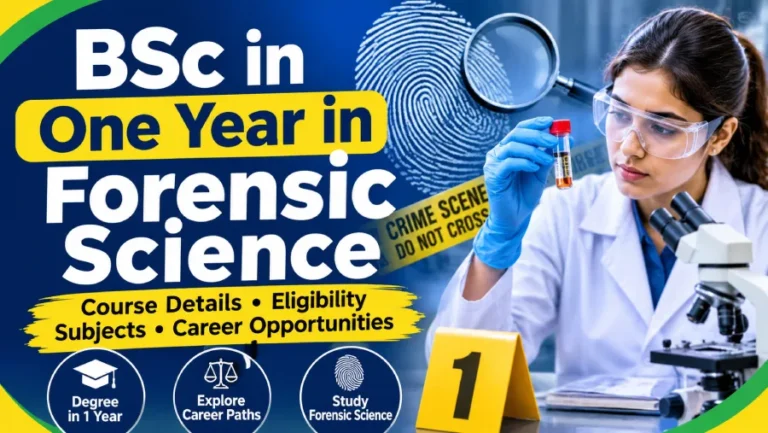
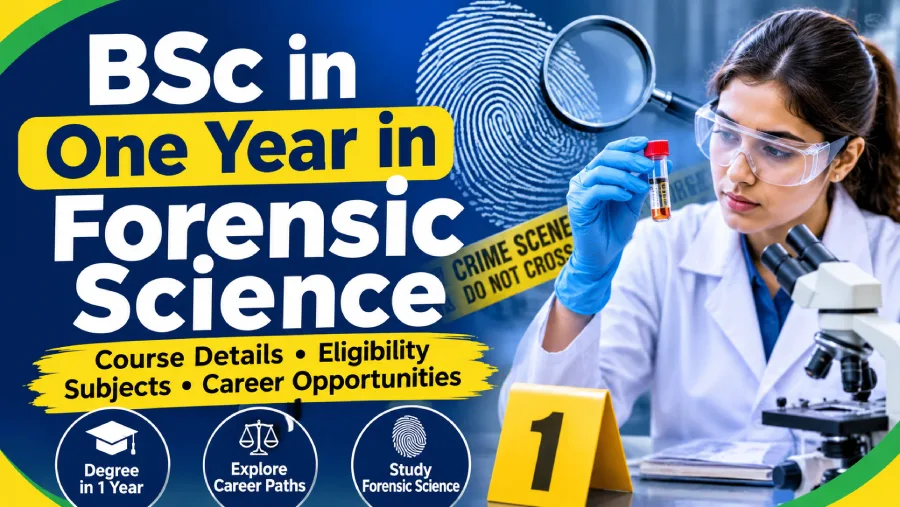
Forensic Science is an interdisciplinary field that combines scientific knowledge, analytical techniques and investigative methods to examine evidence and assist in legal investigations. It plays an important role in criminal investigations, identification, laboratory analysis and the scientific examination of physical evidence.
A Bachelor of Science (BSc) in Forensic Science introduces students to the scientific principles used in examining evidence, analysing biological and chemical materials, understanding crime scenes, studying fingerprints, examining documents and interpreting scientific findings.
With increasing use of scientific technology in investigations, forensic science has become an interesting field for students who enjoy biology, chemistry, laboratory work, analytical thinking and investigation.
Many students search for BSc in One Year in Forensic Science because they want to complete their education faster, continue their studies after a gap or explore flexible higher education options.
This guide explains the course overview, eligibility, subjects, practical learning, career opportunities, higher studies and important considerations regarding one-year degree completion.
What Is a BSc in Forensic Science?
BSc Forensic Science is an undergraduate programme that applies scientific methods and principles to the examination and interpretation of evidence relevant to investigations and legal proceedings.
The programme may introduce students to several scientific disciplines, including biology, chemistry, physics, analytical science, criminalistics and laboratory techniques.
Students learn how scientific evidence is collected, documented, preserved, examined, analysed and interpreted within appropriate forensic procedures.
Common areas of study include:
- Crime Scene Investigation
- Forensic Biology
- Forensic Chemistry
- Fingerprint Science
- Forensic Toxicology
- DNA Analysis
- Digital Forensics
- Forensic Anthropology
- Questioned Document Examination
- Criminalistics
Forensic Science is not limited to crime scene investigation. It also involves laboratory-based analysis, scientific research, evidence documentation, quality assurance, technical reporting and specialised forensic disciplines.
BSc Forensic Science Course Overview
| Course Detail | Information |
|---|---|
| Degree | Bachelor of Science in Forensic Science |
| Course Level | Undergraduate |
| Field | Forensic and Applied Sciences |
| Standard Duration | Typically 3 or 4 years, depending on the programme |
| Study Areas | Crime scene science, forensic biology, chemistry, toxicology and evidence analysis |
| Learning Methods | Lectures, laboratory practicals, case studies, projects and demonstrations |
| Eligibility | Generally Class 12 with relevant science subjects |
| Career Areas | Forensic laboratories, research, evidence examination, investigation support and scientific analysis |
| Higher Studies | MSc Forensic Science, Toxicology, Criminology and specialised forensic disciplines |
Can You Complete a BSc in Forensic Science in One Year?
Students searching for BSc in One Year in Forensic Science are often interested in accelerated education, degree completion after a break or alternative academic pathways.
However, a standard BSc Forensic Science programme is generally structured over three or four years, depending on the university and academic framework. Completing the entire degree in one year is not a standard pathway for new undergraduate students.
Some universities may offer alternative academic routes for eligible students based on previously completed coursework or credits, subject to their regulations.
These may include:
- Credit transfer for previously completed studies
- Re-entry or continuation of an incomplete degree
- Approved accelerated degree pathways
- Recognition of previously earned academic credits, where permitted
Before enrolling, students should verify:
- Whether the university is legally authorised to award the degree.
- Whether the programme is officially offered in the advertised mode.
- Whether the university permits credit transfer or accelerated completion.
- Whether the one-year completion timeline is supported by official academic regulations.
- Whether the degree meets requirements for the student’s intended job, professional pathway or postgraduate admission.
Students should obtain written confirmation of academic eligibility, credits, degree duration and practical requirements before making an admission decision.
Eligibility for BSc Forensic Science
Eligibility criteria vary across institutions, but common admission requirements may include the following.
1. Educational Qualification
Applicants generally need to have completed Class 12 or an equivalent qualification from a recognised educational board.
2. Science Background
Many universities require a science background, often including Physics, Chemistry and Biology or Mathematics. Subject requirements depend on the university.
3. Minimum Marks
Some institutions specify a minimum percentage of marks in Class 12 or relevant science subjects.
4. Entrance Examination
Admission may be based on merit, university entrance examinations or other admission procedures.
5. Alternative Degree-Completion Eligibility
Students seeking re-entry or credit transfer may need to submit transcripts, previously completed course details, credit records and other academic documents.
Applicants should always check the official admission criteria for their chosen university and academic session.
Subjects Covered in BSc Forensic Science
BSc Forensic Science covers a variety of scientific subjects that help students understand evidence, laboratory methods, scientific investigations and the role of forensic professionals.
1. Introduction to Forensic Science
This subject introduces the scope, principles, history and applications of forensic science.
Students learn about the role of forensic science in investigations, different forensic disciplines, evidence examination, scientific documentation and the importance of objectivity.
2. Crime Scene Investigation
Crime Scene Investigation introduces the scientific principles involved in recognising, documenting and examining crime scenes.
Students learn about scene documentation, evidence preservation, photography concepts, scene management, contamination prevention, chain of custody and the importance of maintaining accurate records.
3. Forensic Biology
Forensic Biology focuses on biological evidence and its scientific examination.
Topics may include biological samples, body fluids, hair, tissues, biological identification, biological evidence documentation and the principles of laboratory examination.
4. Forensic Chemistry
Forensic Chemistry applies chemical analysis to materials that may be relevant to investigations.
Students learn about analytical chemistry, chemical testing principles, laboratory instrumentation, material identification, chemical evidence and scientific interpretation.
5. Forensic Toxicology
Forensic Toxicology studies the detection and interpretation of substances such as drugs, alcohol, toxins and chemicals in biological or other samples.
Students may learn about toxic substances, laboratory testing principles, analytical methods, sample handling, toxicological interpretation and the role of toxicology in forensic investigations.
6. Fingerprint Science
Fingerprint Science introduces the principles of fingerprint identification and examination.
Students learn about fingerprint patterns, ridge characteristics, classification concepts, documentation, identification principles and the role of fingerprint evidence in forensic investigations.
7. Forensic Physics
Forensic Physics applies physical science concepts to evidence examination and investigative analysis.
Topics may include motion, impact concepts, measurement, optics, physical evidence, materials analysis and the scientific principles used to interpret physical observations.
8. DNA and Molecular Forensics
This subject introduces the biological and molecular principles involved in DNA-based forensic analysis.
Students may learn about DNA structure, genetic variation, molecular biology, DNA profiling concepts, biological sample analysis and the scientific importance of DNA evidence.
9. Questioned Document Examination
Questioned Document Examination focuses on the scientific examination of documents and their characteristics.
Students may study handwriting comparison concepts, document characteristics, ink and paper examination, printing methods, authenticity-related examinations and scientific documentation.
10. Digital Forensics
Digital Forensics introduces the scientific examination of digital information and electronic evidence.
Students may learn about digital evidence concepts, data integrity, forensic documentation, digital investigation principles, electronic records, evidence preservation and the role of digital forensic specialists.
Practical Learning in BSc Forensic Science
Practical learning is an important part of forensic education because students need to understand scientific procedures, laboratory methods, evidence documentation and analytical techniques.
Depending on the university curriculum and facilities, practical activities may include:
- Forensic laboratory demonstrations
- Biological sample examination
- Microscopy
- Chemical analysis demonstrations
- Fingerprint pattern study
- Forensic photography
- Crime-scene documentation exercises
- Evidence labelling and record keeping
- Chain-of-custody documentation exercises
- Scientific report writing
- Mock crime-scene exercises
- Case-study analysis
- Research projects and laboratory assignments
Practical learning helps students understand the importance of accuracy, objectivity, contamination prevention, scientific limitations, proper documentation and ethical conduct.
Benefits of Studying BSc Forensic Science
1. Interdisciplinary Scientific Knowledge
Forensic Science combines several scientific disciplines, including biology, chemistry, physics, molecular science and analytical techniques.
2. Investigation-Related Career Opportunities
The degree may provide a foundation for exploring career opportunities in forensic laboratories, scientific investigation support, research and evidence-related fields.
3. Laboratory and Analytical Skills
Students develop familiarity with laboratory methods, scientific observations, analytical thinking, evidence documentation and research procedures.
4. Exposure to Modern Scientific Technology
Forensic science increasingly uses specialised equipment, analytical instruments, DNA technologies, digital tools and advanced laboratory methods.
5. Opportunities for Specialisation
Students may pursue higher education in forensic biology, toxicology, DNA analysis, digital forensics, forensic chemistry, criminology and related areas.
6. Research Opportunities
Students interested in scientific research may explore further studies and research projects in forensic sciences, analytical science, molecular biology and related disciplines.
7. Contribution to Scientific Investigations
Forensic professionals support investigations by examining evidence scientifically and providing findings that may assist investigative and legal processes.
Career Opportunities After BSc Forensic Science
BSc Forensic Science graduates may explore entry-level positions and support roles in laboratories, research organisations, forensic service providers and related scientific fields.
Specific forensic positions may require postgraduate qualifications, competitive examinations, practical training, government recruitment eligibility or additional certifications.
1. Forensic Laboratory Assistant
Laboratory assistants support sample handling, laboratory preparation, documentation, equipment organisation and routine procedures under appropriate supervision.
2. Crime Scene Assistant
Crime scene assistants may support scene documentation, evidence recording, photography, scene organisation and other tasks according to training and the employing organisation’s procedures.
3. Forensic Science Research Assistant
Research assistants support forensic science studies, laboratory experiments, literature reviews, data collection and scientific documentation.
4. Forensic Biology Assistant
Professionals in this area may assist with biological sample documentation, laboratory preparation, biological examination and related tasks according to their training.
5. Toxicology Laboratory Assistant
Toxicology laboratory assistants may support sample preparation, testing procedures, documentation and laboratory activities involving toxicological analysis.
6. Fingerprint Technician
Fingerprint-related professionals may assist with fingerprint documentation, records, examination support and identification-related processes, depending on the role and qualifications.
7. Digital Forensics Assistant
Digital forensics assistants may support the documentation, examination and organisation of digital evidence within authorised forensic workflows.
8. Quality Assurance Assistant
Quality assurance professionals support laboratory procedures, documentation, quality systems, equipment records and compliance-related activities.
9. Scientific Documentation Assistant
These professionals help prepare, organise and maintain scientific records, case documentation, technical reports and laboratory-related paperwork.
10. Forensic Science Educator or Academic Assistant
Graduates may explore educational support, tutoring, laboratory demonstration or academic assistance roles. Formal teaching positions may require additional qualifications.
Career eligibility depends on the employer, job description, recruitment rules, practical experience and additional academic requirements.
Industries Where Forensic Science Graduates Can Work
Forensic Science graduates may explore opportunities in different organisations and sectors, including:
- Government forensic science laboratories
- Private forensic laboratories
- Scientific research organisations
- Police and investigation-related departments
- Legal and investigative support services
- Digital forensic service providers
- Laboratory testing and analysis organisations
- Universities and educational institutions
- Scientific consultancy
- Biotechnology and analytical science organisations
- Cybersecurity and digital investigation sectors
Some government forensic positions require specific degrees, specialised qualifications, competitive recruitment examinations or experience. Students should check individual recruitment notifications before applying.
Skills Developed During BSc Forensic Science
A BSc Forensic Science programme can help students develop scientific, analytical and professional skills.
- Scientific observation
- Laboratory safety awareness
- Evidence documentation
- Analytical thinking
- Research methodology
- Sample handling awareness
- Data recording and interpretation
- Scientific report writing
- Attention to detail
- Critical thinking
- Problem-solving
- Quality assurance awareness
- Ethical conduct
- Objectivity and accuracy
- Communication skills
These skills may be useful in forensic laboratories, scientific research, analytical work and related career pathways.
Higher Education Options After BSc Forensic Science
Students who complete an eligible BSc Forensic Science degree may pursue postgraduate education to specialise in a particular forensic discipline.
Possible options include:
- MSc Forensic Science
- MSc Forensic Chemistry
- MSc Forensic Biology
- MSc Forensic Toxicology
- MSc DNA Forensics
- MSc Digital Forensics
- MSc Criminology
- MSc Analytical Chemistry
- MSc Biotechnology
- MSc Molecular Biology
- Postgraduate programmes in Cyber Forensics
- Research-based postgraduate programmes in forensic science
Admission requirements vary by university and specialisation. Some programmes may require specific undergraduate subjects, entrance examinations, laboratory experience or other prerequisites.
Is BSc Forensic Science a Good Choice?
BSc Forensic Science can be a suitable choice for students interested in scientific investigations, laboratory work, analytical methods, evidence examination and the application of science in legal contexts.
It may be particularly attractive to students who enjoy Biology, Chemistry, Physics, research, problem-solving, scientific observation and investigative subjects.
The degree can provide an academic foundation for further specialisation in forensic science, analytical chemistry, molecular biology, toxicology, digital forensics and related disciplines.
However, students should understand that a bachelor’s degree alone may not qualify them for all specialised forensic roles. Some positions require postgraduate qualifications, practical experience, technical training, examinations or specific recruitment eligibility.
How to Choose the Right University for BSc Forensic Science
Choosing the right institution is important for developing a strong scientific foundation and gaining practical exposure to forensic techniques.
University Recognition
Verify the institution’s recognition, legal status and authority to award the degree.
Course Curriculum
Review the subjects, scientific disciplines, laboratory components, research assignments and specialisation options.
Laboratory Facilities
Check the availability of forensic science laboratories, analytical equipment, biology and chemistry facilities, practical training and appropriate safety arrangements.
Faculty Qualifications
Explore the academic background and experience of faculty members in forensic science and related subjects.
Practical Training
Check whether the programme includes laboratory practicals, research projects, case studies, demonstrations, field-based exercises or internship opportunities.
Study Mode
Confirm whether the programme is offered in regular, online, distance or hybrid mode and whether the specific mode is officially permitted.
Course Duration
Understand the standard duration of the programme and verify whether any accelerated or credit-transfer pathway is officially available.
Career Support
Explore research opportunities, internships, academic guidance, career services and further education support.
Fee Structure
Review tuition fees and other costs, including laboratory, practical, examination, research and additional charges.
Students should prioritise academic quality, practical exposure and degree validity when choosing a university.
Frequently Asked Questions (FAQs)
1. Can I complete BSc Forensic Science in one year?
A standard BSc Forensic Science programme generally takes three or four years, depending on the university. Completing the entire degree in one year is not a standard route for new undergraduate students. Alternative completion pathways must be officially permitted and subject to eligibility.
2. What is the eligibility for BSc Forensic Science?
Students generally need Class 12 with relevant science subjects. Many universities require Physics, Chemistry and Biology or Mathematics, but exact subject combinations and marks requirements vary.
3. What subjects are taught in BSc Forensic Science?
Common subjects include Forensic Biology, Forensic Chemistry, Crime Scene Investigation, Fingerprint Science, Forensic Toxicology, DNA and Molecular Forensics, Forensic Physics, Digital Forensics and Questioned Document Examination.
4. Is BSc Forensic Science a science degree?
Yes. BSc Forensic Science is an undergraduate science programme that applies scientific principles and analytical techniques to evidence examination and investigation-related studies.
5. Can I pursue BSc Forensic Science after 12th?
Yes. Students who meet the university’s educational, subject and admission requirements can apply after completing Class 12.
6. What jobs can I get after BSc Forensic Science?
Possible opportunities include forensic laboratory assistant, research assistant, crime scene assistant, forensic biology assistant, toxicology laboratory assistant, fingerprint technician and digital forensics support roles, depending on eligibility.
7. Can I get a government job after BSc Forensic Science?
Yes, graduates may apply for certain government vacancies where their qualification meets the recruitment requirements. Eligibility, examinations, experience and specialised qualifications vary by department and position.
8. Can I pursue MSc after BSc Forensic Science?
Yes. Eligible graduates may apply for MSc Forensic Science, Forensic Chemistry, Forensic Biology, Toxicology, Digital Forensics and related postgraduate programmes.
9. Does BSc Forensic Science involve laboratory work?
Yes. Many programmes include laboratory practicals, scientific demonstrations, evidence-related exercises, research activities and laboratory-based coursework. The extent depends on the curriculum and facilities of the university.
10. What should I check before enrolling in a one-year BSc Forensic Science programme?
Check university recognition, degree validity, study mode, academic credits, course duration, practical requirements, eligibility and whether the advertised completion timeline is officially permitted.
Conclusion
BSc Forensic Science is an undergraduate programme that combines scientific knowledge with investigative applications. It introduces students to forensic biology, chemistry, toxicology, fingerprint science, DNA analysis, crime scene science, digital forensics and evidence-related scientific procedures.
Graduates may explore opportunities in forensic laboratories, research, investigation support, analytical science, digital forensics and related sectors. Students can also pursue postgraduate education to develop specialised knowledge and qualify for advanced forensic career pathways.
For students searching for BSc in One Year in Forensic Science, it is essential to verify the programme’s academic structure, recognition, eligibility, laboratory requirements and officially permitted degree-completion pathway before enrolling.
Choosing a recognised university and gaining appropriate scientific and practical knowledge can help students build a strong foundation for a career in forensic science.