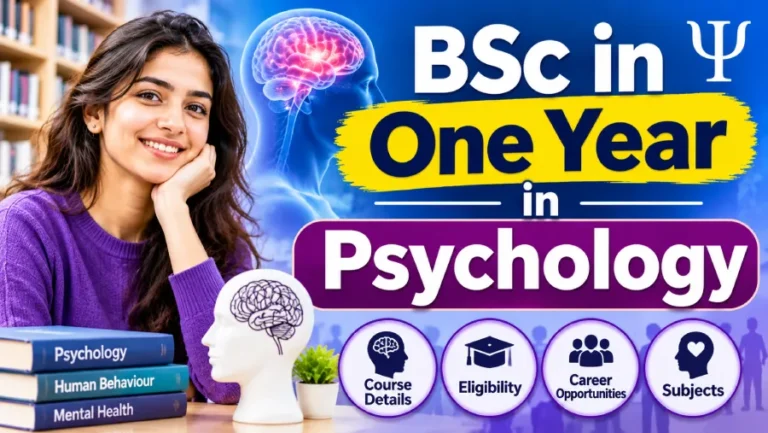
Psychology is the scientific study of human behaviour, thoughts, emotions, mental processes and interactions. It helps us understand why people think, feel, learn, behave and respond differently in various situations. From memory and personality to stress, relationships and decision-making, psychology explores many aspects of human experience.
A Bachelor of Science (BSc) in Psychology introduces students to the scientific study of behaviour and mental processes. The programme typically includes subjects such as cognitive psychology, developmental psychology, social psychology, personality, psychological research, biological psychology and psychological assessment.
Many students search for BSc in One Year in Psychology because they want to complete their education in less time, continue a degree after a study break or explore flexible higher education pathways.
In this guide, we will discuss the course overview, eligibility, subjects, career opportunities, benefits and higher education options for BSc Psychology, while also explaining important considerations about one-year degree completion.
What Is a BSc in Psychology?
BSc Psychology is an undergraduate programme that studies human behaviour and mental processes using scientific methods. It explores how individuals think, feel, learn, develop, interact with others and respond to their surroundings.
The programme introduces students to different areas of psychology, including the biological foundations of behaviour, cognitive processes, personality, social interactions, psychological development and research methods.
Students may study subjects such as:
- Introduction to Psychology
- Cognitive Psychology
- Developmental Psychology
- Social Psychology
- Biological Psychology
- Personality Psychology
- Abnormal Psychology
- Research Methodology
- Psychological Statistics
- Counselling Psychology
Psychology is relevant to several fields, including education, healthcare, human resources, research, social services, organisational development, behavioural science and mental health-related professions.
BSc Psychology Course Overview
| Course Detail | Information |
|---|---|
| Degree | Bachelor of Science in Psychology |
| Course Level | Undergraduate |
| Field | Behavioural and Psychological Sciences |
| Standard Duration | Typically 3 or 4 years, depending on programme structure |
| Study Areas | Human behaviour, cognition, emotions, development, personality and research |
| Learning Methods | Lectures, case studies, projects, research, surveys and practical activities |
| Eligibility | Generally Class 12; stream requirements vary by university |
| Career Areas | Research, education, HR, social services, behavioural support and related fields |
| Higher Studies | MSc Psychology, Counselling, Applied Psychology, Clinical Psychology and specialised programmes |
Can You Complete a BSc in Psychology in One Year?
Students searching for BSc in One Year in Psychology may be looking for a faster route to complete their undergraduate education or resume studies after a break.
However, a standard BSc Psychology programme is generally structured over three or four years, depending on the university and its academic framework. Completing an entire undergraduate degree in one year is not a standard pathway for new undergraduate students.
Some universities may offer alternative completion arrangements for eligible students, depending on previous academic credits and applicable regulations. These may include:
- Credit transfer for previously completed coursework
- Re-entry or continuation of a discontinued degree
- Approved accelerated study pathways
- Recognition of previously earned credits, where permitted
Before enrolling, students should verify:
- Whether the university is legally authorised to award the degree.
- Whether the programme is officially offered in the advertised study mode.
- Whether previous academic credits can be transferred.
- Whether the proposed one-year completion duration is officially permitted.
- Whether the qualification meets requirements for their intended career or postgraduate programme.
Students should obtain written confirmation of their eligibility, credit requirements, duration and degree-awarding conditions before making an admission decision.
Eligibility for BSc Psychology
Eligibility requirements differ across universities, but common admission criteria may include the following.
1. Educational Qualification
Applicants generally need to complete Class 12 or an equivalent qualification from a recognised educational board.
2. Stream Requirements
Many universities accept students from different Class 12 streams, including Science, Commerce and Arts/Humanities. Some institutions may have specific subject requirements.
3. Minimum Marks
Universities may require a minimum percentage of marks in Class 12. The requirements may vary according to institution and admission category.
4. Entrance Examination
Some institutions may offer admission through merit, entrance examinations, interviews or other selection procedures.
5. Eligibility for Alternative Completion Routes
Students seeking credit transfer or re-entry may need to submit transcripts, course details, credit records and other supporting academic documents.
Applicants should confirm the eligibility criteria directly with their chosen university before applying.
Subjects Covered in BSc Psychology
BSc Psychology covers several subjects that help students understand human behaviour, mental processes, development, personality and psychological research.
1. Introduction to Psychology
Introduction to Psychology provides a foundation in the major concepts, theories and scientific approaches used to study human behaviour.
Students learn about psychological perspectives, emotions, motivation, learning, memory, perception, personality and the different branches of psychology.
2. Cognitive Psychology
Cognitive Psychology studies mental processes such as thinking, attention, perception, memory, problem-solving, reasoning and decision-making.
It helps students understand how people process information, learn new concepts, remember experiences and make decisions.
3. Developmental Psychology
Developmental Psychology examines how people change throughout their lives, from infancy and childhood to adolescence, adulthood and ageing.
Students explore physical, cognitive, emotional and social development and the factors that influence growth at different stages of life.
4. Social Psychology
Social Psychology studies how individuals are influenced by other people, social situations, groups, culture and society.
Topics may include attitudes, social influence, group behaviour, interpersonal relationships, prejudice, communication and social perception.
5. Biological Psychology
Biological Psychology explores the relationship between the brain, nervous system, biological processes and behaviour.
Students may learn about brain structure, neurons, neurotransmitters, hormonal influences, sleep, emotions and the biological foundations of psychological processes.
6. Personality Psychology
Personality Psychology focuses on individual differences in behaviour, thoughts, emotions, characteristics and patterns of responding to situations.
Students explore personality theories, personality development, individual differences, personality assessment concepts and factors that influence personality.
7. Abnormal Psychology
Abnormal Psychology introduces psychological disorders, emotional difficulties, behavioural challenges and different approaches to understanding psychological distress.
Students may study classifications of psychological conditions, symptoms, contributing factors, psychological perspectives and general approaches to support and treatment.
8. Research Methodology in Psychology
Research Methodology teaches students how psychological studies are planned, conducted, analysed and presented.
Topics may include research questions, hypotheses, experimental methods, surveys, observation, interviews, ethics, sampling, data collection and research report writing.
9. Psychological Statistics
Psychological Statistics introduces statistical methods used to analyse and interpret psychological research data.
Students may learn about descriptive statistics, averages, variability, correlation, data presentation, statistical reasoning and introductory inferential methods.
10. Counselling Psychology
Counselling Psychology introduces the principles of psychological support, communication, active listening, interpersonal understanding and approaches used in counselling contexts.
Students may explore helping relationships, counselling theories, professional boundaries, ethics, communication techniques and the importance of appropriate referral.
Practical Learning in BSc Psychology
Practical learning helps students apply psychological concepts to real-world behaviour, research questions and social situations.
Depending on the university curriculum, practical activities may include:
- Psychological research projects
- Surveys and questionnaire design
- Behavioural observation
- Case-study analysis
- Basic psychological experiments
- Interviewing exercises
- Cognitive assessment demonstrations
- Data collection and analysis
- Psychological report writing
- Group discussions and presentations
- Research ethics assignments
- Fieldwork or supervised practical activities
Practical learning helps students develop research skills, communication abilities, observation, analytical thinking and an understanding of ethical practices in psychology.
Benefits of Studying BSc Psychology
1. Understanding Human Behaviour
Psychology helps students develop a deeper understanding of human behaviour, emotions, motivation, thinking, personality and interpersonal relationships.
2. Broad Career Opportunities
Psychology graduates may explore opportunities in education, human resources, research, social services, behavioural support, community programmes and related sectors.
3. Strong Research and Analytical Skills
The programme introduces research methods, statistics, data interpretation, observation and scientific thinking.
4. Better Communication Skills
Psychology encourages active listening, empathy, interpersonal communication, observation and the understanding of different perspectives.
5. Opportunities for Specialisation
Students can pursue higher education in areas such as clinical psychology, counselling, organisational psychology, cognitive psychology, developmental psychology, educational psychology and research.
6. Applications Across Industries
Psychological knowledge is relevant in workplaces, schools, research institutions, community organisations, social services and other settings where human behaviour and interactions are important.
7. Foundation for Advanced Education
A BSc Psychology degree may provide a foundation for postgraduate studies in psychology and related disciplines, subject to admission and professional requirements.
Career Opportunities After BSc Psychology
BSc Psychology graduates may explore entry-level opportunities in different sectors. Many specialised professional roles require postgraduate qualifications, supervised training, additional credentials or other requirements.
1. Psychology Research Assistant
Research assistants support psychological studies, data collection, literature reviews, participant coordination, research documentation and analysis.
2. Human Resources Assistant
HR assistants may work in recruitment support, employee records, onboarding, training coordination, workplace communication and employee engagement.
3. Behavioural Research Assistant
Behavioural research assistants help conduct studies related to human behaviour, decision-making, learning, social interaction and behavioural patterns.
4. Student Support Assistant
Student support professionals may assist with educational programmes, student engagement, academic support activities and coordination of student services, depending on the role.
5. Community Support Worker
Community support workers may help coordinate support programmes, community activities, outreach initiatives and services for individuals or groups.
6. Social Services Assistant
Graduates may explore support roles in community organisations, social-service programmes, outreach projects and welfare-related initiatives, subject to employer requirements.
7. Recruitment Coordinator
Recruitment coordinators assist with hiring processes, candidate communication, interview scheduling, recruitment documentation and talent acquisition activities.
8. Training and Development Assistant
These professionals may assist with employee training programmes, learning activities, workshop coordination, training materials and development initiatives.
9. Psychology Content Writer
Graduates with good writing skills may explore opportunities in psychology-related educational content, research communication, awareness materials, articles and digital publications.
10. Mental Health Programme Assistant
Graduates may work in administrative, outreach or programme-support roles within mental health awareness and community programmes, depending on employer requirements and the role’s scope.
Important: A bachelor’s degree in Psychology alone does not automatically qualify a graduate to independently practise as a clinical psychologist, diagnose psychological disorders or provide specialised psychological therapy. Professional practice requirements depend on the jurisdiction, role, postgraduate education, supervised training and applicable regulations.
Industries Where Psychology Graduates Can Work
BSc Psychology graduates may explore opportunities across a range of sectors, including:
- Educational institutions
- Human resources and recruitment
- Research organisations
- Social services
- Community development organisations
- Mental health awareness programmes
- Corporate training
- Market research
- Behavioural research
- Non-governmental organisations
- Student support services
- Psychology-related publishing and content
Skills Developed During BSc Psychology
A BSc Psychology programme can help students develop skills that are useful in research, education, organisational environments and people-focused roles.
- Communication skills
- Active listening
- Research methodology
- Data collection and interpretation
- Observation skills
- Analytical thinking
- Critical reasoning
- Problem-solving
- Report writing
- Understanding human behaviour
- Teamwork and collaboration
- Ethical awareness
- Interpersonal skills
- Presentation skills
These skills may be valuable across different industries, especially in roles involving people, research, communication and organisational activities.
Higher Education Options After BSc Psychology
Students who complete an eligible BSc Psychology degree may pursue postgraduate education to specialise in a particular area of psychology or related field.
Possible options include:
- MSc Psychology
- MSc Clinical Psychology
- MSc Counselling Psychology
- MSc Applied Psychology
- MSc Cognitive Psychology
- MSc Developmental Psychology
- MSc Organisational Psychology
- MSc Educational Psychology
- MSc Behavioural Science
- Postgraduate programmes in Mental Health and related areas
Admission requirements differ by programme. Some postgraduate courses may require a specific psychology background, minimum credits in psychology, entrance examinations, interviews or other prerequisites.
Students who wish to pursue regulated psychological professions should carefully check the applicable professional qualification and licensing requirements before choosing their postgraduate pathway.
Is BSc Psychology a Good Choice?
BSc Psychology can be a good choice for students interested in understanding people, human behaviour, emotions, learning, mental processes, social interactions and research.
It can provide a broad foundation for careers in education, HR, research, community support, behavioural studies, organisational settings and related areas.
The programme may be particularly suitable for students who enjoy reading, research, observing behaviour, analysing information, understanding people and learning how psychological concepts apply in real-life situations.
However, students should understand that a bachelor’s degree is usually the starting point for many specialised psychology careers. Advanced professional roles may require further education, supervised training and relevant professional qualifications.
How to Choose the Right University for BSc Psychology
Selecting the right university is important for gaining a strong academic foundation and preparing for future career or postgraduate opportunities.
University Recognition
Verify the institution’s legal status, recognition and authority to award the degree.
Course Curriculum
Review the subjects, research methodology, psychological theories, practical activities, projects and available specialisations.
Faculty Qualifications
Check the academic background and experience of faculty members teaching psychology and related subjects.
Practical and Research Opportunities
Look for research projects, practical activities, behavioural studies, internships, fieldwork and opportunities to gain academic experience.
Study Mode
Confirm whether the programme is offered in regular, online, distance or hybrid mode and whether the specific mode is officially permitted.
Course Duration
Understand the standard duration of the programme and verify whether any accelerated or credit-transfer pathway is officially available to eligible students.
Higher Education Guidance
Check whether the university offers academic counselling, postgraduate guidance, research support or career services.
Fee Structure
Review the tuition fees and additional costs such as examination charges, research activities, practical components and other applicable fees.
Students should choose a programme that provides valid academic learning and meets their future goals instead of focusing only on the advertised duration.
Frequently Asked Questions (FAQs)
1. Can I complete BSc Psychology in one year?
A standard BSc Psychology programme generally takes three or four years, depending on the university. Completing the entire degree in one year is not a standard route for new undergraduate students. Any alternative pathway must be officially permitted and subject to academic eligibility.
2. What is the eligibility for BSc Psychology?
Students generally need to complete Class 12 from a recognised board. Some universities accept applicants from all streams, while others may have specific subject or marks requirements.
3. What subjects are taught in BSc Psychology?
Common subjects include Introduction to Psychology, Cognitive Psychology, Developmental Psychology, Social Psychology, Biological Psychology, Personality Psychology, Abnormal Psychology, Research Methodology and Psychological Statistics.
4. Is BSc Psychology a science degree?
Yes. BSc Psychology is a science-based undergraduate programme that studies behaviour and mental processes using scientific concepts, research methods and data analysis.
5. Can I pursue BSc Psychology after 12th Commerce or Arts?
Many universities accept students from Commerce and Arts/Humanities backgrounds for Psychology programmes. Eligibility depends on the university’s admission requirements.
6. What jobs can I get after BSc Psychology?
Possible entry-level roles include research assistant, HR assistant, recruitment coordinator, training assistant, student support assistant, community support worker and psychology content writer.
7. Can I become a clinical psychologist after BSc Psychology?
A BSc Psychology degree alone generally does not qualify someone to practise independently as a clinical psychologist. Further education, supervised professional training and the applicable professional requirements must be completed.
8. Can I pursue MSc Psychology after BSc Psychology?
Yes. Eligible graduates may apply for postgraduate programmes in Psychology, Clinical Psychology, Counselling Psychology, Applied Psychology, Cognitive Psychology and other specialised fields, subject to admission requirements.
9. Is Psychology a good career option?
Psychology can be a suitable career field for students interested in behaviour, research, education, people-focused work and psychological sciences. Career opportunities depend on qualifications, specialisation, experience and professional requirements.
10. What should I check before enrolling in a one-year BSc Psychology programme?
Check university recognition, degree validity, study mode, academic credits, eligibility, course duration, research and practical requirements, and whether the proposed completion timeline is officially permitted.
Conclusion
BSc Psychology is an undergraduate programme that explores human behaviour, mental processes, emotions, cognition, personality, development and social interactions. It provides a foundation for understanding people through scientific research, psychological theories, observation and analytical methods.
Graduates may explore opportunities in research, human resources, education, community services, behavioural studies, recruitment, training and other people-focused fields. Students can also continue with postgraduate education to specialise in psychology and pursue advanced professional pathways.
For students searching for BSc in One Year in Psychology, it is important to verify the university’s recognition, course structure, eligibility, credit-transfer policy and officially permitted degree-completion pathway before enrolling.
Choosing the right university and planning further education carefully can help students build a strong foundation for a career in psychology and behavioural sciences.