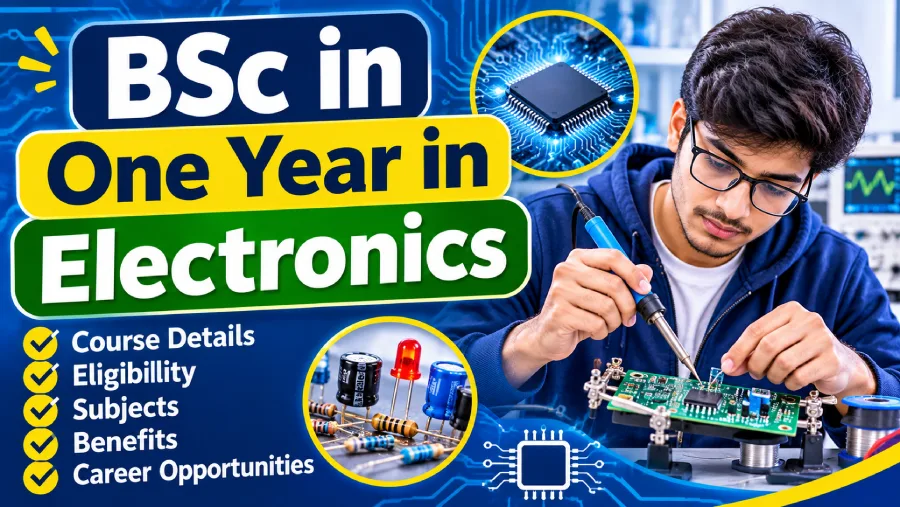
Electronics is one of the most important fields of modern science and technology. It plays a major role in computers, communication systems, mobile devices, automation, industrial equipment, medical instruments, and smart technologies.
A Bachelor of Science (BSc) in Electronics helps students understand electronic circuits, semiconductor devices, digital systems, communication technology, microprocessors, instrumentation, and signal processing. The programme develops a scientific and technical foundation for understanding how electronic systems are designed, operated, tested, and maintained.
The BSc in One Year in Electronics is a course pathway searched by students interested in flexible or accelerated higher education options. One-year completion, however, depends on eligibility, previous academic qualifications, credit recognition, and the availability of an officially approved programme structure.
What Is BSc in Electronics?
BSc in Electronics is an undergraduate science programme that focuses on the principles and applications of electronic devices, circuits, systems, and technologies.
Students learn about electrical and electronic components, circuit design, digital logic, semiconductor devices, communication systems, microprocessors, electronic measurements, and instrumentation.
The course combines theoretical concepts with practical learning to help students understand how electronic equipment works and how electronic systems are used in industries, communication networks, computers, automation, and modern technology.
BSc in One Year in Electronics: Course Overview
| Course Details | Information |
|---|---|
| Course Name | Bachelor of Science in Electronics |
| Degree Level | Undergraduate |
| Duration | 1 year, subject to approved eligibility and pathway |
| Field | Physical Science and Technology |
| Main Subjects | Circuits, Digital Electronics, Semiconductor Devices, Communication |
| Learning Mode | As officially permitted by the institution |
| Eligibility | Depends on previous qualifications and university regulations |
| Career Areas | Electronics, Testing, Manufacturing, Telecommunications, Technical Support |
| Higher Education | MSc Electronics, Instrumentation, Applied Physics, related fields |
Can You Complete BSc Electronics in One Year?
A conventional BSc in Electronics generally takes multiple years to complete. A one-year completion option may be possible only through an eligible academic pathway officially permitted by the university and applicable regulations.
Students considering such programmes should verify:
- Whether the university officially offers the one-year pathway.
- Whether previous qualifications or academic credits meet the eligibility requirements.
- Whether the programme is recognised and valid for further education or employment.
- Whether the required laboratory and practical components are included.
- Whether the programme and study mode are approved for the relevant academic session.
- Whether the final qualification is awarded under a valid university framework.
Students should obtain written confirmation of the programme structure and degree validity before admission.
Eligibility for BSc in One Year in Electronics
Eligibility criteria may vary depending on the university, programme, and academic pathway.
Common eligibility requirements may include:
- Completion of Class 12 with Science subjects.
- Physics and Mathematics, where required.
- A previous undergraduate qualification for certain accelerated or credit-transfer pathways.
- Academic transcripts and previous marksheets.
- Relevant academic credits, if applicable.
- Meeting the university’s admission and documentation requirements.
Students with a background in Physics, Mathematics, Computer Science, Electrical Science, or related subjects may find electronics relevant to their academic and career interests.
Subjects Covered in BSc Electronics
The BSc Electronics curriculum introduces students to electronic components, circuits, digital systems, communication technologies, and instrumentation.
1. Basic Electrical Circuits
Covers electrical circuit fundamentals, voltage, current, resistance, power, circuit analysis, and the operation of basic electrical networks.
2. Analog Electronics
Introduces analog circuits, amplifiers, electronic signals, operational amplifiers, filters, and the fundamentals of analog signal processing.
3. Digital Electronics
Focuses on digital systems, logic gates, Boolean algebra, combinational circuits, sequential circuits, counters, registers, and digital applications.
4. Semiconductor Devices
Studies semiconductor materials, diodes, transistors, electronic device characteristics, and their applications in electronic circuits.
5. Electronic Instrumentation
Introduces electronic measuring instruments, sensors, measurement techniques, testing equipment, instrumentation systems, and signal measurement.
6. Communication Systems
Explores the fundamentals of electronic communication, modulation, transmission, receivers, communication channels, and signal transmission technologies.
7. Microprocessors and Microcontrollers
Introduces microprocessor architecture, microcontrollers, basic programming concepts, digital control, and embedded system fundamentals.
8. Signals and Systems
Studies continuous and discrete signals, system behaviour, signal processing concepts, frequency analysis, and electronic signal applications.
9. Electronic Measurements and Testing
Focuses on measuring electronic quantities, testing components, understanding laboratory instruments, troubleshooting, and electronic system evaluation.
10. Computer Applications in Electronics
Introduces computer-based applications used in electronics, basic simulation, technical software, data handling, and electronic system analysis.
Practical Learning in Electronics
Electronics is a technical subject that involves laboratory work, circuit testing, measurements, and practical experimentation. Depending on the programme, students may gain exposure to:
- Electronic component identification.
- Basic circuit assembly and testing.
- Digital logic circuit experiments.
- Electronic measurement instruments.
- Semiconductor device testing.
- Circuit troubleshooting.
- Laboratory safety and equipment handling.
- Basic microcontroller and electronics projects.
- Technical documentation and laboratory reporting.
Practical experience is particularly important for electronics-related jobs. Students should confirm the availability of practical training and laboratory requirements before selecting a programme.
Benefits of Studying BSc in Electronics
1. Strong Foundation in Technology
The programme helps students understand electronic devices, circuits, systems, communication technologies, and hardware applications.
2. Industry-Relevant Technical Knowledge
Electronics is used in manufacturing, telecommunications, automation, consumer technology, industrial systems, and many other sectors.
3. Practical and Analytical Skills
Students gain exposure to circuit analysis, testing, troubleshooting, measurement techniques, and technical problem-solving.
4. Diverse Career Opportunities
Graduates can explore entry-level roles in electronics manufacturing, testing, maintenance, technical support, instrumentation, and related industries.
5. Further Education Options
A BSc in Electronics can provide a foundation for postgraduate studies in Electronics, Instrumentation, Applied Physics, Communication Technology, and related areas.
6. Exposure to Emerging Technologies
Electronics connects with developing technologies such as embedded systems, automation, robotics, sensors, smart devices, and digital hardware.
Career Opportunities After BSc Electronics
Graduates may explore entry-level and trainee opportunities in electronics-related industries. Job eligibility depends on technical skills, practical experience, employer requirements, and further qualifications.
1. Electronics Technician
Assists with the installation, testing, maintenance, and repair of electronic equipment and systems.
2. Testing Technician
Performs basic electronic testing, equipment checks, measurements, test documentation, and quality-related activities.
3. Maintenance Technician
Supports routine maintenance, troubleshooting, inspection, and repair of electronic equipment in industrial or commercial environments.
4. Electronics Production Assistant
Assists in electronic product manufacturing, assembly, production documentation, and manufacturing operations.
5. Quality Control Assistant
Supports inspection, product testing, documentation, and quality monitoring processes in electronics manufacturing.
6. Technical Support Executive
Provides technical assistance, equipment support, troubleshooting guidance, and customer support for electronic products or systems.
7. Instrumentation Assistant
Supports the operation, maintenance, testing, and calibration of instruments and measurement equipment under appropriate supervision.
8. Field Service Technician
Assists with installation, inspection, troubleshooting, servicing, and maintenance of electronic equipment at customer or operational locations.
9. Research Laboratory Assistant
Supports laboratory activities, electronic experiments, measurements, documentation, and technical research projects.
10. Embedded Systems Trainee
May explore trainee opportunities involving microcontrollers, electronic hardware, embedded systems, and basic device programming after developing relevant skills.
Industries That Hire Electronics Graduates
Electronics graduates may explore opportunities across different industries, including:
- Electronics manufacturing
- Telecommunications
- Consumer electronics
- Industrial automation
- Semiconductor-related industries
- Electrical and electronic equipment servicing
- Instrumentation and control
- Automotive electronics
- Robotics and embedded systems
- Research and development laboratories
Job opportunities depend on technical competencies, practical training, experience, and the qualifications required for individual positions.
Skills Developed During BSc Electronics
The course helps students build technical, analytical, and professional skills.
- Electronic circuit fundamentals
- Component identification
- Circuit analysis
- Electronic measurements
- Testing and troubleshooting
- Digital systems understanding
- Technical documentation
- Problem-solving
- Analytical thinking
- Teamwork and communication
These skills are useful in electronics testing, manufacturing, maintenance, technical support, instrumentation, and further technical education.
Higher Education Options After BSc Electronics
Students interested in advanced study or specialisation may consider the following postgraduate pathways.
1. MSc Electronics
Provides advanced knowledge of electronic circuits, devices, systems, communication, signal processing, and electronics research.
2. MSc Applied Physics
Focuses on the practical applications of physics in technology, electronic devices, materials, instrumentation, and scientific research.
3. MSc Instrumentation
Explores measuring systems, sensors, control technologies, instrumentation, automation, and industrial applications.
4. MSc Communication Technology
Provides advanced study of communication systems, signal transmission, digital communication, networking fundamentals, and related technologies.
5. MSc Physics
Offers advanced study in physical sciences, including electronics, electromagnetism, materials science, modern physics, and research.
6. Postgraduate Diploma in Embedded Systems
May provide specialised training in microcontrollers, embedded hardware, device programming, and system development, depending on eligibility and programme structure.
7. Research and Doctoral Studies
Eligible students may pursue research-based higher education and doctoral programmes in electronics, applied physics, instrumentation, and related disciplines.
Is Electronics a Good Career Choice?
Electronics can be a good academic and career choice for students interested in technology, circuits, hardware, scientific principles, troubleshooting, and practical applications.
Electronic systems are used across numerous industries, including telecommunications, manufacturing, healthcare equipment, automation, computing, transportation, and consumer technology.
However, career advancement often depends on practical experience, technical certifications, specialised knowledge, and additional education. Students who develop hands-on skills in circuit design, testing, microcontrollers, embedded systems, automation, or instrumentation can strengthen their career prospects.
How to Choose the Right University for BSc Electronics
Before enrolling in a BSc Electronics programme, students should carefully evaluate the university and programme.
Consider the following factors:
- University recognition and accreditation.
- Official programme duration and completion requirements.
- Eligibility for accelerated or credit-transfer pathways.
- Curriculum and subject coverage.
- Laboratory facilities and practical training.
- Faculty qualifications and academic support.
- Technical equipment and learning resources.
- Fees, payment terms, and refund policies.
- Degree acceptance for higher education and employment.
- Written confirmation of programme structure and eligibility.
Selecting the right institution helps students make informed academic decisions and build a foundation for future technical careers.
Frequently Asked Questions (FAQs)
1. What is BSc Electronics?
BSc Electronics is an undergraduate science programme that studies electronic circuits, devices, semiconductor technology, digital systems, communication, instrumentation, and electronic applications.
2. Can I complete BSc Electronics in one year?
One-year completion depends on eligibility and an officially approved academic pathway. Students should confirm the programme requirements directly with the university.
3. What are the eligibility criteria for BSc Electronics?
Eligibility commonly requires Class 12 Science qualifications, often including Physics and Mathematics, but requirements vary by institution and pathway.
4. What subjects are taught in BSc Electronics?
Common subjects include Basic Electrical Circuits, Analog Electronics, Digital Electronics, Semiconductor Devices, Communication Systems, Instrumentation, Microprocessors, and Signals and Systems.
5. What jobs can I get after BSc Electronics?
Graduates may explore electronics technician, testing technician, maintenance technician, production assistant, quality control assistant, technical support, instrumentation assistant, and related entry-level roles.
6. Is BSc Electronics good for the electronics industry?
Yes, it provides a scientific foundation relevant to electronics manufacturing, testing, equipment servicing, instrumentation, telecommunications, and other technical sectors.
7. Can I pursue embedded systems after BSc Electronics?
Yes, eligible graduates may pursue specialised training in embedded systems, microcontrollers, hardware programming, and related technologies.
8. Is BSc Electronics useful for higher studies?
Yes. It can provide a foundation for postgraduate study in Electronics, Applied Physics, Instrumentation, Communication Technology, and related fields.
9. Does BSc Electronics include practical training?
Traditional electronics programmes generally include laboratory experiments, circuit testing, measurements, practical projects, and equipment-based learning. Students should verify the practical components of their chosen programme.
10. What is the future scope of Electronics?
Electronics has applications in automation, telecommunications, embedded systems, robotics, semiconductor technologies, consumer devices, automotive systems, and industrial equipment.
Conclusion
BSc in Electronics is a valuable undergraduate programme for students interested in circuits, electronic devices, hardware, communication systems, instrumentation, and modern technology. It provides a foundation in electronics principles and their practical applications across industries.
Students considering a BSc in One Year in Electronics should carefully verify eligibility, university recognition, academic credits, programme approval, and practical training requirements before enrolling.
With the right academic foundation, hands-on experience, and further specialisation, electronics can offer opportunities in manufacturing, testing, technical support, instrumentation, embedded systems, telecommunications, and higher education.