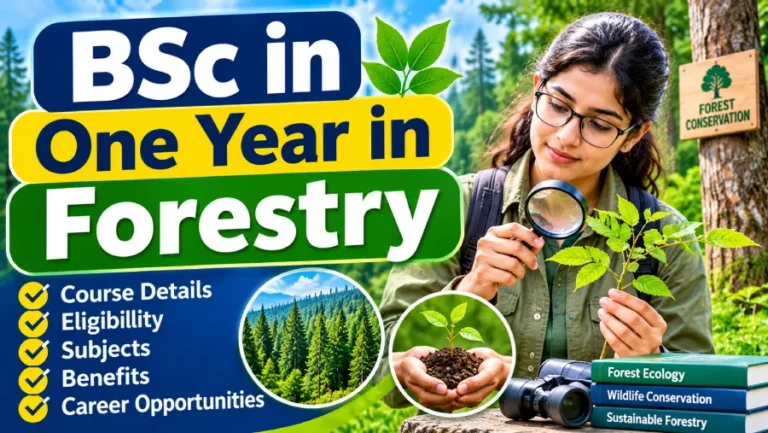
Forests play an important role in maintaining ecological balance, supporting wildlife, protecting biodiversity, regulating climate, and providing natural resources. Forestry is a scientific discipline focused on the conservation, management, development, and sustainable use of forest ecosystems.
A Bachelor of Science (BSc) in Forestry introduces students to forest ecology, silviculture, forest management, wildlife conservation, tree biology, soil science, environmental protection, and natural resource management. The course helps students understand how forests are managed, how ecosystems function, and how natural resources can be protected for future generations.
The BSc in One Year in Forestry is a course option searched by students looking for flexible or accelerated higher education pathways. However, one-year degree completion depends on eligibility, prior academic credits, university regulations, and an officially approved academic structure.
What Is BSc in Forestry?
BSc in Forestry is an undergraduate science programme that focuses on forest ecosystems, tree cultivation, forest management, wildlife habitats, biodiversity, conservation practices, and natural resources.
The course explores how forests grow, how forest ecosystems interact with the environment, how natural resources are managed, and how forestry practices can support ecological sustainability.
Students gain knowledge in areas such as forest ecology, silviculture, forest economics, wildlife management, soil science, environmental conservation, forest surveying, and agroforestry.
Forestry connects scientific knowledge with field-based applications and can be relevant to conservation organisations, forestry departments, environmental projects, research institutions, and natural resource management sectors.
BSc in One Year in Forestry: Course Overview
| Course Details | Information |
|---|---|
| Course Name | Bachelor of Science in Forestry |
| Degree Level | Undergraduate |
| Duration | 1 year, subject to approved eligibility and pathway |
| Field | Forest and Environmental Sciences |
| Main Subjects | Forest Ecology, Silviculture, Wildlife, Forest Management |
| Learning Mode | As officially permitted by the institution |
| Eligibility | Depends on previous academic qualifications and university regulations |
| Career Areas | Forestry, Conservation, Environment, Research, Natural Resources |
| Higher Education | MSc Forestry, Environmental Science, Wildlife Science, Ecology |
Can You Complete BSc Forestry in One Year?
A conventional BSc Forestry degree generally requires multiple years of academic study, practical training, and field-based learning. One-year completion may only be available through a specific academic pathway permitted by the university and applicable regulations.
Students considering an accelerated or credit-transfer pathway should verify:
- Whether the university officially offers the one-year completion programme.
- Whether their previous academic qualification meets admission requirements.
- Whether academic credits or prior learning can be recognised.
- Whether the degree is recognised and valid for employment or higher education.
- Whether practical, laboratory, and field training requirements are fulfilled.
- Whether the programme and study mode are officially approved for the relevant session.
Students should obtain written confirmation of the programme structure and eligibility before enrolling.
Eligibility for BSc in One Year in Forestry
Eligibility requirements vary depending on the institution, programme, and admission pathway.
Common eligibility considerations may include:
- Completion of Class 12 with Science subjects.
- Biology, Chemistry, or Mathematics, depending on university requirements.
- Previous undergraduate qualifications for certain accelerated pathways.
- Academic transcripts and previous marksheets.
- Relevant academic credits, where applicable.
- Meeting the university’s admission and documentation requirements.
Students with backgrounds in Biology, Agriculture, Botany, Zoology, Environmental Science, or other related subjects may find forestry relevant to their academic interests.
Subjects Covered in BSc Forestry
The BSc Forestry curriculum includes scientific, environmental, and practical subjects that help students understand forest ecosystems, natural resource management, conservation, and forestry operations.
1. Forest Ecology
Studies forest ecosystems, interactions between organisms, ecological processes, biodiversity, environmental factors, and forest ecosystem balance.
2. Silviculture
Focuses on the cultivation, regeneration, growth, and management of forest trees, including techniques used to establish and maintain healthy forests.
3. Forest Management
Introduces forest planning, management practices, resource assessment, sustainable harvesting principles, forest protection, and long-term forest development.
4. Forest Botany and Tree Biology
Studies tree species, plant structure, growth, reproduction, classification, and the biological characteristics of forest vegetation.
5. Soil Science
Explores soil composition, soil properties, fertility, soil formation, erosion, and the relationship between soil and forest productivity.
6. Wildlife Management
Introduces wildlife habitats, animal populations, biodiversity, conservation strategies, ecological relationships, and human-wildlife interactions.
7. Forest Mensuration
Studies the measurement and assessment of forest resources, including tree dimensions, forest volume, growth estimation, and forest inventory concepts.
8. Agroforestry
Explores the integration of trees with agricultural crops, livestock, and land-use systems to improve sustainability, productivity, and ecological benefits.
9. Forest Protection
Focuses on forest health, fire management, pest control, diseases, environmental threats, and strategies for protecting forest ecosystems.
10. Forest Economics and Natural Resource Management
Introduces the economic, social, and environmental aspects of forest resources, resource planning, sustainable development, and forest-related industries.
Practical Learning in Forestry
Forestry is a field-oriented discipline that combines scientific learning with practical observation, field surveys, and environmental activities. Depending on the programme, students may gain exposure to:
- Tree identification and forest species observation.
- Forest surveys and inventory techniques.
- Field-based ecological studies.
- Soil sampling and soil assessment.
- Forest mapping and resource documentation.
- Wildlife habitat observations.
- Nursery management and tree propagation.
- Forest conservation and restoration activities.
- Basic GIS and forest mapping applications.
- Field reporting and environmental documentation.
Field training is an important part of forestry education. Students should confirm the practical and fieldwork requirements of their selected university programme, especially when considering an accelerated pathway.
Benefits of Studying BSc in Forestry
1. Knowledge of Forest Ecosystems
Students gain an understanding of forests, trees, biodiversity, wildlife habitats, ecological processes, and natural environments.
2. Environmental Conservation Awareness
The course develops knowledge of forest conservation, habitat protection, ecological restoration, sustainable land use, and environmental protection.
3. Opportunities in Natural Resource Management
Forestry knowledge is relevant to forest management, conservation projects, environmental planning, and sustainable resource utilisation.
4. Field-Based Learning
Students may develop practical experience through forest visits, field observations, surveys, tree identification, and ecosystem studies.
5. Diverse Career Opportunities
Graduates can explore opportunities in forestry support, conservation, environmental organisations, research, nursery management, and related sectors.
6. Higher Education Opportunities
A BSc in Forestry may provide a foundation for postgraduate education in forestry, wildlife science, ecology, environmental science, natural resource management, and related disciplines, subject to admission requirements.
Career Opportunities After BSc Forestry
Forestry graduates may explore entry-level, assistant, trainee, and support roles in forestry, conservation, environmental projects, research, and natural resource management. Specific roles may require additional qualifications, practical experience, examinations, or recruitment eligibility.
1. Forestry Assistant
Supports forest management activities, field observations, plantation monitoring, forest documentation, and conservation work.
2. Forest Survey Assistant
Assists with forest surveys, tree measurements, resource inventories, mapping, field data collection, and documentation.
3. Conservation Project Assistant
Supports biodiversity conservation programmes, habitat protection projects, ecosystem restoration, and conservation activities.
4. Wildlife Conservation Assistant
Assists wildlife-related projects, habitat monitoring, field observations, wildlife documentation, and conservation research.
5. Forest Nursery Assistant
Works with seed collection, seedlings, tree propagation, plant care, nursery maintenance, and plantation preparation.
6. Environmental Field Assistant
Supports environmental surveys, field monitoring, conservation assessments, and environmental project activities.
7. Agroforestry Assistant
Assists with tree-based farming systems, plantation activities, agroforestry projects, land management, and sustainable agricultural practices.
8. Forest Research Assistant
Supports forestry research through data collection, field observations, specimen documentation, forest measurements, and research activities.
9. Natural Resource Management Assistant
Assists with projects involving forest resources, conservation planning, sustainable land management, resource documentation, and environmental programmes.
10. Environmental Education Assistant
Supports nature awareness programmes, environmental education, conservation communication, community outreach, and educational activities.
Industries and Sectors That Hire Forestry Graduates
Forestry graduates may explore opportunities in several sectors, including:
- Forest and forestry departments
- Wildlife conservation organisations
- Environmental NGOs
- Forest research institutions
- Agroforestry and plantation companies
- Natural resource management projects
- Environmental consultancy organisations
- Ecotourism and nature education
- Forest nurseries and seed organisations
- Biodiversity and conservation projects
Government forestry officer positions may have specific degree, examination, age, nationality, and recruitment requirements. A degree alone does not guarantee eligibility for a particular government post.
Skills Developed During BSc Forestry
The course can help students develop scientific, practical, environmental, and professional skills.
- Tree and plant identification
- Forest ecosystem understanding
- Field survey techniques
- Environmental observation
- Forest resource documentation
- Basic mapping and GIS awareness
- Biodiversity monitoring
- Conservation knowledge
- Analytical and problem-solving skills
- Communication and teamwork
These skills can be useful in forest management, conservation projects, environmental monitoring, forestry research, natural resource management, and further education.
Higher Education Options After BSc Forestry
Students interested in specialised knowledge or advanced career pathways may consider the following postgraduate programmes.
1. MSc Forestry
Provides advanced study of forest ecosystems, silviculture, forest management, forestry research, conservation, and sustainable resource practices.
2. MSc Environmental Science
Focuses on environmental systems, sustainability, pollution, conservation, climate change, and environmental management.
3. MSc Wildlife Science
Offers specialised learning in wildlife ecology, animal populations, habitat conservation, biodiversity, and wildlife research.
4. MSc Ecology
Explores ecological processes, ecosystem dynamics, biodiversity, conservation science, and environmental research.
5. MSc Natural Resource Management
Focuses on the planning, conservation, assessment, and sustainable management of natural resources.
6. MSc Agroforestry
Provides specialised study of tree-based agricultural systems, agroforestry practices, land management, crop-tree interactions, and sustainable farming.
7. Research and Doctoral Studies
Eligible students may pursue research-based postgraduate education and doctoral studies in forestry, ecology, wildlife, environmental science, conservation, and related disciplines.
Is Forestry a Good Career Choice?
Forestry can be a rewarding academic and career choice for students who enjoy nature, environmental science, trees, wildlife, fieldwork, conservation, and sustainability.
The field is relevant to biodiversity protection, forest restoration, climate-related initiatives, land management, wildlife conservation, sustainable agriculture, and natural resource planning.
Students interested in forestry careers should develop practical field skills, gain internship or project experience, learn mapping and data collection tools, and consider postgraduate specialisation to strengthen their career prospects.
How to Choose the Right University for BSc Forestry
Before enrolling in a BSc Forestry programme, students should carefully evaluate the university and the programme structure.
Consider the following factors:
- University recognition and accreditation.
- Official programme duration and completion requirements.
- Eligibility for accelerated or credit-transfer pathways.
- Curriculum and subject coverage.
- Fieldwork and practical training facilities.
- Forest survey and research opportunities.
- Faculty qualifications and academic support.
- Fees, payment terms, and refund policies.
- Degree acceptance for further education and employment.
- Written confirmation of programme structure and eligibility.
Choosing the right university can help students make informed academic decisions and prepare for future career opportunities.
Frequently Asked Questions (FAQs)
1. What is BSc Forestry?
BSc Forestry is an undergraduate science programme that studies forests, trees, forest ecosystems, wildlife habitats, conservation, forest management, and sustainable natural resource use.
2. Can I complete BSc Forestry in one year?
One-year completion depends on eligibility and an officially approved academic pathway. Students should confirm the programme structure and requirements directly with the university.
3. What are the eligibility criteria for BSc Forestry?
Eligibility generally depends on Class 12 Science qualifications or other academic credentials accepted under the university’s specific admission pathway.
4. What subjects are taught in BSc Forestry?
Common subjects include Forest Ecology, Silviculture, Forest Management, Tree Biology, Soil Science, Wildlife Management, Forest Mensuration, Agroforestry, Forest Protection, and Forest Economics.
5. What jobs can I get after BSc Forestry?
Graduates may explore roles such as forestry assistant, forest survey assistant, conservation project assistant, nursery assistant, wildlife conservation assistant, environmental field assistant, and research assistant.
6. Is BSc Forestry useful for environmental conservation?
Yes. Forestry provides knowledge relevant to forest ecosystems, biodiversity, wildlife habitats, restoration, sustainable land use, and conservation initiatives.
7. Can I work in wildlife conservation after BSc Forestry?
Graduates may explore entry-level or support opportunities in wildlife conservation projects, habitat monitoring, biodiversity programmes, and environmental organisations. Additional training may be required for specialised roles.
8. Is BSc Forestry good for higher studies?
Yes. It can provide a foundation for postgraduate studies in Forestry, Wildlife Science, Ecology, Environmental Science, Agroforestry, and Natural Resource Management.
9. Does BSc Forestry include fieldwork?
Conventional forestry programmes generally include field visits, forest surveys, tree identification, resource assessment, and practical learning. Students should verify how fieldwork requirements are fulfilled in their selected programme.
10. What is the future scope of Forestry?
Forestry has applications in forest conservation, biodiversity protection, restoration, agroforestry, sustainable land management, environmental projects, wildlife habitats, and natural resource planning.
Conclusion
BSc in Forestry is a valuable undergraduate programme for students interested in forest ecosystems, trees, wildlife, biodiversity, conservation, and environmental sustainability. It introduces students to forest science, ecology, silviculture, resource management, and practical applications in natural environments.
Students considering a BSc in One Year in Forestry should carefully verify eligibility, university recognition, academic credits, programme approval, and field training requirements before enrolling.
With the right academic foundation, practical experience, and further specialisation, forestry can lead to opportunities in conservation, forest management, environmental projects, research, agroforestry, natural resource management, and higher education.