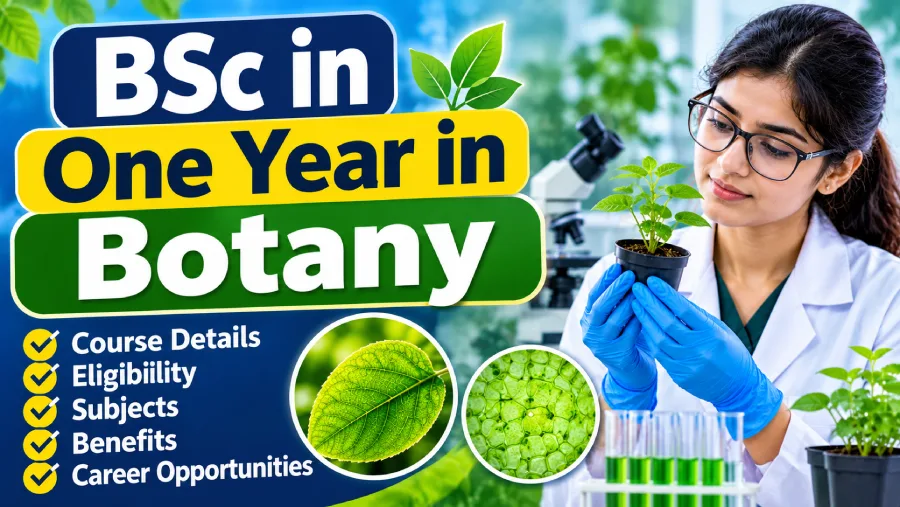
Botany is an important branch of biological science that focuses on the study of plants, their growth, structure, reproduction, genetics, and interaction with the environment. Plants are essential for maintaining ecological balance, supporting agriculture, producing medicines, and sustaining life on Earth.
A Bachelor of Science (BSc) in Botany provides students with scientific knowledge about plant diversity, physiology, ecology, biotechnology, plant diseases, and environmental conservation. It helps learners understand how plants function, adapt to different environments, and contribute to ecosystems and human society.
The BSc in One Year in Botany is a programme sought by students exploring accelerated or alternative higher education pathways. However, one-year completion depends on the student’s eligibility, previous academic credits, university regulations, and an officially approved programme structure.
What Is BSc in Botany?
BSc in Botany is an undergraduate degree programme that studies plants and plant-related biological processes. It includes the study of plant cells, tissues, anatomy, classification, physiology, reproduction, genetics, ecology, and evolution.
The course helps students understand plant development, photosynthesis, nutrient absorption, environmental adaptation, plant biodiversity, and the role of plants in agriculture and ecological sustainability.
Botany also connects with modern scientific disciplines such as biotechnology, genetics, microbiology, environmental science, horticulture, forestry, and agricultural research.
BSc in One Year in Botany: Course Overview
| Course Details | Information |
|---|---|
| Course Name | Bachelor of Science in Botany |
| Degree Level | Undergraduate |
| Duration | 1 year, subject to approved pathway and eligibility |
| Field | Biological Sciences |
| Main Subjects | Plant Biology, Genetics, Ecology, Plant Physiology |
| Learning Mode | As officially permitted by the institution |
| Eligibility | Depends on previous academic qualifications and university rules |
| Career Areas | Agriculture, Research, Environment, Horticulture, Biotechnology |
| Higher Education | MSc Botany, Biotechnology, Environmental Science, Life Sciences |
Can You Complete BSc Botany in One Year?
A conventional BSc Botany programme generally requires multiple years of study. Completing it in one year may only be possible through a specific approved pathway, such as an eligible credit-transfer or other recognised academic arrangement, where permitted.
Students interested in a one-year BSc Botany programme should verify:
- Whether the university officially offers the advertised pathway.
- Whether their previous education qualifies them for admission.
- Whether previous academic credits can be recognised.
- Whether the programme complies with applicable higher education regulations.
- Whether practical and laboratory requirements are included.
- Whether the degree is valid for employment and further studies.
Students should carefully verify all academic and recognition details before enrolling.
Eligibility for BSc in One Year in Botany
Eligibility criteria depend on the university and the specific academic pathway.
Common requirements may include:
- Completion of Class 12 with Science subjects.
- Biology as a subject, where required.
- Previous undergraduate qualifications for certain accelerated pathways.
- Academic transcripts and previous marksheets.
- Relevant academic credits, where applicable.
- Meeting the university’s admission and documentation requirements.
Students with backgrounds in Biology, Botany, Zoology, Agriculture, Biotechnology, or other related sciences may find the subject relevant to their academic interests.
Subjects Covered in BSc Botany
The BSc Botany curriculum generally includes a combination of theoretical knowledge, laboratory work, plant identification, scientific investigation, and environmental studies.
1. Plant Diversity and Classification
Introduces the diversity of plant life, classification systems, taxonomic characteristics, and the evolutionary relationships between different plant groups.
2. Plant Anatomy
Studies the internal structure of plants, including tissues, roots, stems, leaves, vascular systems, and their specialised functions.
3. Plant Physiology
Explores the biological processes in plants, including photosynthesis, respiration, water transport, mineral nutrition, plant growth, and hormonal regulation.
4. Genetics
Introduces inheritance, genetic variation, DNA, genes, mutations, and the role of genetics in plant development and breeding.
5. Ecology
Examines the relationships between plants, organisms, and their environments, including ecosystems, biodiversity, population dynamics, and ecological balance.
6. Plant Reproduction and Development
Studies sexual and asexual reproduction in plants, pollination, fertilisation, seed formation, germination, and plant development.
7. Plant Pathology
Explores plant diseases caused by fungi, bacteria, viruses, and other agents, including disease development, prevention, and plant health management.
8. Bryology and Pteridology
Introduces non-flowering plant groups, including mosses, liverworts, ferns, and their reproductive and ecological characteristics.
9. Biotechnology and Plant Tissue Culture
Studies the application of biological techniques in plant research, propagation, tissue culture, crop improvement, and agricultural development.
10. Environmental Botany
Focuses on plant interactions with the environment, conservation, habitat restoration, climate impacts, sustainable ecosystems, and biodiversity protection.
Practical Learning in Botany
Botany involves practical learning and scientific observation. Depending on the programme, students may gain exposure to:
- Plant specimen collection and identification.
- Microscopy and plant tissue observation.
- Botanical laboratory techniques.
- Herbarium preparation and documentation.
- Plant anatomy and morphology studies.
- Seed germination and growth observations.
- Plant ecology fieldwork.
- Scientific recording and research reporting.
Practical learning is an important component of botanical education. Students should confirm the availability and completion requirements of laboratory and field-based training in their chosen programme.
Benefits of Studying BSc in Botany
1. Understanding Plant Life and Biodiversity
Students develop knowledge of plant species, their characteristics, biological processes, and ecological significance.
2. Opportunities in Agriculture
Botanical knowledge is useful in crop science, plant growth, soil-plant relationships, horticulture, agricultural research, and sustainable farming practices.
3. Environmental Awareness
The programme helps students understand ecosystems, biodiversity conservation, climate change, habitat protection, and environmental sustainability.
4. Research and Scientific Learning
Students gain exposure to scientific investigation, observation, data recording, laboratory techniques, and research fundamentals.
5. Diverse Career Possibilities
Graduates can explore opportunities in plant research, environmental organisations, botanical gardens, agricultural support, education, and related industries.
6. Higher Education Opportunities
A BSc in Botany provides a foundation for postgraduate studies in Botany, Biotechnology, Environmental Science, Plant Science, Ecology, and other related disciplines, subject to admission requirements.
Career Opportunities After BSc Botany
Botany graduates can explore entry-level and support roles in research, agriculture, horticulture, environmental organisations, plant science, and education.
1. Botanical Research Assistant
Supports plant science research projects through specimen preparation, data collection, observations, documentation, and research assistance.
2. Plant Science Assistant
Assists with plant growth studies, plant identification, nursery operations, plant care, and research-related activities.
3. Horticulture Assistant
Works in plant cultivation, nursery management, landscaping support, ornamental plant production, and horticultural operations.
4. Agriculture Research Assistant
Supports agricultural research activities, crop observations, field data collection, plant growth monitoring, and research documentation.
5. Nursery Management Assistant
Helps manage plant nurseries, seedlings, propagation activities, plant care, inventory, and customer requirements.
6. Environmental Field Assistant
Supports biodiversity surveys, field observations, ecosystem monitoring, environmental projects, and conservation activities.
7. Herbarium Assistant
Assists with collecting, preserving, identifying, organising, and documenting plant specimens.
8. Plant Tissue Culture Technician Trainee
May work in supervised plant tissue culture and propagation environments after receiving relevant practical training.
9. Botanical Garden Assistant
Supports plant collections, garden maintenance, species identification, visitor education, plant conservation, and botanical activities.
10. Science Content Writer
Creates educational material, articles, research summaries, and learning content related to botany, plant science, agriculture, and environmental topics.
Industries That Hire Botany Graduates
Botany graduates may explore opportunities in several sectors, including:
- Agriculture and crop production
- Horticulture and landscaping
- Plant nurseries
- Biotechnology
- Pharmaceutical and medicinal plant research
- Environmental conservation
- Forestry and biodiversity
- Botanical gardens and nature centres
- Academic and scientific research
- Seed and plant breeding organisations
Career opportunities depend on practical experience, additional qualifications, employer requirements, and the nature of the role.
Skills Developed During BSc Botany
The course helps students develop scientific and professional skills useful in plant science and related sectors.
- Plant identification and observation
- Laboratory techniques
- Botanical documentation
- Scientific research fundamentals
- Environmental awareness
- Data collection and analysis
- Critical thinking
- Problem-solving
- Fieldwork skills
- Communication and teamwork
These skills can support students in research, horticulture, agricultural projects, environmental work, and further education.
Higher Education Options After BSc Botany
Students interested in advanced learning or specialised career paths may consider the following postgraduate programmes.
1. MSc Botany
Provides advanced knowledge of plant biology, plant physiology, taxonomy, genetics, ecology, and botanical research.
2. MSc Biotechnology
Focuses on biological technologies, genetic applications, plant biotechnology, research, and industrial applications.
3. MSc Environmental Science
Explores environmental systems, conservation, climate change, biodiversity, sustainability, and environmental management.
4. MSc Plant Science
Provides specialised study in plant growth, development, crop science, plant genetics, plant health, and research.
5. MSc Horticulture
Focuses on plant cultivation, horticultural production, ornamental plants, landscaping, fruit crops, and nursery development.
6. MSc Ecology
Studies ecosystems, biodiversity, conservation biology, environmental interactions, ecological research, and wildlife habitats.
7. Research and Doctoral Studies
Eligible students may pursue research-based postgraduate education and doctoral programmes depending on academic qualifications and institutional requirements.
Is Botany a Good Career Choice?
Botany can be a good academic and career choice for students who enjoy biology, plants, nature, environmental science, agriculture, and research.
The subject has applications in food production, biodiversity protection, crop improvement, horticulture, biotechnology, medicinal plants, and climate-related environmental research.
Students interested in building a career in botany should consider gaining practical experience through internships, fieldwork, research projects, laboratory training, and specialised postgraduate studies. Additional qualifications and experience can help them progress towards more advanced positions.
How to Choose the Right University for BSc Botany
Before enrolling in a BSc Botany programme, students should carefully evaluate the institution and programme structure.
Consider the following factors:
- University recognition and accreditation.
- Official programme duration.
- Eligibility for accelerated or credit-transfer pathways.
- Curriculum and subject coverage.
- Laboratory facilities and practical training.
- Fieldwork opportunities.
- Faculty qualifications and academic support.
- Fees, payment terms, and refund policies.
- Degree acceptance for higher education and employment.
- Written confirmation of the programme’s completion pathway.
Choosing the right university can help students make informed decisions and build a strong academic foundation for their future.
Frequently Asked Questions (FAQs)
1. What is BSc Botany?
BSc Botany is an undergraduate science programme focused on plants, including their structure, physiology, genetics, classification, reproduction, ecology, and importance.
2. Can I complete BSc Botany in one year?
One-year completion depends on an eligible and officially approved academic pathway. Students should confirm the university’s regulations and admission requirements.
3. What are the eligibility criteria for BSc Botany?
Eligibility commonly includes Class 12 Science qualifications, often with Biology, although requirements vary by institution and academic pathway.
4. What subjects are taught in BSc Botany?
Subjects may include Plant Anatomy, Plant Physiology, Genetics, Ecology, Plant Reproduction, Plant Pathology, Biotechnology, Plant Classification, and Environmental Botany.
5. What jobs can I get after BSc Botany?
Graduates may explore roles such as research assistant, horticulture assistant, plant science assistant, nursery assistant, environmental field assistant, herbarium assistant, and botanical garden assistant.
6. Is Botany useful for agriculture?
Yes. Botany provides knowledge of plants, growth, genetics, physiology, and environmental interactions that are relevant to agriculture, crop science, horticulture, and plant research.
7. Can I work in biotechnology after BSc Botany?
Graduates may explore entry-level or trainee opportunities in biotechnology-related environments. Additional practical training and specialised qualifications may be required.
8. Is BSc Botany good for higher studies?
Yes. It can provide a foundation for postgraduate studies in Botany, Biotechnology, Plant Science, Ecology, Environmental Science, Horticulture, and related subjects.
9. Does BSc Botany include practical work?
Yes, conventional botany programmes typically include laboratory activities, specimen studies, plant observations, fieldwork, and practical training.
10. What is the future scope of Botany?
Botany has applications in agriculture, plant biotechnology, horticulture, environmental conservation, biodiversity, medicinal plant research, forestry, and scientific research.
Conclusion
BSc in Botany is a valuable academic programme for students interested in plants, biological sciences, agriculture, biodiversity, research, and environmental sustainability. It provides a foundation in plant structure, genetics, physiology, ecology, biotechnology, and plant-related scientific applications.
Students exploring a BSc in One Year in Botany should carefully verify eligibility, university recognition, academic credits, programme approval, and practical training requirements before enrolling.
With the right academic foundation, practical experience, and further specialisation, botany can lead to opportunities across agricultural industries, horticulture, environmental conservation, plant research, biotechnology, and higher education.