What Is a BSc in Electronics?
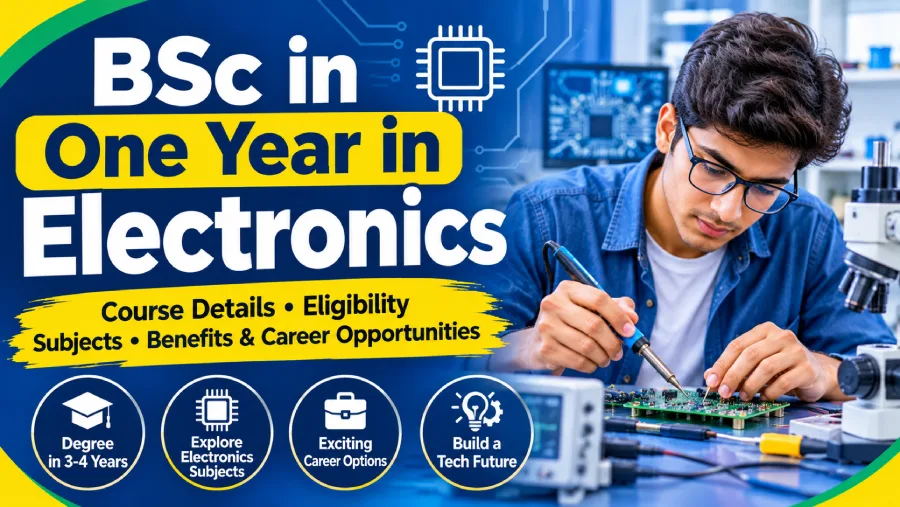
A Bachelor of Science (BSc) in Electronics is an undergraduate science programme focused on the study of electronic components, circuits, electrical signals, semiconductor technology and electronic systems. It helps students understand how electronic devices work, how circuits are designed and tested, and how electronic technologies are applied in industries.
The course combines theoretical knowledge with practical learning in circuit analysis, digital electronics, communication systems, microprocessors and electronic measurements.
Students may encounter programmes offered under different names, including:
- BSc Electronics
- BSc Electronics Science
- BSc Applied Electronics
- BSc Electronics and Communication
- BSc Instrumentation and Electronics
Course structure and specialisation depend on the university.
BSc in Electronics: Course Overview
| Course Detail | Information |
|---|---|
| Degree | Bachelor of Science (BSc) |
| Specialisation | Electronics |
| Academic Level | Undergraduate |
| Field | Science and Technology |
| Standard Duration | Usually 3–4 years, depending on programme |
| Eligibility | Class 12 or equivalent |
| Preferred Subjects | Physics and Mathematics, depending on university |
| Study Format | Regular, online or distance, where permitted |
| Core Areas | Circuits, devices, digital electronics, communication |
| Career Sectors | Electronics, manufacturing, telecom, testing and automation |
Can You Complete a BSc in Electronics in One Year?
The possibility of completing a BSc in Electronics in one year depends on the student’s previous academic qualifications, completed credits and the academic policies of the university.
Some students may explore alternative pathways such as:
1. Credit Transfer
Students with previously completed undergraduate coursework may be eligible to transfer credits, subject to the university’s evaluation and approval.
2. Recognition of Prior Learning
Some institutions may assess eligible prior learning against academic requirements. This process is institution-specific and does not automatically guarantee a shortened degree.
3. Accelerated Degree Options
Certain institutions may offer approved accelerated study arrangements to eligible students. These programmes have defined credit and academic requirements.
4. Flexible Study
Online or distance learning can help students manage their education alongside employment or other commitments. However, the university and specific programme must be appropriately recognised and approved for the relevant mode of study.
Students should verify the degree-awarding institution, programme recognition, credit requirements, duration and qualification validity before enrolling in any programme advertised as a one-year BSc.
Eligibility for BSc in Electronics
Eligibility for BSc Electronics varies according to the university. Common requirements may include:
- Completion of Class 12 or equivalent from a recognised board.
- Physics as a compulsory subject in many institutions.
- Mathematics may be required or preferred.
- Minimum qualifying marks as specified by the university.
- Entrance examinations or merit-based admission, where applicable.
- Previous academic records for credit-transfer or alternative pathways.
Students should review the official admission requirements before applying.
Subjects Covered in BSc Electronics
The curriculum covers fundamental and advanced concepts related to electronic devices, circuits and systems.
1. Basic Electrical Circuits
Students learn about voltage, current, resistance, capacitance, inductance, circuit laws and basic electrical networks. This subject builds the foundation for understanding electronic systems.
2. Analog Electronics
Analog electronics focuses on continuous electrical signals and circuits. Students study amplifiers, diodes, transistors, operational amplifiers and their applications.
3. Digital Electronics
This subject introduces binary numbers, logic gates, Boolean algebra, combinational circuits and sequential circuits used in digital devices.
4. Semiconductor Devices
Students explore semiconductor materials and electronic components such as diodes, transistors and integrated circuits. The subject explains how semiconductor technology forms the foundation of modern electronics.
5. Electronic Instrumentation
Electronic instrumentation covers measuring devices and techniques used to monitor electrical and electronic quantities. Students learn about instruments, sensors, measurement accuracy and signal analysis.
6. Communication Systems
This subject introduces the principles of transmitting and receiving information. Topics may include modulation, demodulation, signal transmission, communication channels and wireless communication fundamentals.
7. Microprocessors and Microcontrollers
Students learn the architecture, working principles and applications of microprocessors and microcontrollers used in embedded systems, control devices and electronic equipment.
8. Signals and Systems
Signals and systems introduce the mathematical and analytical methods used to understand electronic signals, system responses, filtering and signal processing.
9. Electronic Measurements and Testing
This subject focuses on testing electronic circuits and components using measurement instruments and testing procedures. Students learn how to identify faults and evaluate circuit performance.
10. Computer Applications in Electronics
Students explore the role of computing in electronic design, circuit simulation, technical data analysis and digital system applications.
Practical Learning in BSc Electronics
Practical work is an essential component of electronics education. Depending on the programme, students may participate in:
- Circuit assembly and testing.
- Breadboard experiments.
- Electronic component identification.
- Oscilloscope and multimeter measurements.
- Digital logic experiments.
- Semiconductor testing.
- Microcontroller-based projects.
- Electronic troubleshooting.
- Circuit simulation exercises.
- Laboratory reports and technical documentation.
These activities help students develop the practical knowledge needed to understand electronic equipment and systems.
Benefits of Studying BSc Electronics
1. Strong Technical Foundation
The programme helps students understand electronic components, circuit behaviour, electrical signals and the working principles of electronic devices.
2. Industry-Relevant Knowledge
Electronics is used in manufacturing, communication, automation, consumer products, healthcare equipment and many other industries.
3. Practical Skills Development
Laboratory sessions, circuit testing and projects can help students develop practical problem-solving and troubleshooting abilities.
4. Diverse Career Opportunities
Graduates can explore entry-level opportunities in electronics production, technical support, testing, equipment maintenance and related fields.
5. Further Study Options
The degree can provide a foundation for postgraduate education and specialised technical programmes, subject to admission requirements.
6. Technology-Focused Learning
Students gain exposure to technologies used in digital systems, communication equipment, embedded electronics and electronic instrumentation.
Career Opportunities After BSc Electronics
After completing a recognised BSc in Electronics, graduates may explore opportunities across technical and industrial sectors. Job eligibility depends on employer requirements, practical experience, specialised skills and additional qualifications.
1. Electronics Technician
Electronics technicians help assemble, inspect, test, repair and maintain electronic devices and equipment.
2. Testing Technician
Testing technicians perform electronic component and circuit tests, record results and support product quality evaluation.
3. Maintenance Technician
Maintenance technicians help maintain electronic systems, identify faults and support equipment reliability in industrial or commercial environments.
4. Electronics Production Assistant
These professionals support electronic manufacturing processes, assembly operations, production documentation and quality procedures.
5. Quality Control Assistant
Quality control assistants inspect electronic products and components to help ensure they meet specified standards and requirements.
6. Technical Support Executive
Technical support professionals help troubleshoot electronic products, assist customers or users, and resolve equipment-related technical problems.
7. Instrumentation Assistant
Instrumentation assistants support the installation, testing, calibration and maintenance of measurement and control instruments.
8. Field Service Technician
Field service technicians visit workplaces or customer sites to install, inspect, troubleshoot and maintain electronic equipment.
9. Research Laboratory Assistant
Research laboratory assistants support experiments, testing, measurements, technical data collection and electronic research projects.
10. Embedded Systems Trainee
Students with additional training in microcontrollers, programming and embedded systems may explore trainee opportunities involving electronic control devices and embedded hardware.
Industries That Employ Electronics Graduates
BSc Electronics graduates may explore opportunities in several industries, including:
- Electronics manufacturing.
- Telecommunications.
- Semiconductor and component industries.
- Consumer electronics.
- Industrial automation.
- Electrical and electronic equipment maintenance.
- Automotive electronics.
- Aerospace and defence manufacturing, subject to specific requirements.
- Medical equipment manufacturing and support.
- Research and testing laboratories.
- Robotics and embedded technology.
- Information and communication technology.
Skills Developed During BSc Electronics
The programme helps students build technical and analytical skills that are useful in electronics-related work.
Important skills include:
- Circuit analysis and understanding.
- Electronic component identification.
- Basic circuit design.
- Digital logic fundamentals.
- Electronic testing and measurements.
- Troubleshooting and fault identification.
- Technical documentation.
- Laboratory safety and procedures.
- Analytical and problem-solving abilities.
- Basic understanding of microcontrollers and embedded systems.
Students can strengthen these skills by working on personal electronics projects and learning industry tools.
Higher Education Options After BSc Electronics
Graduates interested in advanced technical knowledge can explore postgraduate programmes and specialised training.
1. MSc Electronics
An MSc in Electronics provides advanced study of electronic devices, circuits, communication systems, digital technology and related research areas.
2. MSc Applied Electronics
This programme focuses on practical applications of electronic technology, instrumentation, control systems and electronic system development.
3. MSc Physics
Students may pursue postgraduate Physics with suitable eligibility, potentially focusing on electronics, solid-state physics, materials science or related subjects.
4. MSc Instrumentation
This programme focuses on measurement systems, sensors, control instrumentation, industrial testing and monitoring technologies.
5. Embedded Systems Courses
Specialised training in embedded systems can help students understand microcontrollers, hardware-software integration and electronic control applications.
6. VLSI and Semiconductor Training
Students may pursue specialised training in chip design, semiconductor devices, digital design and integrated circuit technologies, depending on their background and course prerequisites.
Is BSc Electronics a Good Career Choice?
BSc Electronics can be a good option for students who enjoy Physics, Mathematics, technology, electronic devices and practical problem-solving.
The course provides foundational knowledge that can be applied in electronics manufacturing, equipment testing, communication technologies, automation, instrumentation and technical services.
Students who want stronger career prospects should focus on practical experience, laboratory skills, technical certifications and projects alongside their academic qualification. Learning microcontrollers, circuit design software, embedded systems and troubleshooting can help improve their readiness for entry-level technical roles.
How to Choose the Right University for BSc Electronics
Before enrolling, students should carefully evaluate the institution and programme.
- University Recognition: Verify the institution’s legal status and authority to award the degree.
- Programme Approval: Confirm that the specific programme and study mode are valid for the relevant academic session.
- Curriculum: Review the subjects covered, including analog electronics, digital systems, semiconductors and communication technology.
- Laboratory Facilities: Check whether the institution provides suitable practical facilities and equipment.
- Faculty: Review the qualifications and experience of the teaching faculty.
- Study Mode: Understand whether the programme is regular, online or distance-based and verify the validity of that mode.
- Course Duration: Check the official duration, credits and requirements for any accelerated or credit-transfer pathway.
- Career Support: Review technical training, internship opportunities, industry exposure and career guidance.
Frequently Asked Questions (FAQs)
1. Can I complete BSc Electronics in one year?
A standard BSc Electronics is generally a multi-year undergraduate programme. One-year completion should only be considered if the university confirms an approved pathway and you meet the required academic and credit conditions.
2. What is the eligibility for BSc Electronics?
Students generally need Class 12 or equivalent. Physics and Mathematics are commonly required or preferred, depending on the university.
3. Is Mathematics compulsory for BSc Electronics?
Many universities require Mathematics or have specific subject prerequisites. Requirements vary, so students should check the official eligibility criteria.
4. What subjects are taught in BSc Electronics?
Common subjects include basic electrical circuits, analog electronics, digital electronics, semiconductor devices, communication systems, microprocessors, instrumentation and electronic testing.
5. Is BSc Electronics difficult?
The course can be challenging for students unfamiliar with Physics, Mathematics and technical concepts. Regular study, practical experimentation and solving circuit problems can make the subjects easier to understand.
6. What jobs can I get after BSc Electronics?
Graduates may explore jobs such as electronics technician, testing technician, maintenance technician, quality control assistant, technical support executive, field service technician and laboratory assistant.
7. Can I work in the semiconductor industry after BSc Electronics?
Graduates may apply for eligible entry-level roles in semiconductor-related industries. Specialised positions in chip design, VLSI and semiconductor engineering often require additional training or advanced qualifications.
8. Can I study BSc Electronics online?
Some institutions may offer electronics-related courses through online or distance learning. Students should verify whether the specific degree and study mode are officially permitted and whether practical requirements are adequately addressed.
9. What can I study after BSc Electronics?
Possible options include MSc Electronics, MSc Applied Electronics, MSc Instrumentation, MSc Physics and specialised training in embedded systems, semiconductor technology or VLSI, subject to eligibility.
10. Is BSc Electronics useful for government jobs?
A recognised BSc Electronics may meet the educational requirements for some government recruitment opportunities, depending on the specific vacancy. Many technical positions require particular engineering qualifications, diplomas, certifications or additional examinations.
Conclusion
BSc Electronics is an undergraduate science programme that introduces students to electronic circuits, semiconductor devices, digital systems, communication technology and instrumentation. It can provide a foundation for careers in electronics manufacturing, testing, maintenance, technical support, research assistance and related technology sectors.
Students interested in completing a BSc in one year in Electronics should carefully review the university’s academic pathway, credit-transfer rules, recognition and degree validity before admission. Choosing a recognised programme with a strong practical curriculum can be an important step toward building a career in electronics and modern technology.