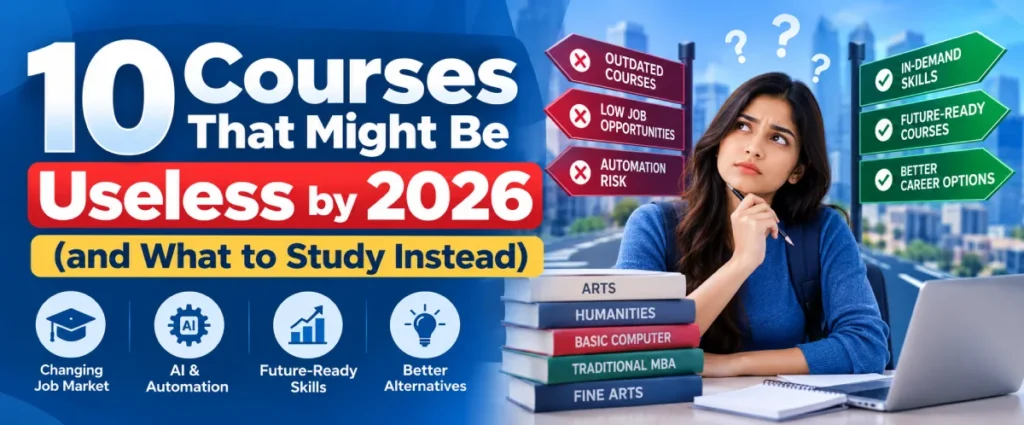
Choosing a college degree is one of the biggest educational decisions a student makes. A degree can require several years of study and a significant financial investment, so naturally, students want a qualification that can support their future career.
But the employment market is changing rapidly.
Artificial intelligence, automation, data analytics, digital platforms and new business models are changing the skills employers need. According to the World Economic Forum’s Future of Jobs Report 2025, around 39% of workers’ existing skill sets are expected to be transformed or become outdated between 2025 and 2030. Technology-related skills such as AI and big data, cybersecurity and technological literacy are among those expected to increase fastest in importance.
Does this mean traditional degrees have suddenly become worthless? No.
When people search for the worst degrees to study 2026, the real question should be: Which degrees could offer weaker career outcomes if I graduate without additional practical and modern skills?
A traditional degree can still be valuable, but students increasingly need to combine academic knowledge with technology, communication, analytics and industry-specific expertise.
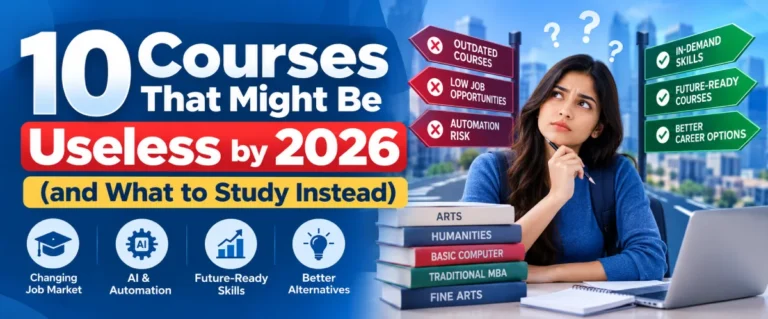
Here are 10 courses that may become less competitive when studied in their traditional form—and what you can consider studying or learning alongside them instead.
Are There Really “Useless” Degrees in 2026?
Calling any recognised degree completely useless would be misleading.
History, literature, commerce, management, engineering, journalism and fine arts can all lead to successful careers. The problem arises when a program’s curriculum or a student’s skill set does not keep pace with changing employer requirements.
The World Economic Forum expects roles such as big data specialists, fintech engineers, AI and machine learning specialists, and software developers to be among the fastest-growing occupations through 2030. At the same time, several clerical and administrative occupations are expected to decline.
Therefore, students researching the worst degrees to get in 2026 should think less about avoiding entire academic disciplines and more about avoiding outdated skill combinations.
10 Worst Degrees to Study in 2026 Without Additional Skills
| Traditional Course/Area | Potential Limitation | Skills or Alternatives to Consider |
|---|---|---|
| General BA | Limited job-specific skills if studied alone | Digital Marketing, Analytics, Public Policy |
| Basic Computer Courses | Basic software skills are now expected | AI, Python, SQL, Data Analytics |
| Traditional Journalism | Media industry is increasingly digital | Digital Media, SEO, Content Strategy |
| General MBA | Generic curriculum may lack emerging skills | Business Analytics, AI, Digital Business |
| Traditional Accounting | Routine tasks increasingly automated | FinTech, Financial Analytics, ERP |
| Fine Arts/Photography | Traditional-only portfolio can limit digital opportunities | Graphic Design, UI/UX, Animation |
| Traditional Engineering | Technology changes rapidly | AI, IoT, Robotics, Renewable Energy |
| Spoken English Only | Communication alone is not a career specialisation | Business Communication + Professional Skills |
| Traditional Law | Technology is transforming legal work | Cyber Law, Data Privacy, IPR |
| Unrecognised Degree | Recognition problems can severely reduce value | Appropriately recognised programs |
1. General BA Without Career-Focused Skills
A Bachelor of Arts is not inherently one of the worst degrees to study 2026. BA programs in subjects such as English, History, Sociology, Political Science and Economics can develop communication, research, critical-thinking and analytical abilities.
The difficulty arises when students graduate without converting these abilities into marketable professional skills.
A traditional BA graduate competing for corporate positions may face candidates who also know digital marketing, data analytics, content management, research tools or business communication.
What to Study Instead or Alongside It
Students can combine a BA with skills such as:
- Digital marketing
- Content writing and SEO
- Data analytics
- Public policy
- Foreign languages
- Business communication
- Research and analytics
- AI productivity tools
The objective does not necessarily have to be replacing the BA. It can be making the degree more career-oriented.
2. Basic Computer Courses
There was a time when knowing basic typing, Microsoft Word, PowerPoint and Excel could distinguish a candidate from other applicants.
Today, basic computer literacy is generally an expected workplace skill rather than a standalone career specialisation.
Students who spend considerable time and money on courses teaching only basic computer operations may therefore receive limited competitive advantage.
What to Study Instead
Consider developing skills in:
- Advanced Excel
- Power BI
- Data analytics
- Python
- SQL
- Artificial intelligence tools
- Cloud computing
- Cybersecurity
AI and big data, networks and cybersecurity, and technological literacy are among the fastest-growing skills identified by employers in the World Economic Forum’s Future of Jobs Report 2025.
3. Traditional Journalism Without Digital Media Skills
Journalism itself is not disappearing.
The way journalism is produced, distributed and consumed, however, has changed dramatically.
Modern journalists may work across websites, social platforms, podcasts, newsletters, video channels and other digital formats. Audience analytics and search visibility can also influence digital publishing strategies.
A journalism qualification focused almost entirely on traditional print processes may therefore provide a narrower skill set.
What to Study Instead or Add
Consider:
- Digital journalism
- Mass communication
- Digital media
- SEO and content marketing
- Video production
- Podcast production
- Social media analytics
- Data journalism
Students interested in journalism should aim to become multimedia communicators rather than limiting themselves to one publishing medium.
4. Generic MBA Without Analytics or Digital Skills
An MBA continues to be a widely pursued postgraduate management qualification. The issue is not the MBA itself but choosing a program whose curriculum provides little exposure to modern business tools.
Companies increasingly operate using data, automation, digital marketing, cloud platforms and AI-assisted decision-making.
An MBA graduate who understands only traditional management theory may therefore have difficulty differentiating themselves.
Better MBA Specialisations to Consider
Depending on career objectives, students can explore:
- MBA in Business Analytics
- MBA in Finance
- MBA in Digital Marketing
- MBA in Information Technology
- MBA in Operations Management
- MBA in FinTech
- MBA with AI/analytics-focused coursework
A good MBA should combine management fundamentals with practical business applications.
5. Accounting Without Technology or Financial Analytics
Accounting remains essential to businesses, so describing an accounting degree itself as useless would be inaccurate.
However, routine financial and clerical activities are increasingly affected by automation.
The World Economic Forum lists accountants and auditors among roles employers expect to decline globally through 2030, alongside several clerical occupations. This does not mean accounting disappears; rather, the nature of the work is changing.
Future accounting professionals may benefit from moving beyond manual bookkeeping.
What to Learn Alongside Accounting
Consider developing expertise in:
- Financial analytics
- ERP systems
- Advanced Excel
- Power BI
- FinTech
- Taxation
- Financial modelling
- AI-assisted accounting tools
A B.Com combined with technology and analytical skills can offer a considerably different career profile from a degree alone.
6. Fine Arts or Photography Without Digital Skills
Creativity remains valuable, but creative industries have become increasingly digital.
Photographers, artists and designers now frequently work with digital platforms, editing software, websites, social media, online portfolios and digital content.
A traditional fine arts or photography education without exposure to digital applications may therefore restrict career options.
What to Study Instead or Alongside It
Students can explore:
- Graphic design
- UI/UX design
- Animation
- Motion graphics
- Video editing
- Digital illustration
- Branding
- Digital marketing
Combining creativity with technology can open opportunities in advertising, media, entertainment, e-commerce, design and digital content.
7. Engineering Without Emerging Technology Skills
Engineering certainly should not automatically be placed among the worst degrees to get in 2026.
Engineering remains fundamental to infrastructure, manufacturing, technology, energy and industrial development.
But engineering disciplines are changing.
Automation, robotics, artificial intelligence, electric vehicles, renewable energy, IoT and smart manufacturing are creating new technical requirements. The World Economic Forum identifies roles including autonomous and electric vehicle specialists, environmental engineers and renewable energy engineers among rapidly growing professions.
Skills Engineering Students Can Add
Depending on the branch, students can consider:
- Artificial intelligence
- Machine learning
- Internet of Things (IoT)
- Robotics
- Industrial automation
- Renewable energy
- Electric vehicle technology
- Data analytics
- CAD and simulation technologies
Traditional engineering knowledge combined with emerging technology can create a much stronger profile.
8. Standalone Spoken English or Personality Development Courses
Good communication remains extremely important.
But a short course teaching only spoken English, interview behaviour or body language generally does not replace a recognised academic qualification or specialised professional skill.
Employers typically expect candidates to combine communication abilities with functional expertise.
What to Study Instead
Rather than relying exclusively on personality development, students can combine communication training with:
- Business administration
- Digital marketing
- Sales
- Human resource management
- Business communication
- Entrepreneurship
- Project management
Think of communication as a career multiplier, rather than the entire career qualification.
9. Traditional Law Without Technology Specialisation
Law is another example where the word “useless” would be inappropriate.
Legal professionals remain essential, but technology is creating new areas of legal work involving digital privacy, intellectual property, cybercrime, AI, online contracts and data governance.
Students who want to differentiate themselves can supplement traditional legal education with emerging specialisations.
Future-Focused Legal Areas
Students may consider:
- Cyber Law
- Intellectual Property Rights
- Data Privacy Law
- Technology Law
- AI and Law
- Corporate Law
- International Business Law
- Compliance and Risk
The strongest combination can be a solid legal foundation plus expertise relevant to modern businesses and technologies.
10. Degrees From Unrecognised Institutions
This is the category students should take particularly seriously.
A program may have an attractive advertisement, low fees or convenient admission process, but students need to verify the recognition status of the institution and program before enrolling.
For ODL and online education in India, UGC’s framework includes recognition processes for institutions and programs, and UGC states that distance education recognition information can be checked through its official system.
UGC was still issuing notices in 2026 inviting eligible higher education institutions to seek recognition to offer ODL and online programs for applicable academic sessions.
What Students Should Do Instead
Before admission:
- Verify the university’s recognition status.
- Check the specific program.
- Check whether the learning mode is permitted.
- Verify recognition/entitlement for the applicable academic session where required.
- Check whether another statutory or professional regulator applies to the course.
This is particularly important for students considering online and distance education.
Worst Degrees to Get in 2026 vs Better Alternatives
| If You’re Considering | Consider Adding or Exploring |
|---|---|
| General BA | BA + Digital Marketing / Analytics |
| Basic Computer Diploma | Data Analytics / AI / Cybersecurity |
| Traditional Journalism | Digital Journalism / Digital Media |
| Generic MBA | MBA in Business Analytics / Finance / Digital Business |
| Traditional Accounting | Finance + Analytics / FinTech |
| Fine Arts | UI/UX / Graphic Design / Animation |
| Traditional Engineering | AI / IoT / Robotics / Renewable Energy |
| Spoken English Course | Professional Degree + Business Communication |
| Traditional Law | Cyber Law / IPR / Data Privacy |
| Unrecognised Degree | Appropriately recognised degree program |
What Should Students Study in 2026?
There is no single “best degree” for every student.
The appropriate course depends on interests, academic background, abilities, career goals and the industries in which a student wants to work.
However, students should increasingly look for programs that combine academic foundations with practical and technological skills.
Promising areas to explore include:
Artificial Intelligence and Machine Learning
AI is influencing industries ranging from finance and healthcare to marketing and manufacturing. AI and machine learning specialists are among the fastest-growing roles identified in the World Economic Forum’s employment outlook.
Data Science and Business Analytics
Businesses generate enormous quantities of data and need professionals capable of turning that information into useful decisions.
Students from technology, mathematics, commerce and management backgrounds can explore different pathways into analytics.
Cybersecurity
As organisations become increasingly digital, cybersecurity knowledge becomes more important. Networks and cybersecurity are among the fastest-growing skill areas identified by employers.
Digital Marketing
Businesses need professionals who understand search engines, paid advertising, social media, content strategy, analytics, e-commerce and digital customer acquisition.
Finance and FinTech
Students interested in commerce can combine financial knowledge with analytics, digital payments, financial technology and related skills.
Renewable Energy and Sustainability
The transition toward cleaner energy is creating opportunities in areas including environmental and renewable-energy engineering.
Best Future-Focused Courses After 12th
| Interest Area | Courses to Explore | Skills to Add |
|---|---|---|
| Business | BBA | Analytics, AI tools, digital marketing |
| Commerce | B.Com | FinTech, Excel, Power BI, taxation |
| Technology | BCA / B.Sc Computer Science | AI, cloud, cybersecurity, coding |
| Arts | BA | Digital communication, analytics, research |
| Media | Journalism / Mass Communication | SEO, video, social media, analytics |
| Design | Design / Fine Arts | UI/UX, animation, digital design |
| Engineering | Relevant Engineering Degree | AI, IoT, automation, sustainability |
| Law | Recognised Law Program | Cyber law, IPR, privacy, technology law |
Degree vs Skills: What Matters More in 2026?
The better question is not necessarily degree or skills?
For many careers, the stronger combination is:
Recognised Degree + Practical Skills + Experience + Technology Knowledge
A degree can provide structured academic knowledge and a recognised qualification. Skills demonstrate what you can actually do.
Internships, projects, portfolios, certifications and practical experience can further strengthen employability.
The World Economic Forum estimates that 170 million jobs could be created globally by 2030 while 92 million could be displaced, resulting in a net increase of 78 million. The challenge, therefore, is not simply that “jobs are disappearing”; jobs and the skills required to perform them are changing.
How to Choose a Future-Ready Degree
Before taking admission, ask yourself:
Does the curriculum look current?
Check whether the syllabus includes tools and concepts relevant to today’s industry.
Does it provide practical learning?
Look for projects, case studies, internships, assignments and applied learning where appropriate.
Can you develop additional skills?
Your degree should leave room for certifications, projects and skill development.
What careers does it lead to?
Research actual job descriptions rather than choosing a course solely because it is popular.
Is the institution and program appropriately recognised?
This is particularly important for students considering online or distance education.
Choosing an Online Degree in 2026
Online education can be useful for students and working professionals who need greater flexibility.
However, students should not assume that every online program advertised on the internet carries the same recognition.
UGC information indicates that recognition for distance education is program-specific rather than simply a blanket assumption for every offering, and its regulations establish recognition requirements for online and ODL programs.
Before enrolling, verify the institution, program, mode and applicable academic session through official sources.
How an Education Consultancy Can Help
With hundreds of universities, courses and specialisations available, choosing a program can be difficult.
An education consultancy can help students compare options based on:
- University recognition
- Program eligibility
- Specialisation
- Course curriculum
- Online or distance learning availability
- Fee structure
- Duration
- Career objectives
- Admission requirements
The goal should not simply be to obtain a degree. Students should choose a recognised program that aligns with their long-term academic and professional plans.
FAQs About the Worst Degrees to Study in 2026
What are the worst degrees to study in 2026?
There is no universally “worst” recognised degree. However, programs with outdated curricula, limited practical exposure or weak alignment with a student’s career goals may provide less value unless supplemented with relevant skills.
What are the worst degrees to get in 2026?
Degrees should not be judged solely by their subject name. Students should be more cautious about programs that lack industry-relevant skills, technology exposure, practical learning or appropriate recognition.
Is a BA useless in 2026?
No. A BA can develop valuable research, communication and critical-thinking skills. Students can improve career readiness by adding areas such as digital marketing, analytics, content, research or public policy depending on their career goals.
Is an MBA useless in 2026?
No. An MBA remains relevant for many business careers. Students should compare curricula and consider programs that incorporate modern areas such as analytics, technology, finance, digital business and strategic decision-making.
Is B.Com still worth it in 2026?
B.Com remains a relevant qualification for careers in commerce, accounting, finance and business. Adding Excel, financial analytics, taxation, ERP, FinTech or other practical skills can strengthen a graduate’s profile.
Which courses have good future potential?
AI, data analytics, cybersecurity, software development, FinTech, digital business and renewable-energy-related areas are among fields worth exploring. Students should choose based on their aptitude and career objectives rather than trends alone.
Should I choose an online degree?
An online degree can be suitable for students who require flexibility. Before enrolling, verify the university, specific program, mode and applicable recognition or entitlement status through official sources.
How can I check whether an online university is recognised?
Students should use official UGC information and relevant regulatory portals to verify the institution and program rather than relying only on advertisements or third-party claims.
Conclusion
Searching for the worst degrees to study 2026 does not mean students should immediately reject traditional subjects such as arts, commerce, management, engineering, journalism or law.
The bigger risk is graduating with an outdated skill set.
Technology is transforming occupations, but it is also creating new opportunities. Students who combine academic knowledge with digital literacy, analytical thinking, AI awareness, communication and practical experience can be better positioned to adapt as careers evolve.
Instead of asking only, “Which degree should I avoid?”, ask:
“Which combination of degree, specialisation and skills will prepare me for the career I want?”
Students considering online or distance education should also verify the recognition of the institution and program before admission. An education consultancy can help compare suitable recognised universities, programs, fees, eligibility requirements and learning modes before students make their final decision.