The Indian Administrative Service (IAS) is one of the most sought-after civil services in India. Every year, thousands of candidates prepare for the UPSC Civil Services Examination to pursue a career in public administration. Along with the opportunity to serve the country, the IAS offers a structured salary, regular increments, career advancement and several government-provided benefits.
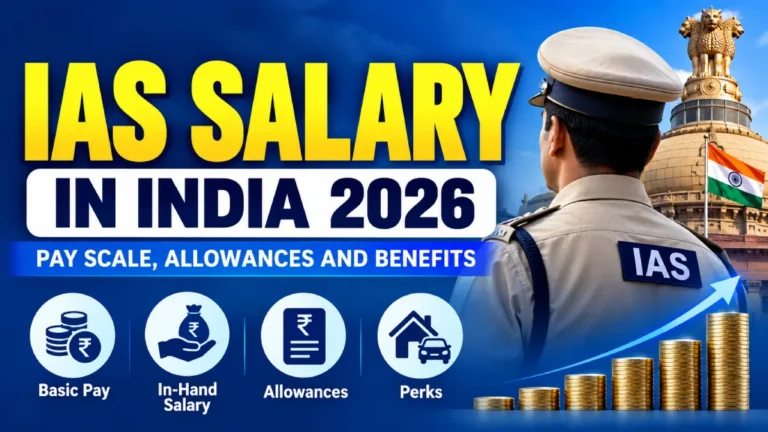
If you are wondering about the IAS salary in India in 2026, a newly recruited IAS officer starts with a basic pay of ₹56,100 per month under the 7th Central Pay Commission (CPC) pay matrix. The salary increases with experience, promotions and changes in pay level. At the highest level, the Cabinet Secretary of India receives a basic salary of ₹2,50,000 per month.
However, the basic pay is only one part of an IAS officer’s compensation. Dearness Allowance (DA), House Rent Allowance (HRA), Transport Allowance (TA) and other eligible benefits can increase the total compensation.
In this article, we explain the basic pay of an IAS officer, estimated in-hand salary, salary by rank, allowances, government facilities, promotion structure and the rules governing additional income.
IAS Salary 2026: Overview
Here is a quick overview of the IAS salary structure in India.
| Particulars | Details |
|---|---|
| Service name | Indian Administrative Service (IAS) |
| Recruiting examination | UPSC Civil Services Examination |
| Starting basic pay | ₹56,100 per month |
| Entry-level pay matrix | Level 10 |
| Highest basic pay | ₹2,50,000 per month |
| Highest pay level | Level 18 |
| Salary structure | 7th Central Pay Commission pay matrix |
| Additional components | DA, HRA, TA and other eligible allowances |
| Other benefits | Government accommodation, medical facilities, leave and official facilities, subject to eligibility |
The figures above refer to the established pay matrix. Actual monthly earnings depend on the officer’s pay level, posting, applicable allowances and deductions.
What Is the Basic Pay of an IAS Officer in 2026?
The basic pay of an IAS officer is the fixed salary amount associated with the officer’s position in the government pay matrix. It does not include allowances such as DA, HRA and TA.
Under the 7th CPC structure, the starting basic pay for a directly recruited IAS officer is ₹56,100 per month at Pay Level 10.
As the officer gains experience and receives increments or promotions, the basic pay increases. Senior officers may progress to higher pay levels, with the Cabinet Secretary’s basic pay fixed at ₹2,50,000 per month.
It is important to understand that basic pay and in-hand salary are different. Basic pay is the foundation for calculating several salary components, while in-hand salary is the amount credited after applicable additions and deductions.
IAS Salary Per Month in 2026
The monthly IAS salary consists of basic pay and eligible allowances. The final amount varies according to the officer’s seniority, location of posting, accommodation arrangements and applicable government rules.
A newly appointed officer at Pay Level 10 has a starting basic salary of ₹56,100 per month. With allowances, the gross monthly salary can be substantially higher.
The main components are:
- Basic pay: The fixed amount determined by the pay matrix.
- Dearness Allowance (DA): An allowance intended to help offset inflation. The applicable rate is revised by the government from time to time.
- House Rent Allowance (HRA): An allowance based on the applicable city category and accommodation eligibility.
- Transport Allowance (TA): An allowance payable according to the relevant entitlement rules.
- Other eligible benefits: Certain allowances or reimbursements may apply depending on the officer’s posting and duties.
The gross salary is calculated by adding the applicable allowances to basic pay. Deductions, including the officer’s applicable pension contribution and income tax, affect the final take-home amount.
IAS Salary In-Hand in 2026
The in-hand IAS salary is the amount an officer receives after applicable deductions.
For a newly recruited officer, the take-home salary may be around ₹80,000 to ₹1,10,000 per month in illustrative scenarios, depending on the applicable DA rate, posting city, HRA eligibility, transport allowance and deductions. This is an indicative range, not a guaranteed salary figure.
For example, an officer posted in a city with a higher HRA entitlement may receive a different gross salary from an officer at the same pay level posted elsewhere. However, an officer occupying government accommodation generally does not receive HRA for that accommodation.
The final amount credited to the officer’s bank account may also vary according to income tax, pension contributions and other applicable deductions.
Note: Always check the latest government orders and the officer’s actual salary slip for an exact figure. Allowance rates and deductions can change.
Basic Pay of IAS Officers by Rank and Pay Level
An IAS officer’s basic pay increases throughout their career. The following table presents important pay levels in the established 7th CPC pay matrix.
| Career stage or pay level | Pay level | Basic pay per month |
|---|---|---|
| Entry-level IAS officer | Level 10 | ₹56,100 |
| Senior Time Scale | Level 11 | ₹67,700 |
| Junior Administrative Grade | Level 12 | ₹78,800 |
| Selection Grade | Level 13 | ₹1,18,500 |
| Higher administrative level | Level 14 | ₹1,44,200 |
| Senior administrative level | Level 15 | ₹1,82,200 |
| Additional Chief Secretary-level pay | Level 17 | ₹2,25,000 |
| Cabinet Secretary | Level 18 | ₹2,50,000 |
These are representative pay-matrix figures, not a guarantee that every officer will receive a particular level after a fixed number of years. Actual progression depends on service rules, eligibility, vacancies where applicable and career circumstances.
The salary table also shows why an IAS officer’s compensation can differ significantly between the beginning and later stages of their career.
Allowances Included in IAS Salary
In addition to basic pay, IAS officers may receive allowances under applicable government rules. The amount depends on the officer’s pay level, posting and eligibility.
1. Dearness Allowance (DA)
Dearness Allowance is paid to eligible government employees to help compensate for changes in the cost of living. It is calculated as a percentage of basic pay.
The government revises DA periodically, so the amount included in an IAS officer’s salary may change during the year.
2. House Rent Allowance (HRA)
HRA helps eligible officers meet accommodation expenses when government housing is not provided or occupied under the applicable rules.
The rate depends on the classification of the posting city and the prevailing government orders. An officer using eligible government accommodation generally does not receive HRA for the same accommodation arrangement.
3. Transport Allowance (TA)
Transport Allowance helps cover eligible commuting expenses. The amount depends on the employee’s pay level, city classification and relevant entitlement rules.
It should not be assumed that every officer receives the same transport allowance. Official vehicle arrangements and other applicable conditions may affect entitlements.
4. Travel and Leave-Related Benefits
Eligible officers may receive travel-related benefits, including Leave Travel Concession (LTC), subject to applicable rules. Official travel for government duties is governed separately by the relevant travel and reimbursement provisions.
5. Other Eligible Allowances
Certain officers may qualify for additional allowances or reimbursements because of their posting, duties or other prescribed conditions. These are not universal benefits and should not be included in every officer’s estimated salary without verification.
Benefits and Perks of an IAS Officer
The IAS offers benefits beyond the monthly salary. These facilities depend on the officer’s role, posting, seniority and government entitlements.
Government Accommodation
Eligible officers may receive government accommodation according to availability and entitlement. The type of accommodation varies by posting and seniority.
Official Vehicle and Transport Facilities
Certain posts provide access to an official vehicle and driver for authorised duties. Availability depends on the position and government arrangements; it is not a personal vehicle benefit that every officer can use without restrictions.
Medical Facilities
IAS officers may be eligible for government medical facilities or reimbursement under the applicable healthcare rules. Coverage and conditions depend on the relevant scheme and service provisions.
Job Security and Career Progression
The IAS offers a structured career with defined service rules, salary progression and opportunities to take on higher administrative responsibilities. Officers may serve in state government departments, district administration and central government assignments during their careers.
Leave and Retirement Benefits
Eligible officers can access leave benefits and retirement-related provisions under the rules applicable to them. Pension arrangements and contribution requirements should be checked against the officer’s applicable service and retirement framework.
These benefits have financial value, but they should not be treated as additional cash salary. Government accommodation, an official vehicle and medical facilities are subject to specific rules and restrictions.
IAS Salary During Training
Candidates selected for the IAS undergo training before taking up their regular responsibilities. During training, they receive pay and allowances according to the applicable service rules.
The entry-level pay matrix provides a basic pay of ₹56,100 per month at Level 10. However, the amount received during training may differ from a simple basic-pay calculation because of applicable deductions, allowances, training arrangements and other rules.
Therefore, candidates should distinguish between the pay-matrix starting salary and the actual amount credited during the training period.
IAS Salary After 5, 10, 15 and 20 Years
An IAS officer’s salary generally grows through annual increments and progression to higher pay levels. However, years of service alone do not determine an officer’s exact basic pay or designation.
As a broad illustration:
- At the beginning of the career: The officer enters the pay matrix at Level 10, with a basic pay of ₹56,100.
- After several years: The officer may progress to higher pay levels, such as Levels 11 and 12, subject to applicable service rules.
- At more senior stages: Higher pay levels can provide basic pay of ₹1 lakh or more per month.
- At the top of the administrative hierarchy: Eligible senior officers may reach the higher pay levels, including Level 17 or Level 18.
These stages are illustrative rather than fixed year-by-year salary guarantees. Promotions, eligibility and individual service history influence the actual progression.
IAS Salary Compared with IPS and IFS Salary
The Indian Administrative Service (IAS), Indian Police Service (IPS) and Indian Foreign Service (IFS) are prominent services recruited through the UPSC Civil Services Examination.
Their pay structures are governed by the relevant service rules and pay-matrix provisions. Directly recruited officers in these services generally start at the prescribed entry-level pay, subject to the applicable rules.
However, their roles and working conditions differ:
- IAS: Focuses on administration, public policy implementation, district governance and government management.
- IPS: Focuses on policing, law enforcement, public safety and internal security.
- IFS: Focuses on diplomacy, foreign relations and India’s representation abroad.
The overall compensation and facilities may vary with seniority, posting and service-specific entitlements. For this reason, salary comparisons should consider both the pay matrix and the conditions attached to a particular role.
IAS Extra Income: Can IAS Officers Earn Beyond Their Salary?
The phrase IAS extra income is often searched by candidates who want to understand whether officers can earn money outside their government salary.
IAS officers are public servants and must follow the applicable conduct rules. They cannot treat their official position as a means of earning unauthorised income.
An officer’s legitimate financial benefits may include:
- Salary increments and promotions under the pay rules.
- Eligible allowances and reimbursements.
- Permitted income from investments or assets, subject to applicable disclosure and conduct requirements.
- Other activities or income sources only where permitted under the applicable service rules and with any required approvals.
Restrictions may apply to private employment, business activities, paid work, gifts and other financial interests. Officers must comply with the relevant conduct rules, including requirements for reporting assets, transactions or outside activities where applicable.
Bribes, commissions, misuse of public resources and payments obtained through abuse of official authority are not legitimate income. They may lead to disciplinary action and criminal proceedings.
Therefore, the appropriate way to assess an IAS officer’s financial position is to consider their lawful salary, eligible benefits, permitted investments and applicable service rules.
Is the IAS Salary Worth It?
For many candidates, the appeal of the IAS extends beyond financial compensation. The service offers opportunities to contribute to public administration, implement government programmes and work on issues affecting citizens.
The structured salary, career progression and eligible government benefits make it an attractive career option. At the same time, IAS officers face demanding responsibilities, transfers, public scrutiny and complex administrative challenges.
Candidates should evaluate the IAS based on their interest in public service and administrative work, rather than salary alone.
Frequently Asked Questions About IAS Salary
1. What is the starting IAS salary in India in 2026?
A newly recruited IAS officer starts with a basic pay of ₹56,100 per month at Pay Level 10 under the established 7th CPC pay matrix. Allowances and deductions determine the final gross and in-hand salary.
2. What is the basic pay of an IAS officer?
The starting basic pay is ₹56,100 per month. Basic pay increases as the officer progresses through the pay matrix through increments and eligible career advancement.
3. What is the in-hand IAS salary per month?
The in-hand salary varies by posting, allowances, accommodation and deductions. An illustrative starting-level estimate may fall around ₹80,000 to ₹1,10,000 per month, but the actual amount can be lower or higher depending on individual circumstances and current rules.
4. What is the highest IAS salary?
At Pay Level 18, the Cabinet Secretary receives a basic pay of ₹2,50,000 per month. This is the top basic-pay figure in the established IAS pay structure.
5. Do IAS officers receive HRA?
Eligible officers may receive HRA according to the applicable city classification and government rules. Officers occupying government accommodation generally do not receive HRA for that accommodation.
6. Do IAS officers receive a government car?
Certain officers receive access to official vehicles for authorised duties, depending on their position and government arrangements. It is not an unrestricted personal benefit for every IAS officer.
7. Can IAS officers earn extra income?
IAS officers may have permitted investments and other lawful financial interests, subject to the applicable conduct rules. Private business, outside employment and paid activities may be restricted or require approval. Bribes and misuse of official authority are illegal.
8. Does the IAS salary increase every year?
Basic pay generally increases through annual increments, subject to the applicable rules. Further increases may occur when an officer progresses to a higher pay level.
9. Is IAS salary the same in every state?
The basic pay follows the applicable pay matrix and service rules, but allowances and deductions may vary with posting, accommodation, entitlements and other circumstances.
Conclusion
The IAS salary in India in 2026 begins at a basic pay of ₹56,100 per month and can reach ₹2,50,000 per month at the Cabinet Secretary level under the established 7th CPC pay matrix.
In addition to basic pay, eligible officers may receive DA, HRA, transport-related benefits and other facilities under government rules. Their actual in-hand salary depends on allowances, posting, accommodation arrangements and deductions.
For UPSC aspirants, understanding the salary structure is useful, but the IAS also involves public responsibility, demanding work and opportunities to contribute to the country’s administration. A well-informed career decision should consider the full role, its benefits and its responsibilities.