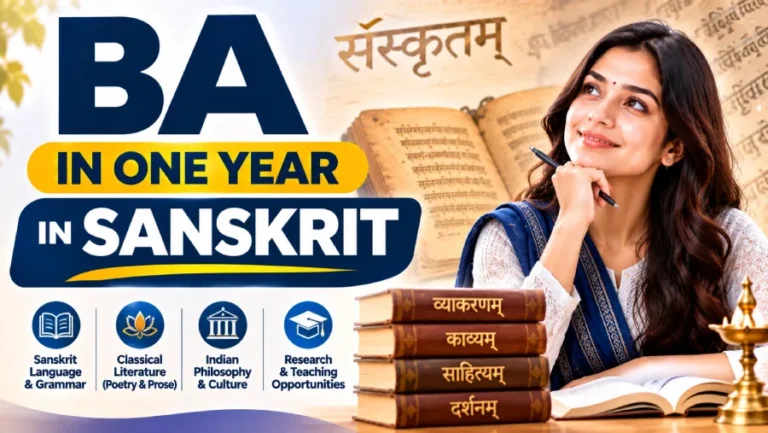
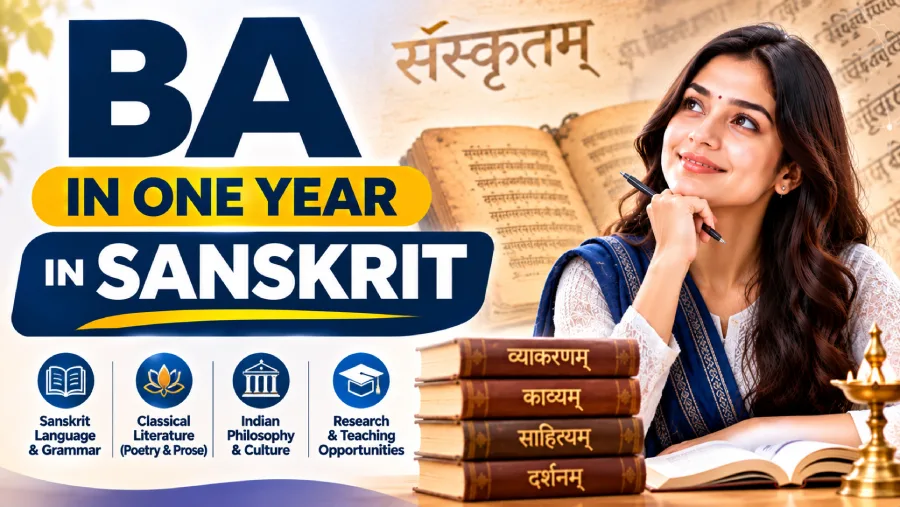
Sanskrit is one of the world’s oldest classical languages and an important part of India’s literary, philosophical and cultural heritage. From ancient scriptures and poetry to grammar, linguistics and philosophical texts, Sanskrit offers students an opportunity to explore a rich intellectual tradition.
For learners interested in languages, literature, history and Indian knowledge systems, a Bachelor of Arts (BA) in Sanskrit can be a valuable academic choice. It helps develop language proficiency, reading and interpretation skills, critical thinking and an understanding of classical literature.
Many students search for options such as BA in one year in Sanskrit because they want to continue their education while managing professional or personal responsibilities. However, it is important to understand the university’s approved course structure, eligibility rules and applicable regulations before enrolling in an accelerated or degree-completion programme.
This guide explains the course, its subjects, eligibility, career opportunities and important admission considerations.
What Is a BA in Sanskrit?
A Bachelor of Arts in Sanskrit is an undergraduate degree programme focused on the study of Sanskrit language, grammar, literature and classical texts. Students explore the structure of the language, its historical development and its influence on Indian literature, philosophy and culture.
The programme may include topics such as:
- Sanskrit grammar and composition
- Classical Sanskrit poetry and prose
- Vedic and classical literature
- Indian philosophy and literary traditions
- Translation and interpretation
- Sanskrit linguistics
- Ancient Indian cultural and intellectual history
The course develops both language knowledge and analytical abilities. It can be useful for students interested in education, research, translation, publishing and cultural studies.
BA in Sanskrit – Course Overview
| Course detail | Information |
|---|---|
| Degree | Bachelor of Arts (BA) |
| Specialisation | Sanskrit |
| Level | Undergraduate |
| Duration | Generally 3 or 4 years, depending on the university and applicable framework |
| Mode | Regular, online or distance mode, where officially approved |
| Main subjects | Sanskrit grammar, literature, poetry, prose and philosophy |
| Eligibility | Generally completion of Class 12 or an equivalent qualification |
| Career areas | Education, translation, research, publishing and cultural organisations |
The exact programme structure, subjects, admission requirements and duration may differ between universities.
Can You Complete a BA in Sanskrit in One Year?
Students searching for a BA in one year in Sanskrit should carefully understand the difference between a regular undergraduate programme and an approved accelerated or degree-completion pathway.
A standard BA generally follows a three-year or four-year academic structure, depending on the applicable university regulations and educational framework. A one-year completion option should not be assumed to be available for every student.
Any accelerated or credit-transfer route must be officially permitted and based on the university’s applicable regulations, previous academic qualifications and eligible academic credits.
Before applying, students should:
- Verify whether the university is legally authorised to offer the programme.
- Check the applicable UGC regulations and recognition requirements in India.
- Confirm whether the one-year route is officially approved.
- Ask how previous qualifications or credits will be evaluated.
- Obtain written confirmation of the degree’s duration and recognition.
- Check whether the selected online or distance-learning mode is officially permitted.
Students should avoid institutions making guaranteed one-year degree claims without providing clear regulatory and academic information.
Eligibility for BA in Sanskrit
The general eligibility requirements for a BA in Sanskrit may include:
- Educational qualification: Completion of Class 12 or an equivalent examination from a recognised board.
- Stream: Students from Arts, Commerce or Science backgrounds may be eligible, depending on university admission rules.
- Language background: Previous Sanskrit study may be helpful, but it is not necessarily compulsory at every university.
- Minimum marks: Some universities may specify minimum percentage requirements.
- Additional requirements: Certain institutions may have entrance examinations or other admission procedures.
Students should always check the latest eligibility criteria published by their chosen university.
Subjects Covered in BA Sanskrit
The BA Sanskrit curriculum introduces students to the language, its grammatical foundations, literary works and philosophical traditions. The exact syllabus varies by institution.
1. Sanskrit Grammar (Vyakarana)
Students learn the rules and structure of Sanskrit, including word formation, sentence construction, grammatical principles and linguistic patterns. Grammar provides the foundation for understanding classical Sanskrit texts.
2. Sanskrit Poetry (Kavya)
This subject introduces students to classical Sanskrit poetry, poetic techniques, literary expression and the works of renowned Sanskrit poets.
3. Sanskrit Prose (Gadya)
Students explore prose compositions and develop the ability to read, understand and interpret Sanskrit passages. The subject may include classical narratives and descriptive literature.
4. Vedic Literature
Vedic literature introduces students to selected texts and traditions from the Vedic period. Students may study their language, themes, historical importance and cultural context.
5. Indian Philosophy (Darshana)
This area introduces major Indian philosophical traditions and their ideas about knowledge, reality, ethics and human existence. Sanskrit texts are important sources for understanding many of these schools of thought.
6. Sanskrit Composition and Translation
Students practise writing simple Sanskrit passages, translating texts and interpreting sentences. These activities help improve language accuracy and communication skills.
7. History of Sanskrit Literature
Students study the development of Sanskrit literature across different periods, including important authors, literary genres and influential works.
8. Indian Literary and Cultural Traditions
This subject explores the relationship between Sanskrit literature and Indian cultural history, including intellectual traditions, classical knowledge and literary heritage.
Benefits of Studying BA Sanskrit
A BA in Sanskrit can offer several academic and professional benefits.
1. Understanding Classical Indian Literature
Students gain exposure to classical literary works, traditional knowledge and important philosophical writings.
2. Strong Language Skills
Studying Sanskrit grammar, composition and translation can improve linguistic understanding and analytical abilities.
3. Academic and Research Opportunities
The degree can provide a foundation for postgraduate studies and research in Sanskrit, linguistics, literature and related disciplines.
4. Cultural Awareness
Students develop a deeper understanding of India’s literary, historical and philosophical traditions.
5. Opportunities in Education and Publishing
Graduates may explore opportunities in education, content development, translation, editing and publishing, subject to the qualifications required for each role.
Career Opportunities After BA in Sanskrit
A BA in Sanskrit can open pathways into several fields. Career opportunities depend on the student’s additional qualifications, practical skills, experience and applicable recruitment requirements.
1. Sanskrit Language Educator
Graduates may explore teaching-related opportunities in institutions where their qualifications meet the relevant requirements. Formal school teaching generally requires a recognised teacher-education qualification and applicable eligibility criteria.
2. Translation Assistant
Students with strong Sanskrit and modern-language skills may explore translation and interpretation work involving classical texts, educational material and cultural publications.
3. Content Writer and Editor
Graduates may work on educational content, language resources, cultural articles and literary material for publishing houses or digital platforms.
4. Research Assistant
Students interested in classical literature, Indian philosophy or language studies may explore research-support opportunities, subject to the requirements of the institution or project.
5. Publishing and Editorial Work
Knowledge of Sanskrit can be useful in editing, proofreading, manuscript-related projects and the publication of educational or literary material.
6. Cultural and Heritage Organisations
Graduates may explore opportunities with organisations involved in preserving manuscripts, documenting cultural traditions and promoting classical languages.
Industries Where Sanskrit Graduates Can Explore Opportunities
A Sanskrit background may be relevant to several professional sectors:
- Education: Academic support, language instruction and educational content.
- Publishing: Editing, proofreading, translation and literary publications.
- Research: Classical language studies, literature and cultural research.
- Digital learning: Online language courses and educational resources.
- Cultural organisations: Heritage documentation and language preservation.
- Media and content development: Articles, scripts and learning materials related to Indian literature and culture.
Some specialist roles require postgraduate qualifications, teaching credentials or additional professional training.
Higher Education Options After BA Sanskrit
Students who wish to continue their academic journey can consider several postgraduate and specialised pathways.
MA in Sanskrit
An MA in Sanskrit offers advanced study of Sanskrit grammar, literature, philosophy, linguistics and classical texts. It can be suitable for students interested in teaching, research and academic careers.
MA in Indian Philosophy or Related Subjects
Depending on admission requirements, students may explore postgraduate programmes in Indian philosophy, classical studies or related humanities disciplines.
Linguistics and Language Studies
Students interested in the structure, development and interpretation of languages may consider further study in linguistics or language-related disciplines.
Research Programmes
After completing the required postgraduate qualifications, eligible students may explore research opportunities in Sanskrit literature, grammar, philosophy and cultural studies.
Admission to each programme depends on the institution’s eligibility requirements.
Is BA Sanskrit a Good Choice?
A BA in Sanskrit can be a good academic choice for students who enjoy languages, literature, history and classical knowledge.
| Student interest | How BA Sanskrit may help |
|---|---|
| Classical languages | Develops Sanskrit reading and grammar skills |
| Literature | Introduces classical poetry and prose |
| Indian philosophy | Builds familiarity with philosophical traditions |
| Teaching | Provides a foundation for further teaching qualifications |
| Translation | Develops language interpretation skills |
| Research | Supports further academic study in related areas |
Students should consider their career goals and the additional qualifications needed for their preferred profession before choosing the course.
How to Choose the Right University for BA Sanskrit
Selecting the right university is an important part of your academic journey. Before taking admission, consider the following factors:
- Recognition and authorisation: Verify the university’s legal status and applicable recognition requirements.
- Programme approval: Check whether the specific course and selected mode of study are permitted.
- Course curriculum: Review the subjects, syllabus and academic structure.
- Duration: Confirm the officially approved programme duration and any eligible credit-transfer provisions.
- Faculty and academic support: Explore the availability of qualified faculty, learning materials and student support.
- Examination process: Understand how assessments and examinations are conducted.
- Fee structure: Review tuition fees, examination charges and other costs.
- Career guidance: Check whether the university offers academic guidance and career support.
Do not rely only on advertisements promising unusually short degree-completion periods. Always verify important details directly with the university.
Frequently Asked Questions (FAQs)
1. What is a BA in Sanskrit?
A BA in Sanskrit is an undergraduate programme that focuses on Sanskrit language, grammar, literature, poetry, prose and related philosophical and cultural traditions.
2. Can I complete a BA in Sanskrit in one year?
A standard BA generally follows a three-year or four-year structure, depending on the university and applicable framework. A one-year completion route should only be considered when it is officially permitted under applicable regulations and the student meets the eligibility and credit requirements.
3. Is Sanskrit compulsory for BA admission?
Not necessarily. Some universities accept students from different academic streams without requiring previous Sanskrit study. Admission rules vary by institution.
4. What are the main subjects in BA Sanskrit?
Common subjects include Sanskrit grammar, poetry, prose, Vedic literature, Indian philosophy, translation, composition and the history of Sanskrit literature.
5. What can I do after completing BA Sanskrit?
Graduates can explore further studies and opportunities in education, translation, publishing, content development, research support and cultural organisations. Some roles require additional qualifications.
6. Can I pursue an MA in Sanskrit after BA?
Yes. Students who meet the admission requirements of the selected university can generally apply for an MA in Sanskrit.
7. Is BA Sanskrit useful for a teaching career?
It can provide a subject foundation for a teaching career. However, formal school teaching generally requires a recognised teacher-education qualification and other applicable eligibility requirements.
8. Can I study BA Sanskrit through distance or online education?
Some universities offer language and humanities programmes through distance or online modes. Students should verify whether the specific programme and mode are officially permitted for the relevant academic session.
Conclusion
A BA in Sanskrit offers an opportunity to explore one of India’s most important classical languages while developing skills in grammar, literature, translation and critical analysis. It can be a meaningful choice for students interested in education, research, publishing, cultural studies and language-related careers.
If you are exploring a BA in one year in Sanskrit, take time to understand the approved course structure, eligibility conditions and recognition requirements. Choosing a properly authorised programme is essential for protecting the value of your academic qualification and planning your future.
At MCM Global Education, students can explore available academic pathways, understand admission requirements and make informed decisions about their educational goals.