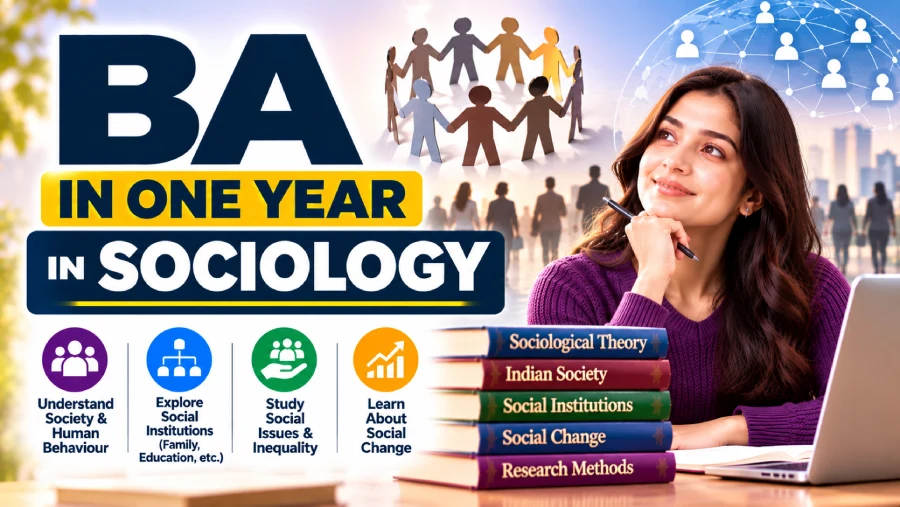
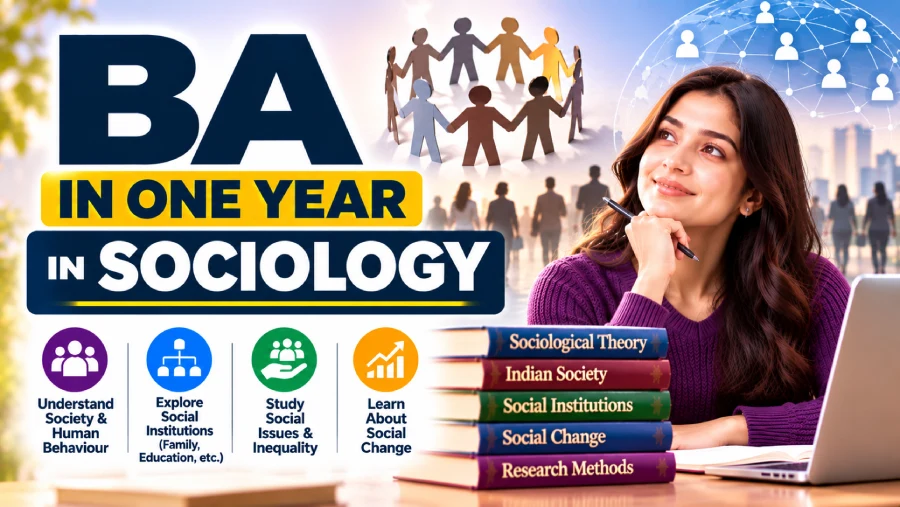
Sociology is the study of society, human relationships, social behaviour, institutions, cultures, and the factors that influence how people live and interact. It helps us understand social structures, family systems, education, communities, inequality, social change, and the challenges affecting modern societies.
A Bachelor of Arts (BA) in Sociology is an undergraduate programme designed for students interested in understanding people, communities, social institutions, and the development of society.
Many students and working professionals search for a BA in one year in Sociology because they want a flexible way to complete their graduation or improve their academic qualifications. However, the availability of an accelerated or degree-completion route depends on the university, previous qualifications, approved credit-transfer arrangements, and applicable education regulations.
This guide explains the BA Sociology course, eligibility requirements, subjects, benefits, career opportunities, and important factors to consider before applying.
What Is a BA in Sociology?
A BA in Sociology is an undergraduate degree programme that focuses on the systematic study of human society and social relationships.
Students explore how individuals interact within families, communities, organisations, and wider social systems. They also examine how culture, education, religion, economics, politics, and social institutions influence human behaviour.
The programme introduces students to important sociological theories, research methods, social problems, population studies, and contemporary social developments.
Students can develop several useful academic and professional skills, including:
- Understanding social behaviour and relationships
- Critical and analytical thinking
- Research and data interpretation
- Communication and report writing
- Understanding cultural diversity
- Identifying social issues and inequalities
- Evaluating social institutions and policies
- Developing problem-solving skills
Sociology connects academic research with real-world social issues, helping students understand how societies function and how they change over time.
BA in Sociology: Course Overview
| Course Detail | Description |
|---|---|
| Degree | Bachelor of Arts (BA) |
| Specialisation | Sociology |
| Academic Level | Undergraduate |
| Duration | Usually 3 or 4 years, depending on the applicable university structure |
| Accelerated Route | Subject to university approval and applicable regulations |
| Study Mode | Regular, online, or distance mode where officially permitted |
| Eligibility | Generally requires Class 12 or an approved equivalent qualification |
| Main Subjects | Sociological Theory, Indian Society, Social Institutions, and Social Change |
| Learning Areas | Social research, culture, communities, inequality, and social development |
| Career Areas | Research, education, social development, community programmes, and administration |
Can You Complete a BA in Sociology in One Year?
Students searching for a BA in one year in Sociology should understand that a standard undergraduate programme generally follows a multi-year academic structure.
A one-year completion option should not be assumed to be available as a regular admission route. Its availability depends on the university’s approved academic framework, the student’s previous educational qualifications, and any permitted credit-transfer or degree-completion arrangements.
Before enrolling, students should:
- Verify the university’s recognition and approval status.
- Confirm that BA Sociology is officially offered for the relevant academic session.
- Check whether the proposed study mode is permitted.
- Ask whether previously earned academic credits can be transferred.
- Obtain written confirmation of the programme duration and examination requirements.
- Verify whether the degree will be accepted for the intended employment or further education.
For applicants in India, it is important to check the applicable University Grants Commission (UGC) regulations and the university’s official programme information.
Eligibility for BA in Sociology
Eligibility requirements vary between universities, but students generally need to meet the following conditions.
1. Educational Qualification
Applicants usually need to complete Class 12 or an equivalent qualification from a recognised educational board.
2. Academic Documents
Students may be required to provide previous academic marksheets, certificates, identity documents, and other admission-related records.
3. Previous University Credits
Students who have previously studied in an undergraduate programme may explore credit-transfer or degree-completion options, subject to university policies and applicable regulations.
4. Admission Requirements
Some universities offer merit-based admission, while others may have additional admission procedures or subject-specific requirements.
Subjects Covered in BA Sociology
The BA Sociology curriculum generally covers social theories, human relationships, cultural systems, social institutions, research methods, and contemporary social issues.
1. Introduction to Sociology
This subject introduces students to the meaning, nature, scope, and importance of Sociology. It explains how societies are organised and how individuals interact within different social environments.
2. Sociological Theory
Students explore major sociological theories and perspectives used to understand society, social relationships, institutions, and human behaviour.
3. Indian Society
This subject examines the structure and characteristics of Indian society, including its diversity, traditions, communities, social institutions, and contemporary developments.
4. Social Institutions
Students study important social institutions such as family, marriage, education, religion, economy, and politics, along with their influence on individuals and communities.
5. Social Change and Development
This subject explores how societies evolve due to industrialisation, urbanisation, modernisation, technology, education, and other social and economic factors.
6. Rural and Urban Sociology
Students examine the characteristics of rural and urban communities, migration, settlement patterns, urbanisation, and the challenges associated with community development.
7. Sociology of Family and Kinship
This subject focuses on family structures, marriage, kinship systems, relationships, changing household patterns, and the role of family in society.
8. Social Stratification
Students learn about social inequality, class, caste, gender, status, power, and the factors that influence opportunities and social mobility.
9. Gender and Society
This subject examines gender roles, social expectations, gender inequality, representation, and changing relationships within modern societies.
10. Sociology of Education
Students explore the relationship between education and society, including educational inequality, social mobility, institutions, and the influence of education on social development.
11. Population and Society
This subject introduces population growth, demographic trends, migration, birth and death rates, population distribution, and their social implications.
12. Research Methods in Sociology
Students learn how to conduct sociological research through surveys, interviews, observation, questionnaires, case studies, and analysis of social information.
Benefits of Studying BA in Sociology
A BA in Sociology offers several academic and professional development benefits.
1. Understanding Human Society
The programme helps students understand how people interact, how communities function, and how social structures influence everyday life.
2. Developing Critical Thinking
Students learn to examine social issues, evaluate different perspectives, and understand the causes and consequences of social change.
3. Improving Research Skills
Sociology introduces students to research methods, data collection, interviews, surveys, and the interpretation of social information.
4. Understanding Cultural Diversity
Students gain knowledge of different cultures, traditions, communities, identities, and social practices.
5. Building Communication Skills
Academic writing, discussions, presentations, and research reports help students develop effective communication skills.
6. Creating Social Awareness
The programme introduces students to social issues such as inequality, poverty, discrimination, unemployment, and access to education.
7. Preparing for Competitive Examinations
Sociology is relevant to the syllabuses of several competitive examinations. Its usefulness depends on the specific examination and its subject requirements.
8. Supporting Further Education
A recognised BA in Sociology can provide a foundation for postgraduate study in Sociology, Social Work, Development Studies, and related disciplines.
Career Opportunities After BA in Sociology
Graduates with a BA in Sociology can explore opportunities in research, education, community development, administration, social organisations, and related sectors.
1. Social Research Assistant
Research assistants support social research projects by collecting information, conducting surveys, organising data, and preparing reports.
2. Community Development Assistant
Graduates may explore roles supporting community development programmes, local initiatives, awareness campaigns, and social welfare projects.
3. NGO Programme Assistant
Non-governmental organisations may recruit graduates for programme coordination, documentation, community engagement, and project support.
4. Human Resources Assistant
Knowledge of human behaviour, social relationships, and organisational structures can be useful in entry-level HR roles involving recruitment coordination, employee records, and workplace administration.
5. Social Research and Data Collection Assistant
Graduates may support research organisations, survey agencies, and development institutions by collecting and organising social and demographic information.
6. Education Support Roles
Graduates may explore academic support, student services, and educational administration positions. Formal teaching roles generally require additional qualifications and compliance with applicable recruitment rules.
7. Public Relations Assistant
Sociology provides an understanding of audiences, communities, and social behaviour that may be useful in communication and public relations roles.
8. Community Outreach Coordinator
Graduates may assist organisations with community engagement, awareness programmes, public information, and social initiatives.
9. Content Writer and Researcher
Students with strong research and writing skills may explore opportunities in educational publishing, social research content, digital media, and documentation.
10. Government Examination Aspirant
A Sociology degree can provide useful subject knowledge for students preparing for government and public-service examinations. Selection depends on the requirements of the relevant examination.
Note: Specialist social work, counselling, and clinical roles may require additional professional qualifications, supervised training, or registration. A BA in Sociology alone does not automatically qualify graduates for these positions.
Industries That Hire Sociology Graduates
A BA in Sociology can be relevant to several professional sectors.
- Social development organisations
- Non-governmental organisations
- Research and survey organisations
- Educational institutions
- Human resources and corporate administration
- Public administration
- Community development programmes
- Public relations and communications
- Publishing and digital media
- Policy research organisations
- Healthcare administration support
The availability of specific positions depends on experience, additional qualifications, employer requirements, and professional regulations.
Higher Education Options After BA in Sociology
Students who complete a recognised BA in Sociology can consider several postgraduate and professional study options.
1. MA in Sociology
An MA in Sociology offers advanced study of sociological theories, social institutions, research methods, social change, and contemporary social issues.
2. MSW (Master of Social Work)
Students interested in community development, social welfare, and social service programmes may explore an MSW, subject to university admission requirements.
3. MA in Social Work
Some institutions offer postgraduate programmes in Social Work with a focus on social welfare, community services, and development.
4. MA in Development Studies
This programme examines social and economic development, poverty, inequality, public programmes, and sustainable development.
5. MA in Gender Studies
Students interested in gender relations, social equality, representation, and gender-based research can explore postgraduate study in Gender Studies.
6. MA in Political Science
Students interested in government, political institutions, public policy, and society may consider Political Science.
7. MBA in Human Resource Management
Students interested in employee relations, organisational behaviour, recruitment, and workplace management may explore an MBA in HRM, subject to admission requirements.
8. Research and Doctoral Studies
Students interested in academic research can pursue postgraduate qualifications and later explore doctoral programmes according to university eligibility criteria.
Is BA in Sociology a Good Choice?
A BA in Sociology can be a good academic choice for students interested in understanding human behaviour, social relationships, communities, cultural diversity, and social development.
It is particularly suitable for individuals who enjoy researching social issues, understanding different perspectives, and exploring how societies change.
| Student Interest | How BA in Sociology Can Help |
|---|---|
| Social Research | Develops research, observation, and analytical skills |
| Community Development | Introduces social institutions and community issues |
| Human Resources | Builds understanding of people and organisational relationships |
| Education | Provides knowledge of educational systems and social development |
| Social Organisations | Explores inequality, welfare, and community programmes |
| Competitive Examinations | Provides knowledge relevant to selected examination syllabuses |
| Higher Education | Supports further study in Sociology and related disciplines |
Students should select the programme based on their academic interests, university recognition, course structure, and long-term career goals.
How to Choose the Right University for BA in Sociology
Choosing the right university is an important part of your academic journey.
Consider these factors before applying:
- University Recognition: Verify the institution’s legal status and applicable recognition or approvals.
- Programme Availability: Confirm that BA Sociology is officially offered for the relevant academic session.
- Study Mode: Check whether regular, online, or distance education is permitted for the programme.
- Course Curriculum: Review the subjects, syllabus, and academic structure.
- Duration: Understand the official programme duration and whether any approved credit-transfer route is available.
- Research Opportunities: Check whether the programme includes practical research, surveys, fieldwork, or project work.
- Admission Process: Review application requirements, eligibility criteria, and deadlines.
- Student Support: Check access to academic guidance, learning resources, and examination information.
- Further Education: Consider whether the qualification meets the admission requirements of your intended postgraduate programmes.
Frequently Asked Questions (FAQs)
1. What is a BA in Sociology?
A BA in Sociology is an undergraduate degree programme that focuses on human society, social relationships, culture, institutions, social behaviour, and social change.
2. Can I complete BA in Sociology in one year?
A one-year completion route depends on the university’s approved regulations, previous qualifications, and eligible credit-transfer arrangements. Students should verify the route before admission.
3. What is the eligibility for BA Sociology?
Generally, students need to complete Class 12 or an equivalent recognised qualification. Specific admission requirements vary by university.
4. What subjects are included in BA Sociology?
Common subjects include Introduction to Sociology, Sociological Theory, Indian Society, Social Institutions, Social Change, Rural and Urban Sociology, Gender and Society, and Research Methods.
5. Is BA Sociology useful for government jobs?
A recognised BA Sociology degree may meet the educational requirement for certain government examinations where a bachelor’s degree is accepted. Individual examination and recruitment requirements still apply.
6. Can I pursue an MA after BA Sociology?
Yes. Graduates with a recognised BA Sociology degree can explore MA Sociology and other related postgraduate programmes, subject to admission requirements.
7. What jobs can I get after BA Sociology?
Potential career areas include social research assistance, NGO programme support, community development, HR assistance, education support, public relations, and content research.
8. Is Sociology useful for UPSC preparation?
Sociology covers social institutions, inequality, social change, communities, and other topics relevant to parts of the UPSC syllabus. However, UPSC preparation requires study across multiple subjects.
9. Can I study BA Sociology through distance education?
Distance education may be available through eligible universities offering the programme with the required approvals. Students should verify the institution and programme for the relevant admission session.
10. What can I study after BA Sociology?
Students can consider MA Sociology, MSW, Development Studies, Gender Studies, Political Science, and other related postgraduate programmes, depending on their eligibility and interests.
Conclusion
A BA in Sociology provides an opportunity to understand human society, social institutions, cultural diversity, relationships, and the factors that influence social change. The programme can help students develop research, analytical, communication, and critical-thinking skills while preparing for further education and different professional pathways.
Students searching for a BA in one year in Sociology should carefully verify the university’s approved academic structure, recognition, eligibility requirements, and any available credit-transfer arrangements before applying. A recognised qualification and a transparent academic pathway are more important than simply choosing a shorter advertised duration.
With the right university and a clear academic plan, studying Sociology can become a valuable step towards academic development and long-term career growth.