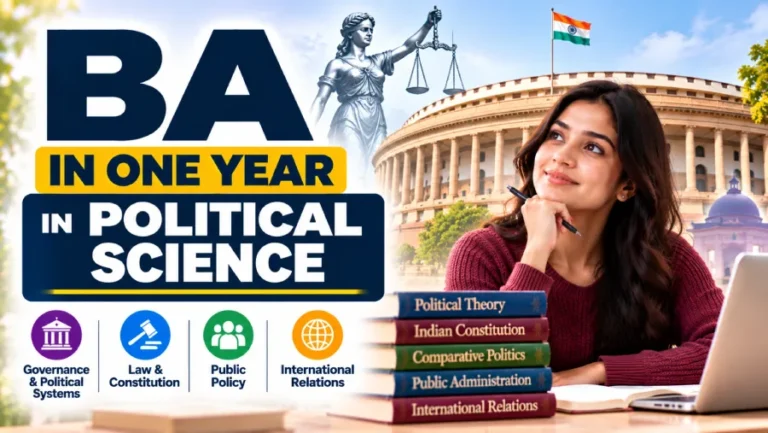
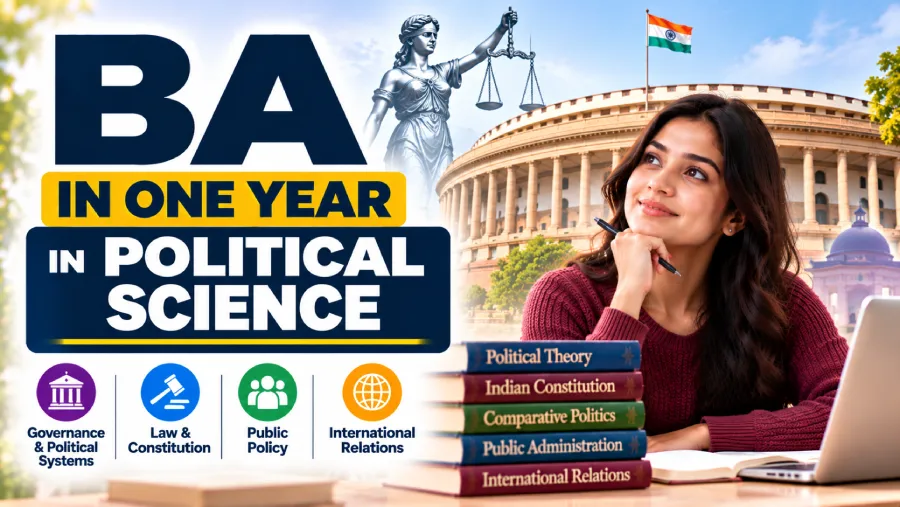
Political Science is the study of governments, political systems, public policies, international relations, political institutions, and the distribution of power in society. It helps students understand how countries are governed, how laws and policies are developed, and how political decisions influence individuals, communities, and nations.
A Bachelor of Arts (BA) in Political Science is an undergraduate programme designed for students interested in politics, governance, democracy, public administration, international affairs, and political developments.
Many students and working professionals search for a BA in one year in Political Science because they want a flexible way to complete their graduation or improve their academic qualifications. However, the availability of an accelerated or degree-completion route depends on the university, previous qualifications, approved credit-transfer arrangements, and applicable education regulations.
This guide explains the BA Political Science course, eligibility requirements, subjects, benefits, career opportunities, and important considerations before choosing a university.
What Is a BA in Political Science?
A BA in Political Science is an undergraduate degree programme that examines political ideas, institutions, governments, public policies, and relationships between countries.
Students learn about different political systems, constitutional frameworks, democratic institutions, political ideologies, elections, public administration, and international organisations.
The programme also introduces students to important political thinkers, historical developments, contemporary political issues, and the functioning of government institutions.
Students can develop several useful academic and professional skills, including:
- Critical and analytical thinking
- Understanding political systems and institutions
- Research and information analysis
- Public policy evaluation
- Communication and presentation
- Academic writing and argument development
- Understanding national and international affairs
Political Science connects political theory with real-world developments, helping students understand how decisions are made and how governments and institutions operate.
BA in Political Science: Course Overview
| Course Detail | Description |
|---|---|
| Degree | Bachelor of Arts (BA) |
| Specialisation | Political Science |
| Academic Level | Undergraduate |
| Duration | Usually 3 or 4 years, depending on the applicable university structure |
| Accelerated Route | Subject to university approval and applicable regulations |
| Study Mode | Regular, online, or distance mode where officially permitted |
| Eligibility | Generally requires Class 12 or an approved equivalent qualification |
| Main Subjects | Political Theory, Indian Government, Comparative Politics, and International Relations |
| Learning Areas | Governance, constitutions, public policy, political institutions, and research |
| Career Areas | Administration, research, education, policy support, media, and public affairs |
Can You Complete a BA in Political Science in One Year?
Students searching for a BA in one year in Political Science should understand that a standard undergraduate programme generally follows a multi-year academic structure.
A one-year completion option should not be assumed to be available as a regular admission route. Its availability depends on the university’s approved academic framework, the student’s previous educational qualifications, and any permitted credit-transfer or degree-completion arrangements.
Before enrolling, students should consider the following:
- Verify the university’s recognition and approval status.
- Confirm that BA Political Science is officially offered for the relevant academic session.
- Check whether the proposed study mode is permitted.
- Ask whether previously earned academic credits can be transferred.
- Obtain written confirmation of the programme duration and examination requirements.
- Verify whether the degree will be accepted for the intended employment or further education.
For applicants in India, it is important to check the applicable University Grants Commission (UGC) regulations and the university’s official programme information.
Eligibility for BA in Political Science
Eligibility requirements vary between universities, but students generally need to meet the following conditions.
1. Educational Qualification
Applicants usually need to complete Class 12 or an equivalent qualification from a recognised educational board.
2. Academic Documents
Students may be required to provide previous academic marksheets, certificates, identity documents, and other admission-related records.
3. Previous University Credits
Students who have previously studied in an undergraduate programme may explore credit-transfer or degree-completion options, subject to university policies and applicable regulations.
4. Admission Requirements
Some universities offer merit-based admission, while others may have additional admission procedures or subject-specific requirements.
Subjects Covered in BA Political Science
The BA Political Science curriculum generally covers political theories, government structures, constitutional systems, public administration, and international relations.
1. Political Theory
Political Theory introduces students to important political concepts such as liberty, equality, justice, rights, democracy, citizenship, and authority.
Students examine different approaches to understanding political institutions and the organisation of society.
2. Indian Government and Politics
This subject focuses on India’s political system, constitutional structure, parliamentary government, political parties, elections, and the functioning of government institutions.
3. Indian Constitution
Students learn about the development and key features of the Indian Constitution, including fundamental rights, directive principles, federalism, constitutional bodies, and the roles of different branches of government.
4. Comparative Politics
Comparative Politics examines political systems and institutions across different countries. Students compare governments, electoral systems, constitutions, political parties, and democratic processes.
5. International Relations
This subject explores relationships between countries, international organisations, diplomacy, foreign policy, global cooperation, and international conflicts.
6. Public Administration
Public Administration focuses on the organisation and functioning of government departments, administrative structures, public services, and policy implementation.
7. Political Ideologies
Students study major political ideologies such as liberalism, socialism, conservatism, nationalism, feminism, and other approaches to political thought.
8. Western Political Thought
This subject introduces students to influential political philosophers and thinkers, their ideas, and their contributions to the development of political theory.
9. Indian Political Thought
Students explore political ideas and contributions of influential Indian thinkers, reformers, and leaders who shaped India’s political and social development.
10. Public Policy
Public Policy examines how governments identify social issues, develop policies, implement programmes, and evaluate their outcomes.
11. Political Sociology
This subject studies the relationship between society and politics, including social movements, identity, class, political participation, and power structures.
12. Research Methods in Political Science
Students learn how to conduct academic research, collect information, evaluate political data, prepare reports, and analyse political developments.
Benefits of Studying BA in Political Science
A BA in Political Science offers several academic and professional development benefits.
1. Understanding Government Systems
The programme helps students understand how governments function, how political institutions are organised, and how public decisions are made.
2. Developing Critical Thinking
Students learn to evaluate political arguments, analyse policies, compare different viewpoints, and understand complex social and political issues.
3. Improving Communication Skills
Political discussions, presentations, debates, and academic writing can improve students’ ability to communicate ideas effectively.
4. Understanding Constitutional Rights
The programme introduces students to constitutional principles, fundamental rights, democratic values, and the responsibilities of citizens.
5. Learning About International Affairs
Students develop an understanding of global politics, diplomacy, international organisations, and relationships between countries.
6. Preparing for Competitive Examinations
Political Science is relevant to the syllabuses of several competitive examinations. Its usefulness depends on the specific examination and its subject requirements.
7. Supporting Further Education
A recognised BA in Political Science can provide a foundation for postgraduate study in Political Science, Public Administration, International Relations, and related disciplines.
Career Opportunities After BA in Political Science
Graduates with a BA in Political Science can explore opportunities in research, administration, education, media, public affairs, and development organisations.
1. Political Research Assistant
Research assistants support political research projects by collecting information, reviewing reports, analysing political developments, and preparing research documents.
2. Public Administration Support Roles
Graduates may explore entry-level administrative positions in organisations working with government services, public programmes, and institutional operations.
3. Policy Research Assistant
Policy research assistants help organisations examine public issues, review policy documents, collect information, and prepare reports.
4. Journalism and Political Content Writing
Graduates with strong writing and research skills may explore opportunities in journalism, political reporting, editorial support, and digital content development.
5. Public Relations Assistant
Political and public affairs knowledge can be useful in public relations roles involving communication, stakeholder engagement, and public information.
6. NGO and Development Organisation Staff
Non-governmental organisations and development institutions may recruit graduates for project coordination, documentation, community engagement, and research support.
7. Legislative and Parliamentary Research Support
Graduates may explore entry-level research and administrative support roles in organisations associated with legislative studies, public affairs, and governance.
8. Education Support Roles
Graduates may work in academic support and educational administration. Formal teaching positions generally require additional qualifications and compliance with applicable recruitment rules.
9. Government Examination Aspirant
A Political Science degree can provide useful subject knowledge for students preparing for government and public-service examinations. Selection depends on the requirements of the relevant examination.
Industries That Hire Political Science Graduates
A BA in Political Science can be relevant to several professional sectors.
- Government and public administration
- Political research organisations
- Public policy and consulting
- Journalism and media
- Non-governmental organisations
- International development organisations
- Public relations and communications
- Educational institutions
- Think tanks and research centres
- Legislative and public affairs organisations
The availability of specific positions depends on experience, additional qualifications, employer requirements, and professional regulations.
Higher Education Options After BA in Political Science
Students who complete a recognised BA in Political Science can consider several postgraduate and professional study options.
1. MA in Political Science
An MA in Political Science provides advanced study of political theories, institutions, governance, political systems, and contemporary political developments.
2. MA in Public Administration
This programme focuses on government administration, public institutions, administrative systems, governance, and policy implementation.
3. MA in International Relations
Students interested in diplomacy, foreign policy, international organisations, and global affairs can explore International Relations programmes.
4. MA in Public Policy
Public Policy programmes examine policy development, implementation, evaluation, governance, and solutions to social and economic challenges.
5. MA in Sociology
Students interested in social structures, institutions, communities, and the relationship between society and politics may consider Sociology.
6. Bachelor of Education (B.Ed.)
Graduates interested in school teaching may explore a B.Ed. programme if they meet the relevant degree, subject, and admission requirements.
7. Research and Doctoral Studies
Students interested in academic research can pursue postgraduate qualifications and later explore doctoral programmes according to university eligibility criteria.
Is BA in Political Science a Good Choice?
A BA in Political Science can be a good academic choice for students interested in government, politics, public policy, international relations, constitutional studies, and social development.
It is particularly suitable for individuals who enjoy analysing current affairs, understanding political institutions, studying public issues, and exploring how societies are governed.
| Student Interest | How BA in Political Science Can Help |
|---|---|
| Government and Administration | Introduces government structures and administrative systems |
| Political Research | Develops research and analytical skills |
| Public Policy | Builds an understanding of policy development and evaluation |
| International Affairs | Explores diplomacy and global political relationships |
| Journalism and Media | Strengthens research, writing, and communication |
| Competitive Examinations | Provides knowledge relevant to various examination syllabuses |
| Higher Education | Supports further study in Political Science and related fields |
Students should select the programme based on their academic interests, university recognition, curriculum, and long-term career plans.
How to Choose the Right University for BA in Political Science
Selecting the right university is an important part of your academic journey.
Consider these factors before applying:
- University Recognition: Verify the institution’s legal status and applicable recognition or approvals.
- Programme Availability: Confirm that BA Political Science is officially offered for the relevant academic session.
- Study Mode: Check whether regular, online, or distance education is permitted for the programme.
- Course Curriculum: Review the subjects, syllabus, and academic structure.
- Duration: Understand the official programme duration and whether any approved credit-transfer route is available.
- Faculty and Academic Support: Check the availability of academic guidance, learning resources, and student support.
- Admission Process: Review application requirements, eligibility criteria, and deadlines.
- Further Education: Consider whether the qualification meets the admission requirements of your intended postgraduate programmes.
Frequently Asked Questions (FAQs)
1. What is a BA in Political Science?
A BA in Political Science is an undergraduate degree programme that focuses on governments, political systems, constitutional frameworks, political theories, public policies, and international relations.
2. Can I complete BA in Political Science in one year?
A one-year completion route depends on the university’s approved regulations, previous qualifications, and eligible credit-transfer arrangements. Students should verify the route before admission.
3. What is the eligibility for BA Political Science?
Generally, students need to complete Class 12 or an equivalent recognised qualification. Specific admission requirements vary by university.
4. What subjects are included in BA Political Science?
Common subjects include Political Theory, Indian Government and Politics, Indian Constitution, Comparative Politics, International Relations, Public Administration, and Political Thought.
5. Is BA Political Science useful for government jobs?
A recognised BA Political Science degree may meet the educational requirement for certain government examinations where a bachelor’s degree is accepted. Individual examination and recruitment requirements still apply.
6. Can I pursue an MA after BA Political Science?
Yes. Graduates with a recognised BA Political Science degree can explore MA Political Science and other related postgraduate programmes, subject to admission requirements.
7. What jobs can I get after BA Political Science?
Potential career areas include political research assistance, policy research support, public affairs, journalism, content writing, NGO project support, and administrative roles.
8. Is Political Science useful for UPSC preparation?
Political Science covers topics such as the Constitution, governance, political institutions, and international relations that are relevant to parts of the UPSC syllabus. However, UPSC preparation requires study across multiple subjects.
9. Can I study BA Political Science through distance education?
Distance education may be available through eligible universities offering the programme with the required approvals. Students should verify the institution and programme for the relevant admission session.
10. What can I study after BA Political Science?
Students can consider MA Political Science, Public Administration, International Relations, Public Policy, Sociology, and other related postgraduate programmes, depending on their eligibility.
Conclusion
A BA in Political Science provides an opportunity to understand governments, political institutions, constitutional systems, public policies, and international affairs. The programme can help students develop critical thinking, research, communication, and analytical skills while preparing for further education and a variety of professional pathways.
Students searching for a BA in one year in Political Science should carefully verify the university’s approved academic structure, recognition, eligibility requirements, and any available credit-transfer arrangements before applying. A recognised qualification and a transparent academic pathway are more important than simply choosing a shorter advertised duration.
With the right university and a clear academic plan, studying Political Science can become a valuable step towards academic development and long-term career growth.