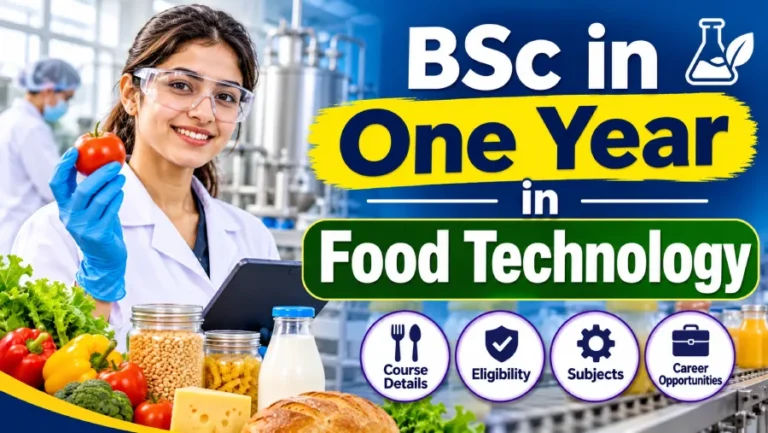
Food Technology is an important field that combines science, technology and innovation to improve the production, processing, preservation, packaging and distribution of food products. As the food industry continues to grow, the demand for professionals with knowledge of food safety, quality control, processing techniques and product development is increasing across different sectors.
A Bachelor of Science (BSc) in Food Technology is designed to help students understand how food is produced, processed, preserved, tested, packaged and maintained for quality and safety. The programme combines scientific principles with practical applications related to food manufacturing, nutrition, microbiology, chemistry and industrial processing.
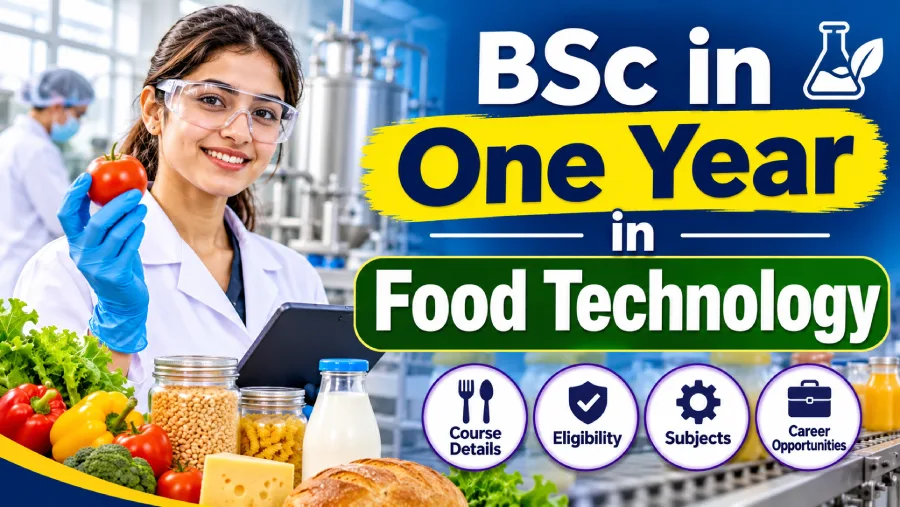
Many students search for BSc in One Year in Food Technology because they want to complete their higher education in less time, continue their studies after a break or explore flexible degree-completion opportunities.
This guide covers the course details, eligibility, subjects, career opportunities, benefits and higher education options associated with BSc Food Technology, along with important information about the one-year completion pathway.
What Is a BSc in Food Technology?
BSc Food Technology is an undergraduate science programme focused on the science and technology involved in food production, processing, preservation, quality management and packaging.
The course helps students understand how raw agricultural products are transformed into safe, nutritious and commercially available food products. It also introduces the scientific methods used to maintain food quality, extend shelf life, reduce food waste and develop new food products.
Students may study subjects such as:
- Food Chemistry
- Food Microbiology
- Food Processing Technology
- Food Preservation
- Food Engineering
- Food Packaging
- Food Quality Assurance
- Food Safety
- Nutrition
- Product Development
Food Technology has applications in dairy products, beverages, bakery products, packaged foods, frozen foods, meat processing, confectionery, agricultural processing and many other industries.
BSc Food Technology Course Overview
| Course Detail | Information |
|---|---|
| Degree | Bachelor of Science in Food Technology |
| Course Level | Undergraduate |
| Field | Food Science and Technology |
| Standard Duration | Typically 3 or 4 years, depending on the programme |
| Study Areas | Food processing, food chemistry, food safety, microbiology and quality control |
| Learning Methods | Lectures, laboratory work, practicals, projects and industrial exposure |
| Eligibility | Generally Class 12 with relevant science subjects |
| Career Areas | Food manufacturing, quality assurance, food safety, research and product development |
| Higher Studies | MSc Food Technology, Food Science, Food Safety, Nutrition and related fields |
Can You Complete a BSc in Food Technology in One Year?
Students interested in completing BSc Food Technology in one year should understand the difference between the standard undergraduate programme and alternative degree-completion pathways.
A conventional BSc Food Technology programme generally takes three or four years, depending on the university, country and curriculum. It includes theoretical subjects, laboratory work, practical training and sometimes industrial internships or projects.
Completing the entire degree in one year is not a standard route for new undergraduate students.
However, students who have previously completed higher education coursework or discontinued a degree may explore university-approved options such as:
- Credit transfer based on previous academic achievements
- Re-entry or continuation of a previously discontinued programme
- Eligible accelerated degree structures
- Recognition of previously earned credits, where permitted by university regulations
Before enrolling, students should confirm:
- Whether the university is legally authorised to award the degree.
- Whether the Food Technology programme is officially offered in the advertised mode.
- Whether the university permits credit transfer or accelerated completion.
- Whether the proposed one-year timeline is supported by official academic regulations.
- Whether the degree meets the requirements of their intended employment or higher education.
Students should obtain written confirmation of their eligibility, academic credits, course duration and degree requirements before paying admission fees.
Eligibility for BSc Food Technology
Eligibility requirements may vary across universities. Common admission requirements include the following:
1. Educational Qualification
Applicants generally need to have completed Class 12 or an equivalent qualification from a recognised educational board.
2. Science Background
Many universities require Physics, Chemistry and Biology or Mathematics. Some institutions may accept other subject combinations based on their admission regulations.
3. Minimum Marks
Applicants may need to meet a minimum percentage of marks in Class 12 or relevant science subjects. Requirements can differ by university.
4. Entrance Examination
Admission may be based on merit, university entrance examinations or other admission procedures, depending on the institution.
5. Alternative Degree-Completion Eligibility
Students applying through re-entry or credit-transfer routes may need to provide academic transcripts, previously completed course details, credit records and other supporting documents.
Applicants should always review the university’s official eligibility criteria for the relevant admission year.
Subjects Covered in BSc Food Technology
BSc Food Technology includes scientific and technical subjects that help students understand food composition, processing methods, quality, safety and industrial production.
1. Food Chemistry
Food Chemistry focuses on the chemical composition and properties of food materials.
Students learn about carbohydrates, proteins, fats, vitamins, minerals, food additives, chemical reactions and the changes that occur during food processing, cooking, storage and preservation.
2. Food Microbiology
Food Microbiology studies microorganisms associated with food, including beneficial organisms, spoilage microorganisms and foodborne pathogens.
Students learn about microbial growth, food contamination, fermentation, hygiene, spoilage prevention and microbiological safety.
3. Food Processing Technology
Food Processing Technology introduces methods used to convert raw food materials into finished or ready-to-consume products.
Topics may include heating, cooling, drying, freezing, pasteurisation, sterilisation, milling, extraction, fermentation and other processing methods.
4. Food Preservation
Food Preservation focuses on techniques used to maintain food quality and extend shelf life.
Students may study refrigeration, freezing, dehydration, heat treatment, chemical preservation, fermentation, packaging and other preservation techniques.
5. Food Engineering
Food Engineering applies engineering principles to food production and industrial processing.
Students learn about equipment, process operations, heat transfer, mass transfer, fluid flow, food processing systems and production efficiency.
6. Food Quality Assurance and Quality Control
This subject focuses on maintaining the quality, consistency and safety of food products.
Students learn about quality testing, inspection, sampling, documentation, quality standards, laboratory procedures and quality-management systems used in food industries.
7. Food Packaging Technology
Food Packaging Technology explores packaging materials, systems and methods used to protect food products during storage, transportation and distribution.
Topics may include packaging design, packaging materials, barrier properties, shelf-life protection, labelling and sustainable packaging.
8. Nutrition and Food Science
Nutrition and Food Science introduces the relationship between food, nutrients and human health.
Students learn about nutritional components, dietary energy, vitamins, minerals, food composition, nutritional requirements and the impact of processing on nutritional quality.
9. Food Safety and Hygiene
Food Safety and Hygiene focuses on preventing contamination and ensuring that food products are safe for consumption.
Students learn about sanitation, hygiene practices, food hazards, contamination control, safe handling, risk management and food safety systems.
10. Food Product Development
Food Product Development involves creating, improving and testing new food products based on consumer preferences, market demand and technical requirements.
Students may learn about product formulation, sensory evaluation, ingredient selection, recipe development, testing, packaging and product improvement.
Practical Learning in BSc Food Technology
Practical learning is an important part of Food Technology because students need to understand how food products are processed, tested, preserved and evaluated in real-world settings.
Depending on the curriculum and institution, students may participate in:
- Food processing experiments
- Food quality testing
- Moisture and acidity analysis
- Microbiological testing demonstrations
- Food preservation experiments
- Product formulation and development
- Sensory evaluation of food products
- Packaging and shelf-life studies
- Laboratory equipment handling
- Food safety and sanitation exercises
- Industrial visits
- Research projects and practical assignments
Practical exposure helps students understand food manufacturing processes and develop technical skills that may be useful in food production, testing, quality assurance and research roles.
Benefits of Studying BSc Food Technology
1. Opportunities in the Food Industry
Food is an essential product, and the industry includes manufacturing, processing, packaging, storage, distribution and quality-management activities.
This creates opportunities for graduates to explore a variety of career pathways.
2. Knowledge of Food Safety and Quality
The programme provides knowledge about food contamination, quality testing, processing conditions, preservation and food safety practices.
3. Growing Food Processing Sector
Packaged food, ready-to-eat products, beverages, dairy products, frozen food and convenience products have created a broad range of activities within the food manufacturing sector.
4. Product Innovation
Food Technology can provide a foundation for developing new products, improving recipes, testing ingredients, evaluating consumer preferences and exploring new processing methods.
5. Entrepreneurship Opportunities
Graduates may explore food-related businesses such as bakery production, packaged snacks, food processing, beverages, catering products, food packaging or specialised food products, subject to appropriate business planning and compliance requirements.
6. Multiple Career Pathways
Students may explore careers in quality control, food production, food safety, product development, laboratory work, packaging and food research.
7. Scope for Higher Education
Graduates may continue their education in Food Technology, Food Science, Food Safety, Nutrition, Biotechnology, Food Engineering or related disciplines, subject to eligibility.
Career Opportunities After BSc Food Technology
BSc Food Technology graduates may explore opportunities in food manufacturing, laboratories, quality-management departments, research, food safety, packaging and product development.
1. Food Quality Control Analyst
Quality control analysts conduct or support tests to evaluate food products and raw materials against specified quality requirements.
Their responsibilities may include sample collection, laboratory testing, recording results and supporting quality inspections.
2. Quality Assurance Executive
Quality assurance professionals help ensure that food production processes follow established quality procedures, documentation requirements, specifications and organisational standards.
3. Food Technologist
Food technologists work with food processing, product quality, manufacturing procedures, preservation methods and product improvement.
4. Food Production Supervisor
Production supervisors coordinate manufacturing activities, production schedules, process monitoring, equipment operations, workforce coordination and production documentation.
5. Food Safety Assistant
Food safety professionals may assist with hygiene monitoring, food safety procedures, documentation, contamination prevention and compliance-related activities.
6. Product Development Assistant
Product development assistants support the creation and testing of new food products, ingredient selection, formulation, sensory evaluation and product improvement.
7. Food Microbiology Laboratory Assistant
These professionals assist with microbiological testing, sample preparation, laboratory observations, hygiene testing and related procedures according to laboratory protocols.
8. Packaging Development Assistant
Packaging professionals may assist with packaging material evaluation, packaging trials, shelf-life studies, labelling and packaging performance.
9. Research Assistant
Research assistants support food science and technology projects involving experiments, testing, sample analysis, data collection and research documentation.
10. Food Entrepreneur
Graduates may start their own food-related businesses, including packaged food production, bakery products, food processing, snacks, beverages, speciality food products or other ventures.
Job titles and responsibilities vary by employer. Some technical and specialised roles may require additional qualifications, practical experience or certifications.
Industries Where Food Technology Graduates Can Work
BSc Food Technology graduates may explore opportunities in several industries, including:
- Food and beverage manufacturing
- Dairy and dairy product industries
- Bakery and confectionery
- Packaged food manufacturing
- Frozen food production
- Meat and seafood processing
- Food testing laboratories
- Quality assurance and food safety
- Food packaging industries
- Agricultural processing
- Research and development
- Food ingredients and additives
- Hospitality and food production
- Food supply chain and storage
Skills Developed During BSc Food Technology
A BSc Food Technology programme may help students develop technical, analytical and practical skills.
- Food processing knowledge
- Food quality testing
- Food safety awareness
- Laboratory techniques
- Food preservation methods
- Product formulation
- Sensory evaluation
- Packaging knowledge
- Documentation and reporting
- Hygiene and sanitation awareness
- Scientific problem-solving
- Production process understanding
- Analytical thinking
- Research skills
- Teamwork and communication
These skills can be useful for entry-level positions and further specialisation within the food industry.
Higher Education Options After BSc Food Technology
Students who complete an eligible BSc Food Technology qualification may consider postgraduate programmes to improve their subject knowledge and explore specialised career opportunities.
Possible higher education options include:
- MSc Food Technology
- MSc Food Science
- MSc Food Microbiology
- MSc Food Safety and Quality Management
- MSc Food Processing and Preservation
- MSc Food Engineering
- MSc Nutrition
- MSc Biotechnology
- MSc Dairy Technology
- MBA Food and Agribusiness Management
- Postgraduate programmes in food product development
Students should check the admission requirements, subject prerequisites and eligibility criteria of the university before applying.
Is BSc Food Technology a Good Choice?
BSc Food Technology can be a suitable option for students interested in food science, manufacturing, laboratory testing, product development, quality control and food safety.
The degree offers exposure to scientific principles and industrial applications associated with food production and processing. It may be particularly attractive to students who enjoy chemistry, biology, practical experiments, food innovation and working with production or laboratory systems.
Food Technology is not limited to manufacturing. It also connects with research, packaging, food safety, quality management, product innovation, supply chain operations and entrepreneurship.
Students should consider their interests, career goals, practical learning opportunities and the quality of the programme before selecting a university.
How to Choose the Right University for BSc Food Technology
Choosing the right institution is important for gaining the academic knowledge and practical experience required in the food industry.
University Recognition
Verify the institution’s recognition, legal status and authority to award the degree.
Programme Curriculum
Review the subjects, credit structure, food science modules, practical components and research opportunities.
Laboratory Facilities
Check the availability of food testing laboratories, processing equipment, microbiology facilities, quality-control instruments and practical training arrangements.
Faculty Experience
Explore the academic qualifications, teaching experience and relevant expertise of faculty members.
Industrial Exposure
Check whether the programme provides industrial visits, internships, projects, practical training or opportunities to understand real food manufacturing processes.
Study Mode
Confirm whether the programme is offered in regular, online, distance or hybrid mode and whether that mode is officially permitted for the specific degree.
Course Duration
Review the standard programme duration and confirm whether any officially permitted accelerated or credit-transfer pathway is available.
Career Support
Explore internship assistance, career guidance, placement support and industry connections.
Fee Structure
Understand the total cost, including tuition, examination, laboratory, practical and other charges.
Students should make sure they understand the programme’s actual academic requirements before admission.
Frequently Asked Questions (FAQs)
1. Can I complete BSc Food Technology in one year?
A standard BSc Food Technology programme generally takes three or four years, depending on the university and programme structure. A full degree in one year is not a standard route for new undergraduate students. Any alternative completion pathway must be officially permitted and subject to academic eligibility.
2. What is the eligibility for BSc Food Technology?
Students generally need Class 12 with relevant science subjects. Universities may require Physics, Chemistry, Biology or Mathematics, along with minimum marks or entrance examinations.
3. What subjects are taught in BSc Food Technology?
Common subjects include Food Chemistry, Food Microbiology, Food Processing, Food Preservation, Food Engineering, Food Packaging, Food Safety, Nutrition, Quality Assurance and Product Development.
4. Is BSc Food Technology a science degree?
Yes. BSc Food Technology is an undergraduate science degree focused on food composition, processing, preservation, quality, safety and technology.
5. Can I pursue BSc Food Technology after 12th?
Yes. Students who meet the university’s educational, subject and admission requirements can apply after completing Class 12.
6. What jobs can I get after BSc Food Technology?
Possible career options include food technologist, quality control analyst, quality assurance executive, food production supervisor, food safety assistant, product development assistant and research assistant.
7. Can I work in food companies after BSc Food Technology?
Yes. Graduates may explore opportunities in food manufacturing, dairy, beverages, packaged foods, bakery, food processing, packaging and quality-management departments, depending on their qualifications and employer requirements.
8. Can I start my own food business after BSc Food Technology?
Yes. Graduates may explore food production, packaged snacks, bakery products, beverages, food processing and other food-related ventures. Business licensing, food safety requirements and other applicable regulations must be followed.
9. Can I pursue MSc after BSc Food Technology?
Yes. Eligible graduates may apply for postgraduate programmes in Food Technology, Food Science, Food Safety, Food Microbiology, Biotechnology, Nutrition and other related disciplines.
10. What should I check before enrolling in a one-year BSc Food Technology programme?
Check university recognition, degree validity, study mode, academic credits, course duration, practical requirements, eligibility and whether the advertised completion timeline is officially permitted.
Conclusion
BSc Food Technology is an undergraduate science programme that combines food science, chemistry, microbiology, processing, preservation, packaging, food safety and quality management. It provides a foundation for understanding how food products are developed, manufactured, tested, preserved and delivered to consumers.
Graduates may explore opportunities in food manufacturing, quality assurance, food testing, research, product development, packaging, food safety and entrepreneurship. Students may also pursue postgraduate education to specialise in advanced food science and technology fields.
For students searching for BSc in One Year in Food Technology, it is important to verify the programme’s academic structure, recognition, eligibility, practical requirements and officially permitted completion pathway before enrolling.
Choosing a suitable university and gaining relevant practical knowledge can help students prepare for opportunities in the growing food and food-processing industry.