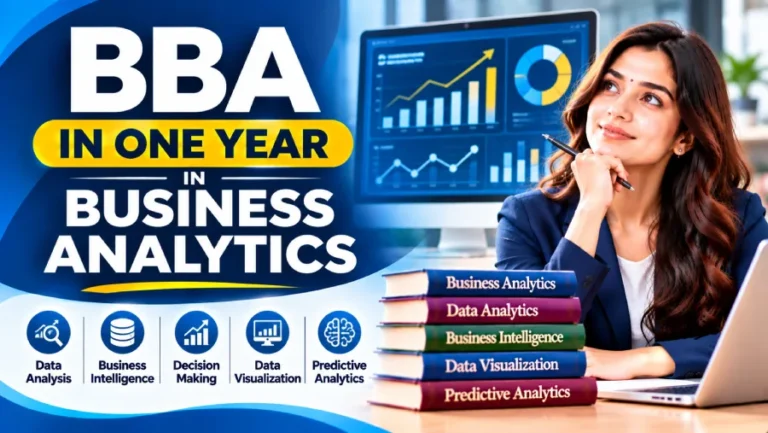
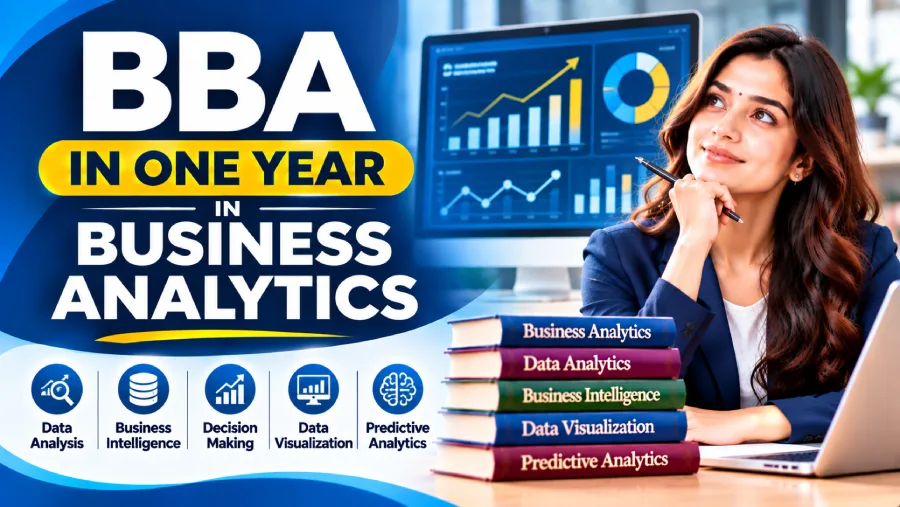
Businesses generate large amounts of data every day. From customer preferences and sales performance to market trends and financial activities, organisations use data to understand their operations and make better decisions. This growing importance of data has increased the demand for professionals who understand both business management and analytical techniques.
For students interested in business, technology, statistics and problem-solving, a Bachelor of Business Administration (BBA) in Business Analytics can be an interesting academic choice. The programme combines business administration principles with data analysis, business intelligence, statistical methods and decision-making techniques.
Many students search for a BBA in one year in Business Analytics because they want to complete their education within a shorter timeframe while managing professional or personal responsibilities. However, it is important to understand the university’s approved programme structure and applicable regulations before enrolling in an accelerated or degree-completion pathway.
This guide explains the course, eligibility requirements, subjects, benefits, career opportunities and important admission considerations.
What Is a BBA in Business Analytics?
A Bachelor of Business Administration in Business Analytics is an undergraduate business programme that focuses on using data and analytical methods to support business decisions.
It introduces students to the relationship between business management, technology and data-driven problem-solving. Students learn how organisations collect, organise, interpret and use information to improve performance and understand market behaviour.
The programme may cover areas such as:
- Business analytics fundamentals
- Business statistics
- Data analysis
- Business intelligence
- Data visualisation
- Predictive analytics
- Marketing analytics
- Financial analytics
- Spreadsheet-based analysis
- Business decision-making
A BBA in Business Analytics can provide a foundation for students interested in business analysis, data-related business functions, market research and management.
BBA in Business Analytics – Course Overview
| Course detail | Information |
|---|---|
| Degree | Bachelor of Business Administration (BBA) |
| Specialisation | Business Analytics |
| Level | Undergraduate |
| Duration | Generally 3 or 4 years, depending on the university and applicable framework |
| Mode | Regular, online or distance mode, where officially approved |
| Main subjects | Business analytics, statistics, data analysis and business intelligence |
| Eligibility | Generally Class 12 or equivalent |
| Career areas | Business analysis, data reporting, market research and business intelligence |
The exact programme structure, syllabus, duration and admission requirements may differ between universities.
Can You Complete a BBA in Business Analytics in One Year?
Students searching for a BBA in one year in Business Analytics should understand the difference between a standard undergraduate programme and an officially approved accelerated or degree-completion pathway.
A regular BBA generally follows a three-year or four-year academic structure, depending on the university and applicable educational framework. A one-year completion option should not be assumed to be available to every student.
Any accelerated or credit-transfer pathway must be officially permitted under applicable regulations and based on the student’s previous academic qualifications and eligible academic credits.
Before applying, students should:
- Verify the university’s legal recognition and authority to award the degree.
- Check whether the specific BBA programme and selected mode of study are officially permitted.
- Confirm whether the proposed one-year route is approved under applicable regulations.
- Ask how previous academic qualifications and credits will be evaluated.
- Obtain written confirmation of the programme duration and degree requirements.
- Review the university’s examination and assessment procedures.
For students in India, checking the applicable UGC regulations and the relevant recognition or entitlement of the institution is particularly important.
Avoid institutions promising guaranteed one-year degrees without providing clear academic and regulatory documentation.
Eligibility for BBA in Business Analytics
The general eligibility requirements for a BBA in Business Analytics may include the following:
1. Educational Qualification
Students generally need to have completed Class 12 or an equivalent qualification from a recognised board.
2. Academic Stream
Students from Commerce, Arts or Science backgrounds may be eligible, depending on the university’s admission policy.
3. Minimum Marks
Some universities may specify a minimum percentage in the qualifying examination.
4. Mathematics and Statistics Background
A background in mathematics or statistics can be helpful because business analytics involves numerical calculations, data interpretation and statistical concepts. However, mathematics may not be compulsory for every university.
5. Entrance Requirements
Certain institutions may conduct entrance examinations, interviews or additional admission assessments.
6. Additional Requirements
For an accelerated or credit-transfer pathway, students may need to provide previous academic records and supporting documents for eligibility evaluation.
Always check the latest admission guidelines of the selected university.
Subjects Covered in BBA Business Analytics
A BBA in Business Analytics combines core business administration subjects with analytical and data-related topics. The exact curriculum varies by institution, but students may study the following subjects.
1. Introduction to Business Analytics
This subject introduces the role of analytics in modern organisations. Students learn how businesses use data to understand performance, identify opportunities and support decision-making.
2. Business Statistics
Students explore statistical concepts used in business research and analysis. Topics may include averages, probability, data distribution, correlation and basic statistical interpretation.
3. Data Analysis
This subject introduces methods for collecting, organising, examining and interpreting data. Students learn how to identify patterns and extract useful information from datasets.
4. Business Intelligence
Business intelligence focuses on transforming business information into meaningful insights. Students may explore reporting systems, performance dashboards and analytical tools used by organisations.
5. Data Visualisation
Students learn how to present information through charts, graphs, dashboards and visual reports. Effective data visualisation helps businesses understand complex information more easily.
6. Predictive Analytics
This subject introduces techniques used to examine historical data and identify possible future trends. Students may learn about forecasting, predictive models and their business applications.
7. Marketing Analytics
Marketing analytics focuses on evaluating marketing performance through data. Topics may include customer behaviour, campaign performance, market segmentation and customer acquisition.
8. Financial Analytics
Students explore how analytical techniques can support financial planning, budgeting, reporting and business performance evaluation.
9. Spreadsheet and Analytical Tools
Students may learn to use spreadsheet software and other analytical tools for data organisation, calculations, reporting and business analysis.
10. Business Research Methods
This subject introduces research planning, data collection, questionnaire design and interpretation of research findings for business purposes.
Benefits of Studying BBA in Business Analytics
A BBA in Business Analytics can provide several academic and professional benefits.
1. Understanding Data-Driven Business Decisions
Students learn how businesses use data to evaluate performance, identify opportunities and make informed decisions.
2. Developing Analytical Skills
The programme introduces logical thinking, data interpretation, problem-solving and quantitative analysis.
3. Combining Business and Technology
Students gain an understanding of business management alongside analytical methods and digital tools.
4. Learning to Interpret Business Trends
Analytics helps organisations identify customer patterns, market changes and operational challenges. Students learn the fundamentals of interpreting such information.
5. Exposure to Multiple Business Functions
Business analytics can be applied to marketing, finance, sales, operations, customer service and supply chain management.
6. Foundation for Further Studies
Graduates can explore postgraduate programmes in business analytics, management, data analytics and related disciplines, subject to admission requirements.
Career Opportunities After BBA in Business Analytics
A BBA in Business Analytics can provide a foundation for entry-level opportunities in business and data-related functions. Career options depend on practical skills, experience, technical knowledge and employer requirements.
1. Business Analyst Trainee
Business analyst trainees support the collection of business requirements, preparation of reports and analysis of organisational processes.
2. Data Analyst Assistant
Graduates with relevant analytical and technical skills may explore junior data-related roles involving data organisation, basic analysis and reporting.
3. Business Intelligence Executive
Business intelligence professionals support the preparation of dashboards, performance reports and business insights using organisational data.
4. Market Research Executive
Market research executives help collect and analyse information about customer preferences, competitors and industry trends.
5. Marketing Analytics Executive
These professionals support the evaluation of marketing campaigns, website performance, customer engagement and promotional activities.
6. Reporting Analyst
Reporting analysts assist organisations in preparing performance reports, maintaining data records and presenting business information.
7. Operations Analyst Assistant
Graduates may explore roles involving operational reporting, process evaluation and identifying opportunities to improve business efficiency.
8. Business Development Analyst
These professionals support business development activities by examining market information, sales performance and potential growth opportunities.
Important: Some specialist data analyst and business intelligence positions require advanced technical skills in SQL, Python, statistics, Excel, Power BI or Tableau. A BBA alone does not guarantee eligibility for every analytical role. Practical projects and additional training can improve career readiness.
Industries Where Business Analytics Graduates Can Explore Opportunities
Business analytics knowledge can be useful across several industries.
- Banking and financial services: Financial reporting, customer analysis and business performance monitoring.
- Information technology: Business reporting, data support and technology-related analysis.
- E-commerce: Customer behaviour analysis, sales trends and product performance.
- Retail: Inventory analysis, customer insights and sales forecasting.
- Healthcare: Operational reporting, service performance and administrative data analysis.
- Education: Student engagement analysis, institutional reporting and admissions insights.
- Marketing and advertising: Campaign measurement, audience analysis and customer acquisition.
- Manufacturing: Production reporting, operational efficiency and supply chain analysis.
- Consulting: Business research, performance analysis and management reporting.
The responsibilities and entry requirements vary between organisations and positions.
Higher Education Options After BBA Business Analytics
Students interested in developing advanced analytical and management knowledge can consider several postgraduate pathways.
MBA in Business Analytics
An MBA in Business Analytics focuses on the application of data and analytical methods to business strategy, management and organisational decision-making.
MBA in Data Analytics
Students interested in data-driven management may explore postgraduate programmes specialising in data analytics, where available.
MBA in General Management
An MBA in General Management can provide broader knowledge of leadership, business strategy, finance, marketing and organisational management.
Master’s in Business Analytics
A specialised postgraduate degree may provide advanced knowledge of statistics, data modelling, business intelligence and analytical methods. Admission requirements vary between institutions.
Postgraduate Diploma in Data Analytics
Students may consider relevant postgraduate diploma programmes to strengthen their understanding of analytical tools and data-driven business practices.
Professional Certifications
Students may also explore additional training in:
- Microsoft Excel and advanced spreadsheets
- Power BI
- Tableau
- SQL
- Python for data analysis
- Google Analytics
- Business intelligence tools
These skills can complement academic learning and help students build practical experience.
Is BBA in Business Analytics a Good Choice?
A BBA in Business Analytics may be a suitable choice for students who enjoy business, technology, numbers, research and problem-solving.
| Student interest | How BBA Business Analytics may help |
|---|---|
| Data analysis | Introduces data collection and interpretation |
| Business management | Explains how analytics supports business decisions |
| Technology | Provides exposure to analytical and digital tools |
| Marketing | Introduces customer and campaign analysis |
| Finance | Develops an understanding of financial reporting and analysis |
| Research | Builds foundational research and statistical knowledge |
| Decision-making | Explains how data can support business planning |
Students should consider their career goals and the additional technical skills required for their preferred roles before choosing the programme.
How to Choose the Right University for BBA Business Analytics
Selecting the right university is an important part of your academic journey. Before taking admission, consider the following factors:
- Recognition and authorisation: Verify the institution’s legal status and authority to award the qualification.
- Programme approval: Check whether the specific BBA programme and selected mode of study are officially permitted.
- Course curriculum: Review the business analytics subjects, statistics modules and practical learning opportunities.
- Duration: Confirm the officially approved programme duration and any applicable credit-transfer arrangements.
- Faculty: Explore the academic qualifications and professional experience of the teaching team.
- Learning resources: Check access to study materials, analytical software, digital platforms and academic support.
- Practical exposure: Look for projects, case studies, internships and opportunities to work with real-world datasets.
- Examination process: Understand assessment methods, examination schedules and evaluation policies.
- Fee structure: Review tuition fees and additional charges before applying.
- Career support: Explore internships, placement assistance and career guidance where available.
Do not choose a university based only on promises of a shorter degree duration. Verify all important details directly with the institution.
Frequently Asked Questions (FAQs)
1. What is a BBA in Business Analytics?
A BBA in Business Analytics is an undergraduate business programme that combines management knowledge with data analysis, statistics, business intelligence and analytical decision-making.
2. Can I complete a BBA in Business Analytics in one year?
A standard BBA generally follows a three-year or four-year structure, depending on the university and applicable framework. A one-year completion route should only be considered if officially permitted and the student meets the relevant eligibility and credit requirements.
3. What are the eligibility requirements for BBA Business Analytics?
Students generally need to complete Class 12 or an equivalent qualification. Minimum marks, mathematics requirements and entrance examinations depend on the university.
4. Which subjects are taught in BBA Business Analytics?
Common subjects include business statistics, data analysis, business intelligence, data visualisation, predictive analytics, marketing analytics and business research methods.
5. What jobs can I explore after BBA Business Analytics?
Graduates may explore entry-level opportunities such as business analyst trainee, reporting analyst, market research executive, business intelligence executive and marketing analytics executive.
6. Is mathematics compulsory for BBA Business Analytics?
Mathematics requirements vary between universities. Some institutions accept students from different academic streams, but statistics and numerical analysis are important parts of the subject. Check the selected university’s eligibility criteria.
7. Do I need programming skills to study Business Analytics?
Programming is not necessarily required for admission to every BBA programme. However, learning tools such as Excel, SQL and Python can be helpful for developing practical analytical skills.
8. Can I pursue an MBA after BBA Business Analytics?
Yes. Students who meet the relevant admission requirements can generally apply for an MBA in Business Analytics, General Management or another specialisation.
9. Is BBA Business Analytics useful for digital business careers?
Yes. The programme introduces data-driven decision-making, customer analysis and business performance measurement, which are relevant to many digital business functions.
10. Can I study BBA Business Analytics through distance or online education?
Some universities offer BBA programmes through online or distance-learning modes. Students should verify whether the specific programme and mode are officially permitted for the relevant academic session.
Conclusion
A BBA in Business Analytics can be a valuable academic foundation for students interested in business management, data interpretation, technology and analytical decision-making. It introduces students to the methods businesses use to understand information, evaluate performance and identify opportunities.
If you are exploring a BBA in one year in Business Analytics, make sure you understand the approved programme structure, eligibility conditions and applicable recognition requirements before enrolling. A properly authorised qualification, combined with practical projects and relevant technical skills, can help you prepare for opportunities in today’s data-driven business environment.
At MCM Global Education, students can explore available academic pathways, understand admission requirements and receive guidance in planning their educational journey.