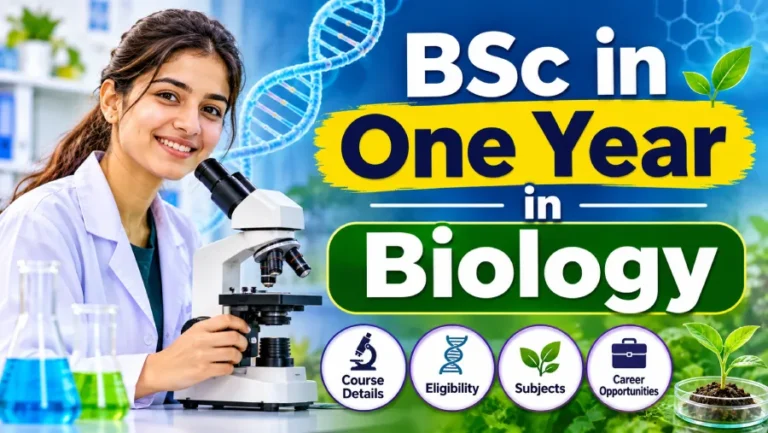
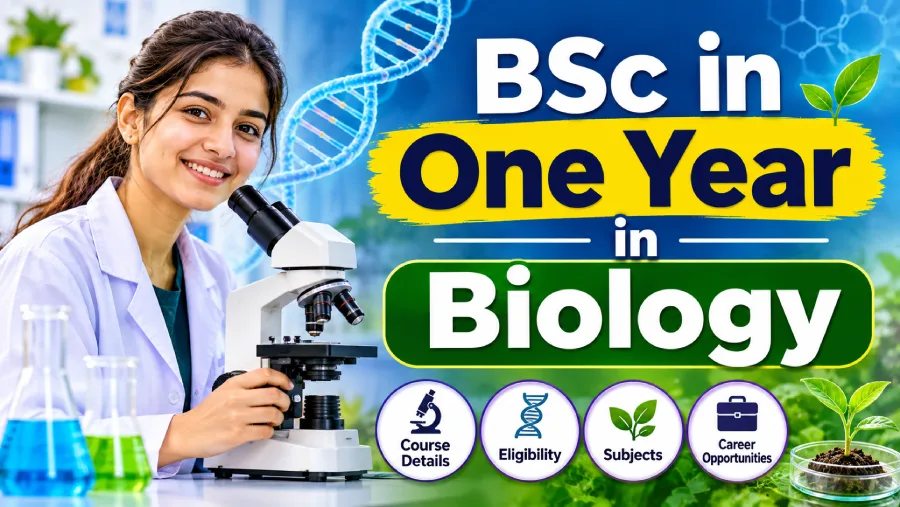
Biology is the study of living organisms, their structure, functions, growth, evolution and interactions with the environment. It plays an important role in understanding human life, plants, animals, microorganisms, ecosystems and the natural world.
A Bachelor of Science (BSc) in Biology provides students with a foundation in biological sciences, including cell biology, genetics, ecology, microbiology, physiology, zoology and botany. It can open opportunities in scientific research, laboratories, biotechnology, environmental science, education and several other fields.
Many students search for BSc in One Year in Biology to explore faster degree completion options, continue their education after a break or improve their academic qualifications for career advancement.
In this guide, we will discuss the course overview, eligibility, subjects, career opportunities, benefits and higher education options associated with BSc Biology, along with important considerations regarding the advertised one-year completion duration.
What Is a BSc in Biology?
BSc Biology is an undergraduate science programme that focuses on the study of living organisms and biological processes. It helps students understand how organisms function, reproduce, grow, adapt and interact with their surroundings.
The programme generally covers both theoretical and practical aspects of biology. Students may learn about microscopic organisms, plants, animals, human biological systems, genetic information, environmental relationships and biological research techniques.
Depending on the university and curriculum, the programme may include subjects such as:
- Cell Biology
- Genetics
- Molecular Biology
- Microbiology
- Botany
- Zoology
- Ecology
- Evolutionary Biology
- Biochemistry
- Human Physiology
Biology is a broad scientific field with connections to healthcare research, biotechnology, agriculture, environmental conservation, pharmaceuticals, food science and laboratory-based industries.
BSc Biology Course Overview
| Course Detail | Information |
|---|---|
| Degree | Bachelor of Science in Biology |
| Course Level | Undergraduate |
| Field | Biological Sciences |
| Standard Duration | Typically 3 or 4 years, depending on programme structure |
| Study Areas | Genetics, ecology, cell biology, microbiology, physiology and life sciences |
| Learning Methods | Lectures, laboratory work, research assignments and practical experiments |
| Eligibility | Generally Class 12 with relevant science subjects |
| Career Areas | Research, laboratories, biotechnology, environmental science, education and life sciences |
| Higher Studies | MSc Biology, Biotechnology, Microbiology, Genetics, Zoology and related fields |
Can You Complete a BSc in Biology in One Year?
Students searching for BSc in One Year in Biology are often interested in completing their undergraduate education faster or continuing their studies after a gap.
However, a standard BSc Biology programme is generally structured over three or four years, depending on the university, country and degree structure. Completing the entire programme in one year is not a standard route for a new undergraduate student.
Some universities may provide alternative pathways for eligible students through credit transfer, re-entry arrangements, recognition of previously completed academic work or officially permitted accelerated study structures.
Students should verify the following before admission:
- Whether the university is authorised to award the degree.
- Whether the Biology programme is officially offered in the advertised mode.
- Whether previously earned credits can be transferred.
- Whether the proposed one-year completion timeline is permitted by the institution’s academic regulations.
- Whether the degree is suitable for the intended employment or postgraduate admission requirements.
The actual duration of degree completion depends on the student’s academic history, credits, eligibility and the university’s applicable rules. Students should obtain written confirmation instead of relying only on promotional claims.
Eligibility for BSc Biology
Eligibility criteria for BSc Biology may vary across universities, but the following are common requirements.
1. Educational Qualification
Students generally need to have completed Class 12 or an equivalent qualification from a recognised educational board.
2. Science Background
Many institutions require a science background, commonly including Biology. Some universities may require Physics and Chemistry along with Biology, while others may have different subject requirements.
3. Minimum Marks
Universities may specify minimum marks in Class 12 or relevant science subjects. Requirements can differ depending on the institution and admission category.
4. Entrance Examination
Admission may be based on Class 12 marks, merit lists, university entrance examinations or other admission procedures.
5. Alternative Completion Eligibility
Students applying through re-entry, credit-transfer or accelerated pathways may need to submit academic transcripts, previous course details, credit records and other documents required by the university.
Always check the admission guidelines for the specific institution and academic session.
Subjects Covered in BSc Biology
BSc Biology includes a range of subjects designed to help students understand living systems from the molecular and cellular levels to organisms, populations and ecosystems.
1. Cell Biology
Cell Biology studies the structure, function and organisation of cells, which are the basic units of life.
Students learn about cell membranes, organelles, cell division, cellular communication, energy production and the processes that support cellular activities.
2. Genetics
Genetics focuses on heredity, genes, chromosomes and the transmission of biological characteristics from one generation to another.
Topics may include genetic variation, inheritance patterns, mutations, DNA, gene expression and the role of genetics in biological diversity.
3. Molecular Biology
Molecular Biology examines biological processes at the molecular level, particularly involving DNA, RNA, proteins and their interactions.
It helps students understand molecular mechanisms involved in cell function, gene regulation, protein synthesis and biological processes.
4. Microbiology
Microbiology is the study of microorganisms such as bacteria, fungi, viruses and other microscopic life forms.
Students learn about microbial structure, growth, reproduction, classification, beneficial microorganisms, pathogens and their importance in medicine, agriculture, industry and the environment.
5. Botany
Botany focuses on plants, their structure, growth, development, reproduction, classification and physiological processes.
Topics may include plant anatomy, plant physiology, photosynthesis, plant diversity, reproduction, plant adaptations and plant-environment relationships.
6. Zoology
Zoology is the study of animals, including their structure, physiology, behaviour, classification, evolution and development.
Students learn about animal diversity, organ systems, reproduction, adaptations, animal ecology and the relationships between animals and their environments.
7. Ecology
Ecology examines how organisms interact with one another and with their surroundings.
It covers ecosystems, biodiversity, food chains, population dynamics, habitats, environmental changes, conservation and the relationships between living organisms and natural resources.
8. Biochemistry
Biochemistry explores the chemical processes occurring in living organisms.
Students study carbohydrates, proteins, lipids, enzymes, metabolism, biomolecules and the biochemical reactions that support growth, energy production and cellular functioning.
9. Evolutionary Biology
Evolutionary Biology studies how living organisms change over generations and how biological diversity develops.
Topics may include natural selection, adaptation, speciation, evolutionary relationships, genetic variation and the history of life.
10. Human Physiology
Human Physiology focuses on how the human body and its systems function.
Depending on the curriculum, students may study the nervous system, circulatory system, respiratory system, digestive system, endocrine system, excretory system and other biological processes.
Practical Learning in BSc Biology
Practical learning is an important part of biological sciences because students need to understand how scientific concepts are observed, tested and analysed.
Depending on the programme and university, practical activities may include:
- Microscopy and cell observation
- Preparation of biological slides
- Identification of plant and animal specimens
- Basic microbiology experiments
- Laboratory safety and equipment handling
- Biological sample observation
- DNA and genetics demonstrations
- Biochemical experiments
- Ecology surveys
- Biodiversity observation
- Research assignments and scientific report writing
Practical training helps students develop laboratory familiarity, scientific observation skills, analytical thinking and an understanding of biological research methods.
Benefits of Studying BSc Biology
1. Broad Scientific Knowledge
BSc Biology provides knowledge about living organisms, ecosystems, biological processes, genetics, evolution and the natural environment.
2. Opportunities in Research
Students interested in scientific research may explore opportunities in biological laboratories, academic institutions, research organisations and specialised life-science projects.
3. Growing Life Sciences Sector
Biology connects with biotechnology, pharmaceuticals, diagnostics, agriculture, environmental science, food science and scientific innovation.
4. Foundation for Higher Education
BSc Biology may provide a foundation for postgraduate study in biological sciences and specialised areas such as genetics, microbiology, biotechnology, ecology and molecular biology.
5. Multiple Career Pathways
Biology graduates can explore different career directions depending on their interests, additional qualifications, laboratory skills and professional experience.
6. Environmental and Conservation Opportunities
Biological knowledge can be useful in biodiversity conservation, wildlife studies, environmental monitoring, ecosystem management and sustainability-related activities.
7. Research and Analytical Skills
The programme may help students develop observation, data interpretation, scientific reasoning, experimental thinking and research documentation skills.
Career Opportunities After BSc Biology
After completing BSc Biology, graduates may explore career opportunities in life sciences, laboratories, research, education, environmental organisations and related industries.
1. Laboratory Assistant
Laboratory assistants support scientific testing, sample preparation, equipment handling, laboratory organisation and documentation under appropriate supervision.
2. Research Assistant
Research assistants help with experiments, observations, data collection, scientific literature reviews and research documentation.
3. Microbiology Laboratory Assistant
Professionals in this area may assist with microbial sample preparation, laboratory testing, observations and routine microbiological procedures, depending on their training and employer requirements.
4. Biological Research Technician
Research technicians support biological experiments, sample analysis, equipment maintenance, data recording and research activities in scientific laboratories.
5. Environmental Research Assistant
Environmental research assistants may support biodiversity surveys, ecological studies, field observations, environmental sampling and conservation projects.
6. Quality Control Assistant
Quality control professionals may work in food, pharmaceutical, biotechnology or related industries where biological or laboratory testing is relevant. Specific job eligibility depends on the employer.
7. Biotechnology Assistant
Biotechnology-related organisations may hire graduates for support roles involving laboratory operations, research activities, documentation and biological processes, subject to the position’s requirements.
8. Science Educator or Tutor
Graduates may explore teaching or tutoring opportunities in biology and related science subjects. Formal school teaching positions may require additional qualifications.
9. Conservation Project Assistant
Conservation organisations may offer roles involving biodiversity monitoring, habitat surveys, environmental education, conservation programmes and field-based activities.
10. Scientific Content Writer
Biology graduates with strong communication skills may explore scientific writing, educational content development, biology-related editorial work and research communication.
Career opportunities depend on the employer, practical experience, additional qualifications, location and the requirements of the particular role.
Industries Where Biology Graduates Can Work
BSc Biology graduates may explore employment opportunities in a variety of industries and sectors, including:
- Biotechnology
- Pharmaceutical industries
- Biological research
- Academic institutions
- Food science and food processing
- Environmental science
- Wildlife and biodiversity conservation
- Agricultural sciences
- Laboratory testing services
- Life sciences companies
- Scientific publishing
- Education and training
- Healthcare-related research support
Some specialised laboratory, healthcare, diagnostic or regulated professional roles require additional qualifications, training, certifications or professional registration.
Skills Developed During BSc Biology
A BSc Biology programme can help students develop skills useful for scientific work, further education and employment.
- Scientific observation
- Biological sample handling
- Laboratory safety awareness
- Research and documentation
- Data collection
- Analytical thinking
- Problem-solving
- Microscopy and laboratory techniques
- Biological identification and classification
- Scientific report writing
- Critical thinking
- Communication and presentation
Developing practical experience and learning specialised laboratory methods can improve a graduate’s preparation for certain entry-level opportunities.
Higher Education Options After BSc Biology
Students who complete an eligible BSc Biology degree may pursue postgraduate education to develop specialised knowledge and improve their academic or professional opportunities.
Possible higher education options include:
- MSc Biology
- MSc Microbiology
- MSc Biotechnology
- MSc Molecular Biology
- MSc Genetics
- MSc Zoology
- MSc Botany
- MSc Biochemistry
- MSc Ecology
- MSc Environmental Science
- Postgraduate programmes in Life Sciences
- Research-based postgraduate programmes
Students should select postgraduate programmes according to their interests, career goals, eligibility and the admission requirements of the institution.
Is BSc Biology a Good Choice?
BSc Biology can be a good choice for students who are interested in living organisms, scientific research, laboratory work, the environment, biotechnology and life sciences.
The degree offers a broad academic foundation that can support different career and higher-education pathways. Students can explore areas such as genetics, microbiology, ecology, molecular biology, plant science, animal science and environmental research.
It may be particularly suitable for students who enjoy science, experimentation, observation, learning about biological processes and understanding how living systems work.
However, students should carefully consider their career goals. Some positions in biotechnology, healthcare laboratories, scientific research and specialised industries may require postgraduate education, technical training or additional professional qualifications.
How to Choose the Right University for BSc Biology
Choosing the right university is an important step in building a strong academic foundation in Biology.
University Recognition
Check the university’s recognition, legal status and authority to award the degree.
Curriculum
Review the subjects, specialisations, practical components, research opportunities and academic structure.
Laboratory Facilities
Biology is a practical science. Check the availability of laboratories, equipment, practical sessions and research facilities.
Faculty and Academic Support
Explore the qualifications and experience of faculty members and the academic support available to students.
Study Mode
Confirm whether the programme is regular, online, distance or hybrid. Verify that the advertised mode is officially permitted for the specific programme.
Programme Duration
Understand the standard duration and whether any officially approved accelerated or credit-transfer route is available to eligible students.
Career Support
Check whether the institution offers research opportunities, internships, industry exposure, career guidance or placement support.
Fee Structure
Review tuition fees and other costs, including laboratory, examination, practical and additional charges.
Students should make an informed decision based on the quality, validity and suitability of the programme rather than course duration alone.
Frequently Asked Questions (FAQs)
1. Can I complete BSc Biology in one year?
A standard BSc Biology degree generally takes three or four years, depending on the programme structure. A complete one-year degree is not a standard pathway for new undergraduate students. Alternative completion arrangements, if available, must be officially permitted and based on applicable eligibility and academic requirements.
2. What is the eligibility for BSc Biology?
Students generally need to complete Class 12 with relevant science subjects. Universities may specify Biology, Chemistry, Physics, minimum marks or other admission conditions.
3. What subjects are taught in BSc Biology?
Common subjects include Cell Biology, Genetics, Molecular Biology, Microbiology, Botany, Zoology, Ecology, Biochemistry, Evolutionary Biology and Human Physiology.
4. Is BSc Biology a science degree?
Yes. BSc Biology is an undergraduate science degree focused on living organisms, biological systems, life processes and scientific study.
5. Can I pursue BSc Biology after 12th?
Yes. Students who fulfil the admission and subject requirements of the university can apply after completing Class 12.
6. What jobs can I get after BSc Biology?
Possible roles include laboratory assistant, research assistant, research technician, quality control assistant, environmental research assistant, science tutor and scientific content writer. Job eligibility depends on the position.
7. Can I work in biotechnology after BSc Biology?
Graduates may explore entry-level biotechnology support roles depending on their practical skills, training and the employer’s eligibility criteria. Specialised positions may require a postgraduate degree.
8. Can I pursue MSc after BSc Biology?
Yes. Eligible graduates may apply for MSc programmes in Biology, Microbiology, Biotechnology, Genetics, Zoology, Botany, Biochemistry, Ecology and other related subjects.
9. Is Biology suitable for a research career?
Yes. Biology provides a foundation for scientific research. Students interested in research may continue with postgraduate studies and specialised training to qualify for advanced research roles.
10. What should I check before enrolling in a one-year BSc Biology programme?
Students should verify university recognition, degree validity, programme availability, study mode, academic credits, duration, practical requirements, eligibility and acceptance for their intended higher education or career pathway.
Conclusion
BSc Biology is a broad undergraduate science programme that helps students understand living organisms, biological processes, genetics, ecosystems, microorganisms and the scientific principles behind life.
It can provide opportunities in research, laboratories, biotechnology, environmental science, education, conservation and related industries. Students can also continue their education through specialised postgraduate programmes to develop advanced knowledge and professional skills.
For students searching for BSc in One Year in Biology, it is important to verify the academic structure, eligibility, recognition and officially permitted degree-completion pathway before enrolling. A valid qualification with appropriate academic learning and practical training is more important than a duration claim alone.
Choosing the right institution and planning your education carefully can help you build a strong foundation for a future in biological sciences and life-science-related careers.