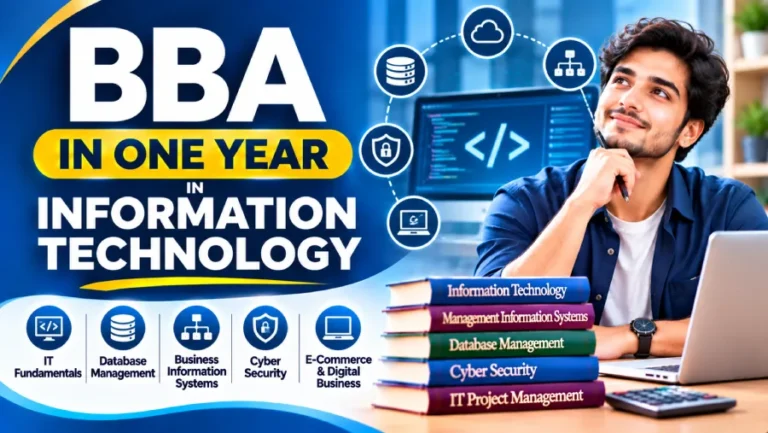
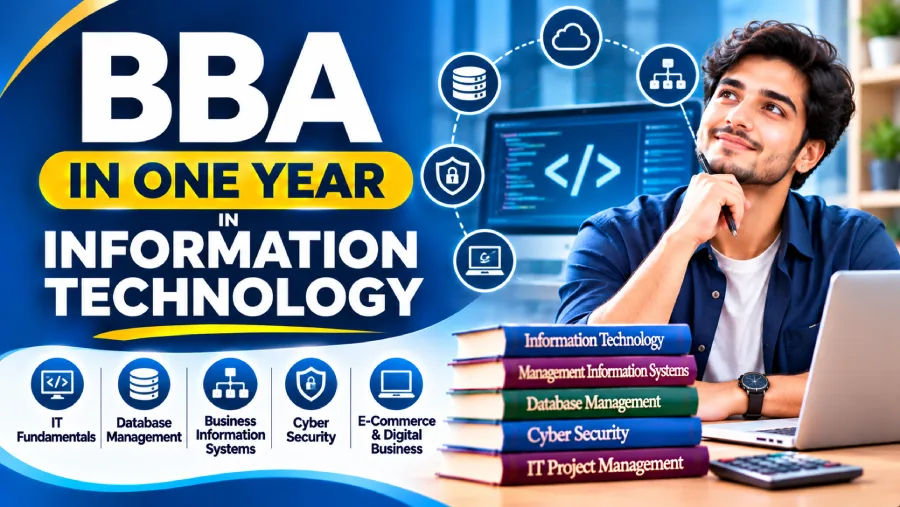
Information Technology (IT) has become an essential part of modern business. Organisations across industries use technology to manage information, improve communication, automate processes and deliver better services. From business software and databases to cybersecurity and digital systems, IT supports almost every area of business operations.
For students interested in technology, computers, business management and problem-solving, a Bachelor of Business Administration (BBA) in Information Technology can be an interesting academic choice. The programme combines business administration fundamentals with knowledge of information systems, IT management, database management and technology-driven business operations.
Many students search for a BBA in one year in Information Technology because they want to complete their education within a shorter timeframe while balancing professional or personal responsibilities. However, it is important to understand the approved university programme structure and applicable regulations before enrolling in an accelerated or degree-completion pathway.
This guide covers the course overview, eligibility, subjects, benefits, career opportunities and important admission considerations.
What Is a BBA in Information Technology?
A Bachelor of Business Administration in Information Technology is an undergraduate business programme that focuses on how organisations use technology to manage business activities and achieve their objectives.
It introduces students to the relationship between business management and information systems. Students learn how technology supports communication, data management, business operations, planning and decision-making.
The programme may cover areas such as:
- Information technology fundamentals
- Management information systems
- Database management
- Computer applications
- IT project management
- Business information systems
- E-commerce
- Cybersecurity fundamentals
- Data management
- IT strategy and governance
A BBA in Information Technology can provide a foundation for students interested in IT administration, business technology, information systems and technology-related management roles.
BBA in Information Technology – Course Overview
| Course detail | Information |
|---|---|
| Degree | Bachelor of Business Administration (BBA) |
| Specialisation | Information Technology |
| Level | Undergraduate |
| Duration | Generally 3 or 4 years, depending on the university and applicable framework |
| Mode | Regular, online or distance mode, where officially approved |
| Main subjects | Information systems, database management, IT management and business applications |
| Eligibility | Generally Class 12 or equivalent |
| Career areas | IT operations, business systems, technology support and project coordination |
The exact programme structure, syllabus, duration and admission requirements may vary between universities.
Can You Complete a BBA in Information Technology in One Year?
Students searching for a BBA in one year in Information Technology should understand the difference between a standard undergraduate programme and an officially approved accelerated or degree-completion pathway.
A regular BBA generally follows a three-year or four-year academic structure, depending on the university and applicable educational framework. A one-year completion option should not be assumed to be available to every student.
In India, the UGC’s 2025 undergraduate and postgraduate degree regulations provide for accelerated degree programmes under specific conditions. However, the accelerated pathway does not mean that a complete three-year BBA can automatically be completed in one year. The prescribed framework limits the reduction in duration, while students must still complete the required academic credits.
Before applying, students should:
- Verify the university’s legal recognition and authority to award the qualification.
- Check whether the specific BBA programme and selected mode of study are officially permitted.
- Confirm whether the proposed accelerated route is approved under applicable regulations.
- Ask how previous academic qualifications and credits will be evaluated.
- Obtain written confirmation of the programme duration and degree requirements.
- Review the university’s examination and assessment procedures.
For online and distance education in India, students should also verify the university’s recognition for the relevant academic session and the approval of the specific programme.
Avoid institutions promising guaranteed one-year degrees without clear academic and regulatory documentation.
Eligibility for BBA in Information Technology
The general eligibility requirements for a BBA in Information Technology may include the following:
1. Educational Qualification
Students generally need to have completed Class 12 or an equivalent qualification from a recognised board.
2. Academic Stream
Students from Commerce, Arts or Science backgrounds may be eligible, depending on the university’s admission policy.
3. Minimum Marks
Some universities may specify a minimum percentage in the qualifying examination.
4. Basic Computer Knowledge
An understanding of computers, internet applications and common software can be helpful. However, prior technical experience is not necessarily compulsory for every programme.
5. Mathematics Requirements
Some universities may have specific mathematics requirements, while others accept students from different academic streams. Check the admission criteria before applying.
6. Entrance Requirements
Certain institutions may conduct entrance examinations, interviews or additional admission assessments.
Always check the latest admission guidelines published by the selected university.
Subjects Covered in BBA Information Technology
A BBA in Information Technology combines core business administration subjects with technology-related topics. The exact curriculum varies by institution, but students may study the following subjects.
1. Introduction to Information Technology
This subject introduces the fundamentals of information technology and its role in business. Students learn about computer systems, software, hardware, networks and common IT applications.
2. Management Information Systems
Students explore how organisations use information systems to collect, process and manage business information. The subject explains how technology supports planning, reporting and management decisions.
3. Database Management Systems
This subject introduces database concepts, data organisation, storage and retrieval. Students learn how businesses manage information and maintain structured databases.
4. Computer Applications for Business
Students learn about computer applications used in business environments. Topics may include spreadsheets, presentations, document processing and digital collaboration tools.
5. IT Project Management
This subject focuses on planning, organising and monitoring technology-related projects. Students explore project objectives, resource allocation, scheduling, communication and risk management.
6. Business Information Systems
Students study how information systems support different business functions, including finance, marketing, human resources and operations.
7. E-Commerce and Digital Business
This subject introduces online business models, digital transactions, e-commerce platforms and technology-enabled customer experiences.
8. Computer Networks and Communication
Students gain an introduction to computer networks, internet connectivity, communication systems and the technologies that allow devices to exchange information.
9. Cybersecurity Fundamentals
This subject introduces information security, data protection, access control, common cyber threats and basic security practices used by organisations.
10. IT Strategy and Governance
Students explore how businesses plan and manage technology resources. Topics may include IT policies, technology investments, digital transformation and alignment between IT and business objectives.
Benefits of Studying BBA in Information Technology
A BBA in Information Technology can provide several academic and professional benefits.
1. Combining Business and Technology
Students develop an understanding of business management alongside information technology concepts. This combination can be useful in organisations where business and technology teams work together.
2. Understanding Business Information Systems
The programme introduces the systems businesses use to manage data, communicate information and support daily operations.
3. Developing Problem-Solving Skills
Students learn how technology can address business challenges, improve processes and support organisational decisions.
4. Exposure to Digital Business
Students gain an introduction to e-commerce, digital platforms and technology-enabled business operations.
5. Understanding IT Management
The programme helps students understand technology planning, project coordination, information systems and IT resource management.
6. Multiple Career Pathways
IT knowledge is relevant to industries such as banking, education, retail, healthcare, manufacturing, e-commerce and professional services.
7. Foundation for Higher Education
Graduates can explore postgraduate programmes in information technology management, business administration, information systems and related disciplines, subject to admission requirements.
Career Opportunities After BBA in Information Technology
A BBA in Information Technology can provide a foundation for entry-level opportunities across business technology and IT support functions. Career options depend on practical skills, experience, technical knowledge and employer requirements.
1. IT Executive
IT executives support routine technology-related activities, coordinate with technical teams and help manage IT resources within an organisation.
2. IT Support Executive
IT support executives assist users with common hardware, software and connectivity issues. Some positions may require additional technical training.
3. Business Analyst Trainee
Business analyst trainees help gather business requirements, prepare reports and understand how technology systems support organisational processes.
4. MIS Executive
Management Information Systems executives help prepare reports, organise business information and maintain data used by different departments.
5. Database Assistant
Database assistants support data entry, database maintenance, record organisation and basic information management activities.
6. IT Project Coordinator
IT project coordinators assist with project schedules, documentation, team communication and progress tracking.
7. E-Commerce Executive
E-commerce executives support online business operations, product information management, order coordination and digital platform activities.
8. Information Systems Assistant
These professionals help maintain business information systems, support users and coordinate routine system-related activities.
Important: Specialist positions in software development, cybersecurity, network engineering, database administration and advanced data analysis may require additional technical qualifications and practical experience. A BBA in Information Technology alone does not guarantee eligibility for every technical role.
Industries Where IT Graduates Can Explore Opportunities
Information technology is relevant to almost every industry. Some examples include:
- Information technology: IT administration, technical coordination and business systems support.
- Banking and financial services: Information systems, technology operations and digital banking support.
- E-commerce: Online platform operations, product information and digital business support.
- Education: Learning management systems, technology coordination and digital administration.
- Healthcare: Information management systems and administrative technology support.
- Retail: Business software, inventory systems and technology-enabled operations.
- Manufacturing: Enterprise systems, operational reporting and technology coordination.
- Telecommunications: Customer technology support and information systems administration.
- Consulting: Business systems analysis, IT project coordination and technology-related research.
The responsibilities and entry requirements vary between organisations and positions.
Higher Education Options After BBA Information Technology
Students interested in developing advanced business and technology knowledge can consider several postgraduate pathways.
MBA in Information Technology
An MBA in Information Technology focuses on technology management, IT strategy, information systems, digital transformation and business technology operations.
MBA in Business Analytics
Students interested in data-driven business decisions may consider an MBA in Business Analytics, subject to admission requirements.
MBA in General Management
An MBA in General Management can provide broader knowledge of business strategy, leadership, finance, marketing and organisational management.
Master’s in Information Systems
A specialised postgraduate programme can provide deeper knowledge of information systems, technology management and digital business processes.
Postgraduate Diploma in Information Technology Management
Students may consider relevant postgraduate diploma programmes to develop specialised knowledge in IT administration, information systems and technology management.
Professional Certifications
Students can also explore additional training in areas such as:
- Microsoft Excel and advanced spreadsheets
- Database management and SQL
- Project management
- Cloud computing fundamentals
- Cybersecurity fundamentals
- Business intelligence tools
- IT service management
- Digital transformation
These additional skills can complement academic learning and support professional development.
Is BBA in Information Technology a Good Choice?
A BBA in Information Technology may be a suitable choice for students who enjoy computers, business management, problem-solving and digital systems.
| Student interest | How BBA in Information Technology may help |
|---|---|
| Computers and software | Introduces IT fundamentals and business applications |
| Business management | Explains how technology supports business operations |
| Data management | Introduces databases and information systems |
| Digital business | Explores e-commerce and online business models |
| Project coordination | Develops knowledge of IT project management |
| Cybersecurity | Introduces information security fundamentals |
| Technology management | Explains IT planning and organisational technology needs |
Students should consider their career goals and the additional technical skills required for their preferred roles before choosing the programme.
How to Choose the Right University for BBA Information Technology
Selecting the right university is an important part of your academic journey. Before taking admission, consider the following factors:
- Recognition and authorisation: Verify the institution’s legal status and authority to award the qualification.
- Programme approval: Check whether the specific BBA programme and selected mode of study are officially permitted.
- Course curriculum: Review the IT subjects, business modules and practical learning opportunities.
- Duration: Confirm the officially approved programme duration and any applicable accelerated or credit-transfer arrangements.
- Faculty: Explore the academic qualifications and professional experience of the teaching team.
- Learning resources: Check access to study materials, digital platforms, computer facilities and academic support.
- Practical exposure: Look for projects, case studies, internships and opportunities to work with business software or information systems.
- Examination process: Understand assessment methods, examination schedules and evaluation policies.
- Fee structure: Review tuition fees and additional charges before applying.
- Career support: Explore internships, placement assistance and career guidance where available.
Do not choose a university based only on promises of a shorter degree duration. Verify all important details directly with the institution.
Frequently Asked Questions (FAQs)
1. What is a BBA in Information Technology?
A BBA in Information Technology is an undergraduate business programme that combines management knowledge with information systems, database management, IT operations and digital business concepts.
2. Can I complete a BBA in Information Technology in one year?
A standard BBA generally follows a three-year or four-year structure, depending on the university and applicable framework. Accelerated completion may be possible only within the limits of applicable regulations and university-approved arrangements. A complete three-year BBA should not be assumed to be available in one year.
3. What are the eligibility requirements for BBA Information Technology?
Students generally need to complete Class 12 or an equivalent qualification. Minimum marks, mathematics requirements and entrance examinations depend on the university.
4. Which subjects are taught in BBA Information Technology?
Common subjects include information technology fundamentals, management information systems, database management, computer applications, IT project management, e-commerce, cybersecurity and business information systems.
5. What jobs can I explore after BBA Information Technology?
Graduates may explore entry-level opportunities such as IT executive, IT support executive, MIS executive, business analyst trainee, database assistant and IT project coordinator.
6. Is mathematics compulsory for BBA Information Technology?
Mathematics requirements vary between universities. Some institutions accept students from different academic streams, while others may specify mathematics or related subjects as an admission requirement.
7. Do I need programming skills to study BBA Information Technology?
Programming is not necessarily required for admission to every BBA programme. However, learning basic programming, databases and other technical skills can be helpful for students interested in developing their IT knowledge.
8. Can I pursue an MBA after BBA Information Technology?
Yes. Students who meet the relevant admission requirements can generally apply for an MBA in Information Technology, Business Analytics, General Management or another specialisation.
9. Can I study BBA Information Technology through distance or online education?
Some universities offer BBA programmes through online or distance-learning modes. Students should verify whether the specific programme and mode are officially permitted for the relevant academic session.
10. What skills are useful for a career after BBA Information Technology?
Useful skills include computer literacy, communication, problem-solving, data management, analytical thinking, project coordination and familiarity with business software and information systems.
Conclusion
A BBA in Information Technology can be a valuable academic foundation for students interested in business management, computers, information systems and digital operations. It introduces students to how organisations use technology to manage information, improve processes and support business decisions.
If you are exploring a BBA in one year in Information Technology, make sure you understand the approved programme structure, eligibility conditions and applicable recognition requirements before enrolling. A properly authorised qualification, combined with practical experience and relevant technical skills, can help you prepare for opportunities across business and technology-related functions.
At MCM Global Education, students can explore available academic pathways, understand admission requirements and receive guidance in planning their educational journey.