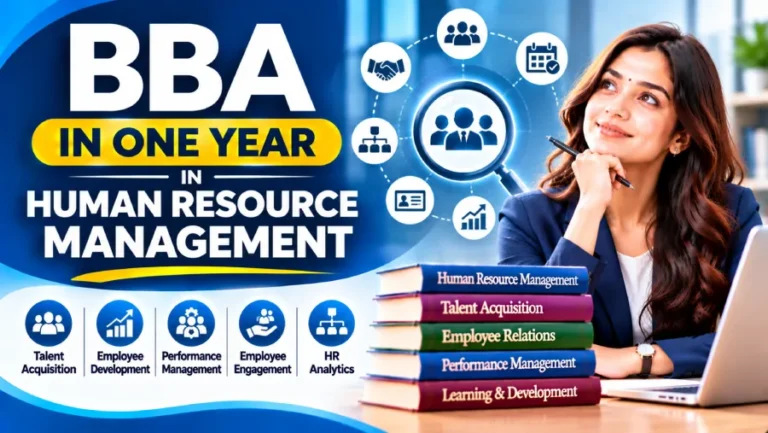
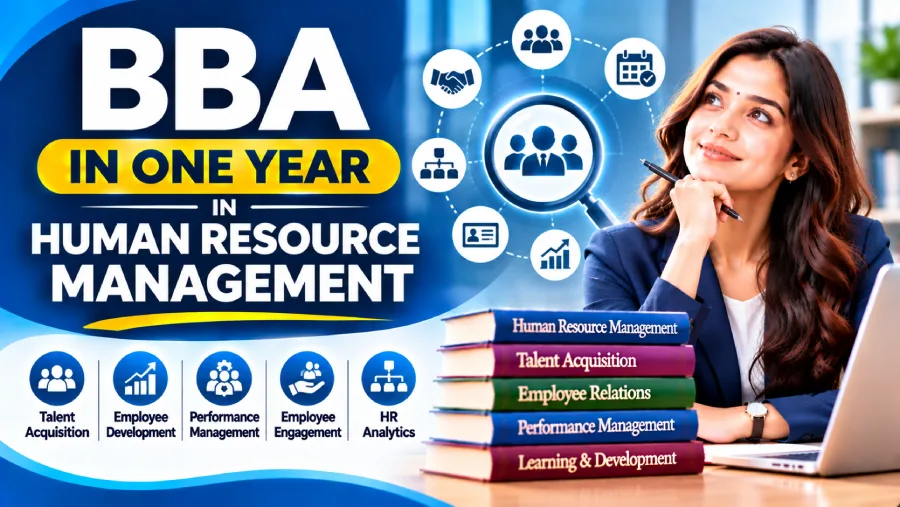
Human Resource Management (HRM) is an important business function focused on managing people, developing workplace policies and supporting organisational growth. From recruiting employees and conducting training to managing performance and maintaining employee relationships, HR professionals help businesses build productive and effective teams.
For students interested in communication, leadership, administration and people management, a Bachelor of Business Administration (BBA) in Human Resource Management can be a valuable academic choice. The programme introduces students to recruitment, employee development, organisational behaviour, performance management and workplace policies.
Many students search for a BBA in one year in Human Resource Management because they want to complete their education within a shorter timeframe while balancing professional or personal responsibilities. However, it is important to understand the university’s approved programme structure and applicable regulations before enrolling in an accelerated or degree-completion pathway.
This guide covers the course overview, eligibility, subjects, benefits, career opportunities and important admission considerations.
What Is a BBA in Human Resource Management?
A Bachelor of Business Administration in Human Resource Management is an undergraduate business programme that focuses on managing employees and developing effective workplace practices.
It helps students understand how organisations recruit, train, motivate, evaluate and retain employees. The programme combines general business administration knowledge with specialised HR subjects.
Students may explore areas such as:
- Human resource management fundamentals
- Recruitment and selection
- Organisational behaviour
- Employee training and development
- Performance management
- Compensation and benefits
- Employee relations
- Labour laws and workplace policies
- HR planning
- HR analytics
A BBA in HRM can provide a foundation for students interested in recruitment, employee relations, training, HR administration and business management.
BBA in Human Resource Management – Course Overview
| Course detail | Information |
|---|---|
| Degree | Bachelor of Business Administration (BBA) |
| Specialisation | Human Resource Management |
| Level | Undergraduate |
| Duration | Generally 3 or 4 years, depending on the university and applicable framework |
| Mode | Regular, online or distance mode, where officially approved |
| Main subjects | Recruitment, employee relations, training and performance management |
| Eligibility | Generally Class 12 or equivalent |
| Career areas | Recruitment, HR operations, employee relations and training |
The exact programme structure, syllabus, duration and admission requirements may vary between universities.
Can You Complete a BBA in Human Resource Management in One Year?
Students searching for a BBA in one year in Human Resource Management should understand the difference between a standard undergraduate programme and an officially approved accelerated or degree-completion pathway.
A regular BBA generally follows a three-year or four-year academic structure, depending on the university and applicable educational framework. A one-year completion option should not be assumed to be available to every student.
Any accelerated or credit-transfer pathway must be officially permitted under applicable regulations and based on the student’s previous academic qualifications and eligible academic credits.
Before applying, students should:
- Verify the university’s legal recognition and authority to award the degree.
- Check whether the specific BBA programme and selected mode of study are officially permitted.
- Confirm whether the proposed one-year route is approved under applicable regulations.
- Ask how previous academic qualifications and credits will be evaluated.
- Obtain written confirmation of the programme duration and degree requirements.
- Review the university’s examination and assessment procedures.
For students in India, checking applicable UGC regulations and the relevant recognition or entitlement of the institution is particularly important.
Avoid institutions promising guaranteed one-year degrees without providing clear academic and regulatory documentation.
Eligibility for BBA in Human Resource Management
The general eligibility requirements for a BBA in Human Resource Management may include the following:
1. Educational Qualification
Students generally need to have completed Class 12 or an equivalent qualification from a recognised board.
2. Academic Stream
Students from Commerce, Arts or Science backgrounds may be eligible, depending on the university’s admission policy.
3. Minimum Marks
Some universities may specify a minimum percentage in the qualifying examination.
4. Communication Skills
Good communication and interpersonal skills can be helpful when studying HR-related subjects. However, specific language or communication requirements depend on the institution.
5. Entrance Requirements
Certain institutions may conduct entrance examinations, interviews or additional admission assessments.
6. Additional Requirements
For an accelerated or credit-transfer pathway, students may need to provide previous academic records and supporting documents for eligibility evaluation.
Always check the latest admission guidelines published by the selected university.
Subjects Covered in BBA Human Resource Management
A BBA in Human Resource Management combines core business administration subjects with specialised people-management topics. The exact curriculum varies by institution, but students may study the following subjects.
1. Principles of Human Resource Management
This subject introduces the role of HR within an organisation. Students learn about workforce planning, employee management, HR responsibilities and the relationship between people and business performance.
2. Recruitment and Selection
Students explore how organisations identify staffing requirements, advertise vacancies, screen applications, conduct interviews and select suitable candidates.
3. Organisational Behaviour
This subject examines how individuals and groups behave within workplaces. Topics may include motivation, leadership, teamwork, communication and organisational culture.
4. Training and Development
Students learn how organisations identify employee training needs and develop programmes to improve professional knowledge, workplace skills and performance.
5. Performance Management
This subject focuses on evaluating employee performance and setting professional development goals. Students may explore performance appraisals, feedback systems and performance improvement plans.
6. Compensation and Benefits Management
Students study how organisations develop salary structures, incentives, employee benefits and compensation policies to attract and retain employees.
7. Employee Relations
This subject introduces workplace relationships, employee engagement, grievance handling, conflict resolution and communication between employees and management.
8. Labour Laws and Industrial Relations
Students gain an introduction to employment-related laws, workplace regulations and industrial relations. The specific legal topics depend on the programme and jurisdiction.
9. Human Resource Planning
HR planning focuses on identifying an organisation’s current and future workforce requirements. Students explore staffing forecasts, workforce allocation and succession planning.
10. HR Analytics
Students learn how organisations use employee-related information to understand workforce trends, recruitment performance, employee retention and HR effectiveness.
Benefits of Studying BBA in Human Resource Management
A BBA in Human Resource Management can provide several academic and professional benefits.
1. Understanding People Management
Students learn how organisations recruit, support, develop and retain employees.
2. Developing Communication Skills
HR professionals regularly interact with employees, candidates and managers. The programme can help students develop professional communication and interpersonal skills.
3. Learning Recruitment Practices
Students gain an understanding of recruitment planning, candidate screening, interviews and employee onboarding.
4. Understanding Workplace Behaviour
The programme introduces organisational behaviour, employee motivation, teamwork and workplace culture.
5. Exposure to Business Management
Students learn how HR activities support organisational objectives and contribute to overall business performance.
6. Multiple Career Pathways
HR knowledge is relevant across industries such as IT, banking, education, healthcare, manufacturing, retail and professional services.
7. Foundation for Higher Education
Graduates can explore postgraduate programmes in human resource management, business administration, organisational development and related disciplines, subject to admission requirements.
Career Opportunities After BBA in Human Resource Management
A BBA in HRM can provide a foundation for entry-level opportunities across different HR functions. Career options depend on practical skills, experience and employer requirements.
1. HR Executive
HR executives support daily human resource activities, maintain employee records, coordinate documentation and assist with workplace policies.
2. Recruitment Executive
Recruitment executives help organisations identify suitable candidates, publish job openings, screen applications, coordinate interviews and support hiring activities.
3. Talent Acquisition Assistant
Talent acquisition professionals support the recruitment process by sourcing candidates, managing applicant information and coordinating with hiring teams.
4. HR Operations Executive
HR operations executives assist with employee onboarding, attendance records, HR documentation and routine administrative processes.
5. Training and Development Coordinator
These professionals help organise employee training sessions, maintain training records and coordinate learning and development activities.
6. Payroll Assistant
Payroll assistants support salary processing, employee attendance records, payroll documentation and benefits administration. Specific payroll roles may require additional knowledge of accounting and applicable employment regulations.
7. Employee Relations Assistant
These professionals support workplace communication, employee engagement activities and the administration of employee concerns.
8. HR Generalist Assistant
HR generalist assistants may support several HR functions, including recruitment, onboarding, employee records, training coordination and HR administration.
Important: Senior HR management, labour-law advisory and specialist HR roles may require postgraduate qualifications, relevant experience or professional training. A BBA provides a foundation but does not guarantee eligibility for every position.
Industries Where HR Graduates Can Explore Opportunities
Human resource management is relevant to almost every industry that employs people. Some examples include:
- Information technology: Recruitment, onboarding and employee development.
- Banking and financial services: HR operations, staffing and employee engagement.
- Education: Recruitment, academic staff administration and training coordination.
- Healthcare: Workforce planning, employee records and HR administration.
- Manufacturing: Employee relations, workforce coordination and training.
- Retail: Recruitment, staff scheduling and employee development.
- Hospitality: Recruitment, onboarding and workplace training.
- Consulting: HR support, talent management and organisational development.
- E-commerce: Recruitment, workforce operations and performance support.
The responsibilities and entry requirements vary between organisations and positions.
Higher Education Options After BBA Human Resource Management
Students interested in developing advanced HR and management knowledge can consider several postgraduate pathways.
MBA in Human Resource Management
An MBA in HRM offers advanced study of strategic human resource management, talent management, employee relations, compensation and organisational development.
MBA in General Management
Students interested in broader business leadership and management responsibilities may consider an MBA in General Management.
Master’s in Human Resource Management
A specialised postgraduate degree can provide deeper knowledge of workforce planning, organisational behaviour, HR strategy and employee development, subject to admission requirements.
Postgraduate Diploma in Human Resource Management
Students may consider a relevant postgraduate diploma to develop specialised knowledge in recruitment, employee relations, HR operations and talent management.
Professional HR Certifications
Students may also explore additional training in areas such as:
- Recruitment and talent acquisition
- HR analytics
- Payroll administration
- Learning and development
- Employee engagement
- HR information systems (HRIS)
- Employment and workplace regulations
These additional skills can complement academic learning and support professional development.
Is BBA in Human Resource Management a Good Choice?
A BBA in Human Resource Management may be a suitable choice for students who enjoy communication, teamwork, leadership, administration and people management.
| Student interest | How BBA in HRM may help |
|---|---|
| Recruitment | Introduces hiring and candidate selection |
| Communication | Develops professional interpersonal skills |
| Leadership | Explains employee motivation and team management |
| Training | Introduces employee learning and development |
| Administration | Builds knowledge of HR operations and documentation |
| Workplace relationships | Explains employee engagement and conflict management |
| Business management | Shows how HR supports organisational goals |
Students should consider their career goals and the additional qualifications or practical skills required for their preferred roles before choosing the programme.
How to Choose the Right University for BBA Human Resource Management
Selecting the right university is an important step in your academic journey. Before taking admission, consider the following factors:
- Recognition and authorisation: Verify the institution’s legal status and authority to award the qualification.
- Programme approval: Check whether the specific BBA programme and selected mode of study are officially permitted.
- Course curriculum: Review the HR subjects, business modules and practical learning opportunities.
- Duration: Confirm the officially approved programme duration and any applicable credit-transfer arrangements.
- Faculty: Explore the academic qualifications and professional experience of the teaching team.
- Learning resources: Check access to study materials, digital platforms and academic support.
- Practical exposure: Look for case studies, projects, internships and opportunities to understand real-world HR processes.
- Examination process: Understand assessment methods, examination schedules and evaluation policies.
- Fee structure: Review tuition fees and additional charges before applying.
- Career support: Explore internships, placement assistance and career guidance where available.
Do not choose a university based only on promises of a shorter degree duration. Verify all important details directly with the institution.
Frequently Asked Questions (FAQs)
1. What is a BBA in Human Resource Management?
A BBA in Human Resource Management is an undergraduate business programme focused on recruitment, employee relations, training, performance management and workforce administration.
2. Can I complete a BBA in Human Resource Management in one year?
A standard BBA generally follows a three-year or four-year structure, depending on the university and applicable framework. A one-year completion route should only be considered if officially permitted and the student meets the relevant eligibility and credit requirements.
3. What are the eligibility requirements for BBA HRM?
Students generally need to complete Class 12 or an equivalent qualification. Minimum marks, entrance examinations and additional requirements depend on the university.
4. Which subjects are taught in BBA Human Resource Management?
Common subjects include human resource management, recruitment and selection, organisational behaviour, training and development, performance management, employee relations and HR analytics.
5. What jobs can I explore after BBA HRM?
Graduates may explore entry-level opportunities such as HR executive, recruitment executive, talent acquisition assistant, HR operations executive, training coordinator and payroll assistant.
6. Is mathematics compulsory for BBA HRM?
Mathematics requirements vary between universities. Many programmes focus on management, communication and organisational subjects, although some business modules may involve basic numerical concepts.
7. Can I pursue an MBA after BBA Human Resource Management?
Yes. Students who meet the relevant admission requirements can generally apply for an MBA in Human Resource Management, General Management or another specialisation.
8. Is BBA HRM useful for a recruitment career?
Yes. The programme introduces recruitment, candidate selection, onboarding and workforce planning, which are relevant to entry-level recruitment roles.
9. Can I study BBA Human Resource Management through distance or online education?
Some universities offer BBA programmes through online or distance-learning modes. Students should verify whether the specific programme and mode are officially permitted for the relevant academic session.
10. What skills are useful for an HR career?
Useful skills include communication, organisation, problem-solving, teamwork, interpersonal skills, confidentiality, recruitment coordination and familiarity with HR software.
Conclusion
A BBA in Human Resource Management can be a valuable academic foundation for students interested in recruitment, employee development, workplace communication and business administration. It introduces the principles and practices organisations use to manage their workforce and create productive working environments.
If you are exploring a BBA in one year in Human Resource Management, make sure you understand the approved programme structure, eligibility conditions and applicable recognition requirements before enrolling. A properly authorised qualification, combined with practical experience and relevant professional skills, can help you prepare for opportunities across different HR functions.
At MCM Global Education, students can explore available academic pathways, understand admission requirements and receive guidance in planning their educational journey.