Data Science has become one of the most important fields in the modern digital economy. Businesses, financial institutions, healthcare organisations, technology companies and government agencies increasingly use data to understand trends, make decisions, improve efficiency and predict future outcomes.
A Bachelor of Science (BSc) in Data Science is an undergraduate programme that combines mathematics, statistics, programming, data analysis, computing and analytical problem-solving. It helps students develop the knowledge and technical skills required to work with data and transform information into meaningful insights.
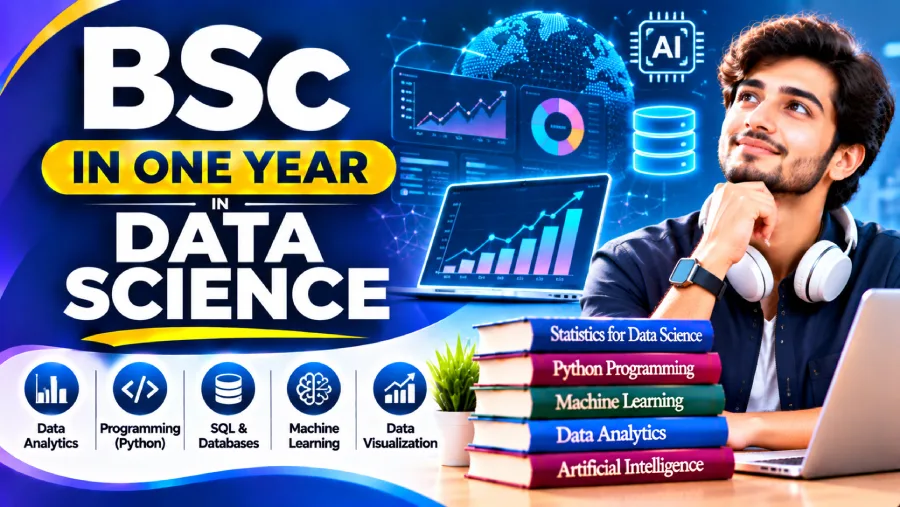
Many students and working professionals search for BSc in one year in Data Science because they want to complete graduation in less time, improve their qualifications or enter the growing technology sector. However, students should understand the difference between a recognised undergraduate degree, an accelerated degree pathway and a short-term professional course.
A standard BSc programme is generally three or four years, depending on the university and programme structure. While approved accelerated pathways may allow eligible students to complete certain undergraduate programmes in fewer semesters, they do not generally allow a full bachelor’s degree to be completed in just one year.
This guide covers BSc Data Science course details, eligibility, subjects, skills, career opportunities, higher education options and how to choose the right university.
What Is BSc in Data Science?
BSc in Data Science is an undergraduate programme focused on collecting, processing, analysing, interpreting and presenting data using mathematical, statistical and computational techniques.
Data Science combines several disciplines, including:
- Mathematics
- Statistics
- Programming
- Computer Science
- Data Analytics
- Artificial Intelligence
- Machine Learning
- Data Visualisation
Students learn how to work with datasets, identify patterns, develop analytical models, create visual reports and use data to support business and technical decisions.
The programme may include practical assignments involving programming languages, databases, statistical software, dashboards and analytical projects.
BSc Data Science can be suitable for students interested in technology, numbers, research, business intelligence and solving real-world problems through data.
BSc in Data Science: Course Overview
| Course Detail | Information |
|---|---|
| Course Name | Bachelor of Science in Data Science |
| Degree Level | Undergraduate |
| Stream | Science / Computing / Technology |
| Standard Duration | Generally 3 or 4 years |
| Main Areas | Statistics, programming, data analysis, machine learning and computing |
| Eligibility | Class 12 or equivalent; requirements vary by university |
| Preferred Subjects | Mathematics is commonly required or recommended |
| Mode of Study | Depends on programme and university approval |
| Practical Learning | Programming assignments, datasets, projects and analytical labs |
| Assessment | Examinations, assignments, projects and practical work |
| Higher Education | MSc Data Science, Statistics, Analytics, AI and related programmes |
| Career Areas | Data analytics, business intelligence, technology, research and data operations |
Can You Complete BSc in Data Science in One Year?
Students searching for BSc in one year in Data Science should carefully verify what the institution is actually offering.
A standard undergraduate bachelor’s degree generally requires three or four years, depending on the university’s programme structure. The University Grants Commission’s 2025 undergraduate degree regulations provide for standard undergraduate durations and an Accelerated Degree Programme framework.
Under the accelerated framework, eligible students enrolled in institutions implementing the programme may complete the required credits in a reduced number of semesters. A three-year undergraduate programme may be shortened by a maximum of one semester, while a four-year programme may be shortened by one or two semesters, subject to applicable requirements.
This does not mean a full BSc in Data Science can automatically be completed in one year.
Alternative Pathways for Students
Students who want to enter the Data Science field more quickly may consider alternatives such as:
- Data Science Certificate Courses: Short-term programmes focused on programming, data analysis, statistics or tools.
- Professional Diploma Programmes: Structured programmes covering data analytics, Python, SQL, visualisation and other technical skills.
- Credit Transfer: Students with previous academic credits may request an evaluation, subject to university rules.
- Approved Accelerated Degree Programmes: Available only where the university officially implements the applicable framework and the student meets the requirements.
- Skill-Based Learning: Learning Python, SQL, Excel, Power BI, statistics and analytical techniques alongside a recognised academic qualification.
Students should distinguish a short-term course or certificate from a bachelor’s degree. Before admission, verify the university’s recognition, degree structure, credit requirements, mode of delivery and completion duration.
Eligibility Criteria for BSc in Data Science
Eligibility for BSc Data Science depends on the university. The following are common requirements.
1. Educational Qualification
Applicants should have completed Class 12 or an equivalent qualification from a recognised board.
2. Mathematics Background
Mathematics is important in Data Science because the programme involves statistics, probability, algebra, calculations, algorithms and analytical methods.
Many universities require Mathematics at the Class 12 level. Some programmes may accept other subject combinations according to their eligibility rules.
3. Minimum Marks
Universities may specify minimum aggregate marks in Class 12. The requirement varies by institution, category and admission policy.
4. Science or Other Stream Eligibility
Some universities require a science background, while others may accept students from different streams if they meet the Mathematics or other specified subject requirements.
5. Entrance Examination
Admission may be based on merit, entrance examinations or the university’s own admission process.
6. Computer Knowledge
Basic computer knowledge can be helpful, although some programmes begin programming from the fundamentals.
Subjects Covered in BSc Data Science
BSc Data Science combines mathematics, computing and analytical subjects. The curriculum may vary between universities, but the following subjects are commonly relevant to the field.
1. Fundamentals of Data Science
This subject introduces students to the Data Science process, including data collection, cleaning, exploration, analysis, interpretation and presentation.
Students learn how data is used to solve problems and support decision-making across different industries.
2. Mathematics for Data Science
Mathematics provides the foundation for many Data Science techniques.
Topics may include linear algebra, calculus, matrices, functions, vectors, optimisation and mathematical modelling.
These concepts help students understand analytical algorithms and machine learning models.
3. Probability and Statistics
Probability and Statistics are essential for understanding data, uncertainty, trends and relationships.
Students learn about probability distributions, descriptive statistics, inferential statistics, hypothesis testing, sampling, correlation and regression.
4. Programming with Python
Python is one of the widely used programming languages in Data Science.
Students learn variables, data types, loops, functions, data structures, file handling and libraries used for data processing and analysis.
Python skills can help students automate tasks, manipulate datasets and develop analytical applications.
5. Database Management Systems
Database Management Systems introduce students to storing, organising, retrieving and managing data.
Topics may include database design, relational databases, SQL queries, tables, joins, indexing and database operations.
6. Data Structures and Algorithms
This subject focuses on the organisation and processing of data through programming.
Students learn about arrays, lists, stacks, queues, trees, searching, sorting and algorithmic problem-solving.
7. Data Analysis and Data Wrangling
Data Analysis involves exploring datasets, identifying patterns and extracting useful insights.
Data Wrangling focuses on preparing raw data for analysis through cleaning, transformation, handling missing values, removing inconsistencies and formatting information.
8. Data Visualisation
Data Visualisation teaches students how to represent data using charts, graphs, dashboards and other visual formats.
Students may learn to create visual reports using tools such as Power BI, Tableau, Python libraries or other software used by their institution.
9. Machine Learning
Machine Learning introduces algorithms that can learn patterns from data and make predictions or classifications.
Students may study regression, classification, clustering, model evaluation, training datasets, testing datasets and basic predictive modelling.
10. Artificial Intelligence and Big Data
Artificial Intelligence and Big Data introduce students to advanced data technologies and analytical applications.
Topics may include AI fundamentals, large datasets, data pipelines, cloud computing concepts, distributed processing and introductory AI applications.
Practical Learning and Projects in Data Science
Practical learning is an important part of Data Science because students need to apply concepts to real datasets and analytical problems.
Students may work on practical activities such as:
- Analysing datasets using Python.
- Creating SQL queries to retrieve information.
- Cleaning and preparing datasets.
- Exploring trends using statistical techniques.
- Building charts and interactive dashboards.
- Creating simple predictive models.
- Comparing machine learning algorithms.
- Analysing customer or business datasets.
- Developing data-driven reports.
- Completing academic or capstone projects.
Example Data Science Projects
Students may develop projects such as:
- Student performance analysis.
- Sales forecasting.
- Customer segmentation.
- E-commerce data analysis.
- Financial trend analysis.
- Healthcare data visualisation.
- Social media engagement analysis.
- Product recommendation analysis.
- Predictive analytics for business.
- Weather or environmental data analysis.
These projects help students build a portfolio and demonstrate their analytical abilities to potential employers.
Benefits of Studying BSc in Data Science
BSc Data Science can provide several academic and professional benefits.
1. Understanding Data-Driven Decision Making
Students learn how data can be used to identify trends, evaluate performance and support decisions.
2. Programming Skills
The programme can develop programming knowledge through Python, SQL and other tools used in data processing and analysis.
3. Analytical Thinking
Students develop the ability to interpret information, identify patterns and solve problems using mathematical and computational techniques.
4. Technology Knowledge
The course introduces students to databases, analytical software, visualisation tools, computing and emerging technologies.
5. Practical Project Experience
Assignments and projects help students apply theoretical concepts to real datasets and practical problems.
6. Industry-Relevant Skills
Students can develop skills relevant to analytics, business intelligence, software, finance, marketing, operations and other data-oriented sectors.
7. Higher Education Opportunities
The degree can provide a foundation for further study in Data Science, Statistics, Computer Science, Artificial Intelligence, Business Analytics and related fields, subject to admission requirements.
Career Opportunities After BSc Data Science
After completing BSc Data Science, graduates may explore entry-level opportunities in data, technology, business analytics and related areas. Job eligibility depends on the employer, technical skills, project experience and additional qualifications.
1. Data Analyst
Data analysts collect, clean, organise and analyse data to identify trends and support business decisions.
They may use spreadsheets, SQL, Python, dashboards and statistical techniques.
2. Junior Data Scientist
Junior data scientists support analytical projects, work with datasets, prepare models, evaluate results and assist senior professionals.
Many Data Scientist positions require advanced skills, practical experience or postgraduate qualifications.
3. Business Intelligence Analyst
Business Intelligence Analysts work with business data, reporting systems, dashboards and performance indicators.
They help organisations understand sales, customer behaviour, operations and business performance.
4. Data Research Analyst
Data Research Analysts gather information from different sources, organise datasets and conduct research to identify patterns, trends and findings.
5. Junior Machine Learning Analyst
Students with additional machine learning skills may explore junior roles supporting model development, testing, data preparation and predictive analytics projects.
6. Data Quality Analyst
Data Quality Analysts help ensure datasets are accurate, consistent, complete and reliable.
They may identify errors, missing values, duplicate records and inconsistencies in organisational data.
7. Reporting Analyst
Reporting Analysts prepare reports, dashboards and analytical summaries to communicate performance and operational information.
8. Operations Analyst
Operations Analysts study business processes, operational data, productivity and performance to identify areas for improvement.
9. Marketing Data Analyst
Marketing Data Analysts study campaign results, customer behaviour, engagement, conversions and marketing performance using data.
10. Data Visualisation Specialist
Data Visualisation professionals create dashboards, reports and visual representations of data to make information easier to understand.
Entry-level candidates may start in junior reporting or analytics roles and progress with experience, stronger technical skills and project work.
Industries That Employ Data Science Graduates
Data Science skills are used across a wide range of industries because organisations increasingly depend on data for planning, operations and decision-making.
Some industries include:
- Information Technology: Software companies, technology services and data solutions.
- Banking and Finance: Risk analysis, financial reporting, fraud detection and customer analytics.
- Healthcare: Healthcare data analysis, operational reporting and research support.
- E-commerce: Customer behaviour, product recommendations, sales analysis and inventory insights.
- Marketing: Campaign analytics, customer segmentation and performance measurement.
- Telecommunications: Network performance, customer analytics and service optimisation.
- Manufacturing: Production analysis, quality monitoring and predictive maintenance.
- Education: Student performance analytics, academic reporting and institutional research.
- Consulting: Data-driven research, business insights and decision support.
- Logistics: Supply chain analysis, demand forecasting and operational efficiency.
Skills Developed During BSc Data Science
BSc Data Science helps students develop a combination of analytical, technical and professional skills.
| Skill | Application |
|---|---|
| Python Programming | Data processing, automation and analytical tasks |
| SQL | Retrieving and managing database information |
| Statistics | Understanding patterns, relationships and uncertainty |
| Data Cleaning | Preparing accurate and usable datasets |
| Data Visualisation | Communicating insights through charts and dashboards |
| Critical Thinking | Evaluating information and analytical results |
| Problem-Solving | Finding solutions using data and computation |
| Machine Learning Fundamentals | Building and evaluating introductory predictive models |
| Excel and Reporting | Analysing data and preparing reports |
| Communication | Presenting data insights to stakeholders |
Higher Education Options After BSc Data Science
Students interested in advanced knowledge or specialised careers can explore postgraduate programmes after completing their undergraduate degree.
1. MSc in Data Science
An MSc in Data Science provides advanced knowledge in statistics, programming, machine learning, data engineering and analytical modelling.
2. MSc in Statistics
Students interested in mathematical analysis, probability, research and statistical modelling may consider postgraduate study in Statistics.
3. MSc in Artificial Intelligence
Artificial Intelligence programmes focus on intelligent systems, machine learning, automation, algorithms and AI applications.
4. MSc in Computer Science
Students may pursue Computer Science to develop deeper knowledge of computing, software, algorithms, systems and programming.
5. Business Analytics
Business Analytics programmes combine data analysis with business decision-making, management, operations and strategy.
6. Data Engineering
Students interested in building data systems, pipelines and infrastructure may pursue specialised education or certifications in Data Engineering.
7. Machine Learning
Machine Learning specialisations focus on predictive models, algorithm development, optimisation and computational methods.
Is BSc in Data Science a Good Choice?
BSc Data Science can be a good choice for students who are interested in technology, mathematics, programming, analytics and solving problems using data.
It may be suitable for students who:
- Enjoy Mathematics and logical reasoning.
- Are interested in computers and programming.
- Want to learn how to analyse large datasets.
- Like identifying trends and solving problems.
- Are interested in Artificial Intelligence and Machine Learning.
- Want to explore careers in analytics and technology.
- Are willing to continuously learn new tools and technologies.
Students should also understand that Data Science is a skill-oriented field. Completing a degree alone may not be enough for competitive technical positions. Programming practice, analytical projects, internships, problem-solving and a strong portfolio can improve career readiness.
How to Choose the Right University for BSc Data Science
Choosing the right university is important for building a strong foundation in Data Science.
1. University Recognition
Verify the institution’s recognition and authority to award the degree. Confirm that the specific programme is officially offered.
2. Curriculum
Review the syllabus to ensure it includes mathematics, statistics, programming, databases, data analysis, visualisation and relevant computing subjects.
3. Programming Education
Check whether the curriculum provides structured programming education, practical assignments and opportunities to work with real datasets.
4. Software and Tools
Review the tools used in the programme, such as Python, SQL, Excel, Power BI, Tableau or other relevant technologies.
5. Practical Projects
Look for project-based learning, capstone projects, case studies and practical assessments.
6. Faculty
Explore the academic background and experience of faculty members in Data Science, Statistics, Computer Science and related fields.
7. Internship Opportunities
Check whether the university offers internships, industry projects, placement support or career guidance.
8. Mode of Study
If considering online or distance education, verify that the specific university, Data Science programme and academic session are officially permitted for that mode.
9. Fee Structure
Compare tuition fees, examination charges, technology costs, project expenses and other applicable fees.
10. Career Support
Explore placement assistance, career counselling, portfolio support, industry connections and professional development opportunities.
Frequently Asked Questions (FAQs)
1. Can I complete BSc Data Science in one year?
A standard BSc Data Science programme is generally three or four years, depending on the university. UGC’s accelerated degree provisions may allow eligible students to complete an undergraduate programme in fewer semesters, but they do not provide a general route to complete a full bachelor’s degree in one year.
2. What is the eligibility for BSc Data Science?
Students generally need to complete Class 12 or an equivalent qualification. Mathematics is commonly required or preferred, but subject requirements vary by university.
3. Is Mathematics compulsory for BSc Data Science?
Many universities require Mathematics because Data Science involves statistics, probability, linear algebra, algorithms and quantitative methods. Check the eligibility criteria of the university you plan to apply to.
4. Do I need coding knowledge before joining BSc Data Science?
Not necessarily. Some undergraduate programmes begin with introductory programming. However, learning basic Python before admission can help students understand the course more comfortably.
5. What programming languages are taught in BSc Data Science?
Python is widely used in Data Science education. Depending on the university, students may also learn SQL, R, Java or other programming and database technologies.
6. What are the subjects in BSc Data Science?
Subjects commonly include Statistics, Mathematics, Python Programming, Database Management, Data Structures, Data Analysis, Data Visualisation, Machine Learning and Artificial Intelligence fundamentals.
7. Is BSc Data Science suitable for commerce students?
Some universities accept commerce students who have studied Mathematics or meet the specified subject requirements. Eligibility depends on the institution’s admission rules.
8. What jobs can I get after BSc Data Science?
Graduates may explore entry-level roles such as Data Analyst, Reporting Analyst, Business Intelligence Analyst, Research Analyst, Data Quality Analyst and junior analytics positions.
9. Can I pursue MSc Data Science after BSc Data Science?
Yes, students may pursue MSc Data Science if they meet the postgraduate programme’s eligibility criteria. Some universities may require specific subjects, Mathematics, programming background or minimum marks.
10. Is Data Science a good career in the future?
Data-related skills are increasingly used across industries. Career opportunities may exist in analytics, AI, business intelligence, finance, technology and research. However, job prospects depend on skills, experience, education, practical projects and market demand.
Conclusion
BSc in Data Science is an undergraduate programme that combines mathematics, statistics, programming and analytical methods to help students understand and use data effectively. It provides a foundation for exploring opportunities in data analytics, business intelligence, technology, artificial intelligence and research-related fields.
Although many students search for BSc in one year in Data Science, it is important to distinguish a recognised bachelor’s degree from a short-term certificate, diploma or approved accelerated study pathway. Students should verify the university, programme duration, eligibility requirements, curriculum, credit structure and recognition before enrolling.
Building practical skills in Python, SQL, statistics, data visualisation and analytical projects alongside academic study can help students prepare for a competitive and evolving data-driven job market.