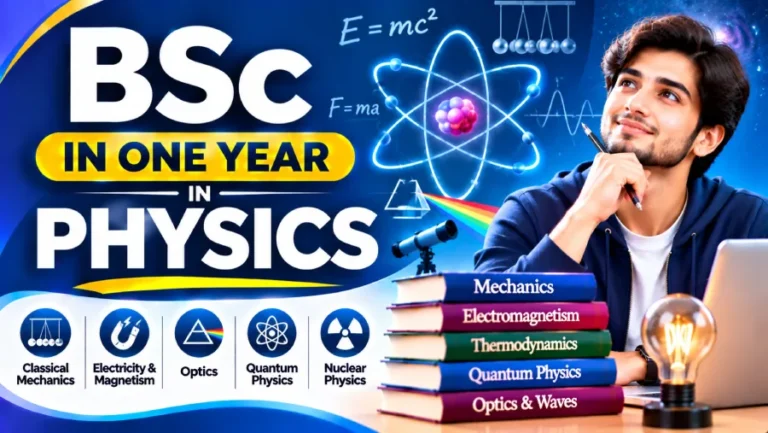
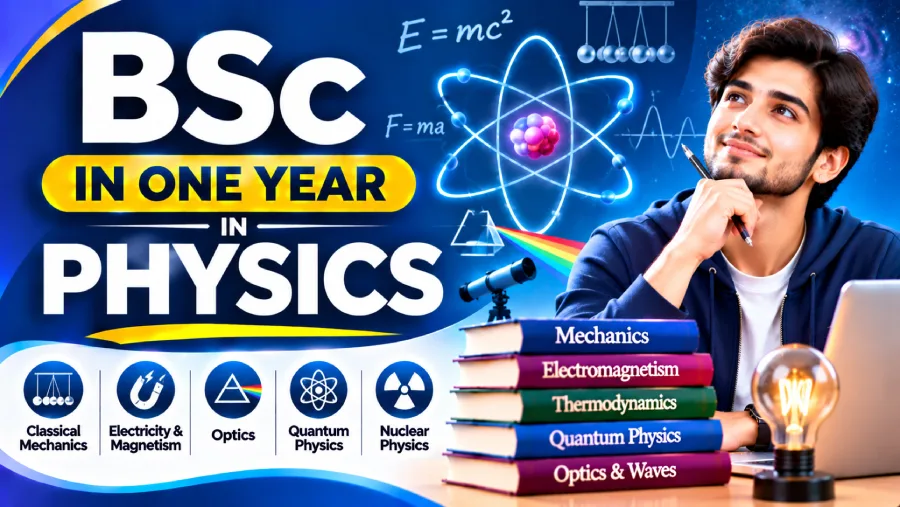
Physics is one of the most fundamental branches of science. It helps us understand how the universe works, from the motion of everyday objects to the behaviour of atoms, electricity, light, energy and space. A Bachelor of Science (BSc) in Physics is an undergraduate programme designed for students interested in scientific principles, mathematical problem-solving, experimentation and technology.
Many students and working professionals look for flexible ways to complete their higher education while managing employment, family responsibilities or other commitments. This has increased interest in programmes advertised under search terms such as BSc in one year in Physics.
However, it is important to understand the academic requirements before choosing a programme. A recognised undergraduate BSc degree is generally structured over three or four years, depending on the university and applicable curriculum. Some institutions may offer approved accelerated study options or credit-based pathways, but a complete BSc degree cannot automatically be completed in one year simply by enrolling in a short-duration course.
This guide explains the BSc Physics programme, its eligibility requirements, important subjects, practical components, career opportunities and the factors students should consider before applying.
What Is BSc in Physics?
BSc in Physics is an undergraduate science programme that focuses on the study of matter, energy, motion, forces and the fundamental laws governing the physical world.
The programme combines theoretical learning with mathematical applications and laboratory experiments. Students explore how scientific principles are applied in areas such as electronics, telecommunications, renewable energy, medical equipment, space research, computing and modern engineering.
A typical BSc Physics curriculum includes subjects such as:
- Classical Mechanics
- Electromagnetism
- Thermodynamics
- Optics
- Quantum Mechanics
- Mathematical Physics
- Electronics
- Nuclear Physics
- Solid State Physics
- Experimental Physics
The programme develops analytical thinking, quantitative reasoning, scientific observation and problem-solving skills. These abilities can be useful in scientific research, technical industries, education and further academic studies.
BSc in Physics: Course Overview
The following table provides a general overview of the programme. The exact structure, duration and subject combinations depend on the university.
| Course Detail | Information |
|---|---|
| Course Name | Bachelor of Science in Physics |
| Degree Level | Undergraduate |
| Stream | Science |
| Main Subject | Physics |
| Standard Duration | Generally 3 or 4 years |
| Mode of Study | Depends on university approval and programme availability |
| Eligibility | Generally 10+2 or equivalent with relevant science subjects |
| Core Areas | Mechanics, optics, electricity, thermodynamics and modern physics |
| Practical Components | Laboratory experiments and project work |
| Assessment | Examinations, assignments, practicals and projects |
| Higher Education | MSc Physics, specialised postgraduate programmes and other eligible courses |
| Career Areas | Research support, laboratories, education, technology and technical industries |
Can You Complete a BSc in Physics in One Year?
Students searching for a BSc in one year in Physics should first understand the difference between a recognised undergraduate degree, an accelerated degree pathway and a short-term certificate programme.
In India, the University Grants Commission (UGC) introduced the 2025 Minimum Standards of Instruction for the Grant of Undergraduate Degree and Postgraduate Degree Regulations. These regulations provide for Accelerated Degree Programmes (ADP), under which eligible students may complete the required academic credits in a shorter period.
For a three-year undergraduate programme, the accelerated pathway can reduce the duration by a maximum of one semester, allowing the required credits to be completed in five semesters rather than six. This is not the same as completing an entire BSc degree in one year. The programme must be implemented by the higher education institution in accordance with the applicable requirements.
Students should also understand that completing one year of an undergraduate programme may lead to an undergraduate certificate under the applicable multiple-entry and exit framework, subject to the prescribed credits and institutional rules. It does not automatically result in a bachelor’s degree.
Before taking admission, students should:
- Confirm that the university is legally authorised to award the degree.
- Check whether the BSc Physics programme is officially offered by the institution.
- Ask whether an accelerated or credit-transfer pathway is available.
- Obtain written confirmation of the total credits and academic requirements.
- Verify the validity of the programme for their intended employment or further education.
For official information, students can refer to the UGC website and its published regulations.
Eligibility Criteria for BSc in Physics
Eligibility requirements vary across universities. However, students generally need to meet the following academic conditions:
1. Educational Qualification
Applicants should have completed Class 12 or an equivalent qualification from a recognised educational board.
2. Science Background
Physics is generally a core eligibility subject. Many universities also require Mathematics at the senior secondary level. Some institutions may accept specific combinations of science subjects, depending on their admission policies.
3. Minimum Marks
Universities may specify minimum aggregate marks in Class 12. The required percentage can vary according to the institution, admission category and programme.
4. Subject Requirements
Students should carefully review whether the university requires Physics and Mathematics, or accepts another approved science subject combination.
5. Previous Academic Credits
Students who have previously studied at a university may be able to request an assessment of their academic credits. Credit transfer is not automatic and depends on the institution’s rules, course equivalence and applicable regulations.
Subjects Covered in BSc Physics
A BSc Physics programme covers several important areas of physical science. The following subjects are commonly included in undergraduate Physics curricula, although the exact syllabus and semester arrangement may differ.
1. Classical Mechanics
Classical Mechanics studies the motion of objects and the forces responsible for changing their movement. Students learn about Newton’s laws of motion, momentum, energy, rotational motion and gravitation.
This subject provides the foundation for understanding mechanical systems and physical interactions.
2. Mathematical Physics
Mathematical Physics introduces the mathematical methods used to solve scientific problems. Topics may include calculus, differential equations, vectors, matrices, complex numbers and mathematical modelling.
Students develop the ability to express physical relationships through equations and mathematical techniques.
3. Electricity and Magnetism
This subject explains the relationship between electric charges, electric fields, magnetic fields and electromagnetic forces.
Students study topics such as electric potential, capacitance, magnetic induction and electromagnetic waves. These principles are important in electrical systems, communication technologies and electronic devices.
4. Thermodynamics
Thermodynamics focuses on heat, temperature, energy and the transformation of energy from one form to another.
Important concepts include the laws of thermodynamics, entropy, heat engines, thermal equilibrium and energy transfer. These principles are widely applied in power generation, refrigeration and industrial processes.
5. Optics
Optics is the study of light and its behaviour. Students explore reflection, refraction, interference, diffraction, polarisation and optical instruments.
The subject provides a foundation for understanding cameras, microscopes, telescopes, lasers and fibre-optic communication systems.
6. Waves and Oscillations
This subject explains periodic motion and the propagation of waves through different mediums.
Students study simple harmonic motion, wave motion, resonance, sound waves and superposition. These concepts are useful in acoustics, communication systems and several engineering applications.
7. Quantum Mechanics
Quantum Mechanics explores the behaviour of matter and energy at atomic and subatomic scales.
Students are introduced to concepts such as wave-particle duality, quantum states, the uncertainty principle and Schrödinger’s equation. The subject forms an important foundation for modern physics and advanced scientific research.
8. Atomic and Nuclear Physics
Atomic and Nuclear Physics examines the structure of atoms, atomic spectra, radioactive decay and the properties of atomic nuclei.
Students learn about nuclear reactions, nuclear energy and the scientific principles behind radiation-based technologies.
9. Electronics
Electronics introduces the principles behind electronic components and circuits. Topics may include semiconductors, diodes, transistors, amplifiers, logic gates and digital electronics.
This subject connects theoretical physics with practical applications in computers, communication equipment and electronic devices.
10. Solid State Physics
Solid State Physics studies the physical properties of solid materials, particularly crystals and semiconductors.
Students learn about crystal structures, electrical conductivity, energy bands, magnetic properties and material behaviour. These concepts are relevant to semiconductor technology, electronics and materials science.
Practical Learning and Laboratory Work
Practical learning is an essential component of a BSc Physics programme. Laboratory experiments help students test theoretical concepts, observe physical phenomena and develop scientific measurement skills.
Common laboratory activities may include:
- Measuring physical quantities using scientific instruments.
- Studying the laws of motion through experiments.
- Measuring resistance, voltage and current in electrical circuits.
- Determining the focal length of optical instruments.
- Performing experiments involving interference and diffraction.
- Studying semiconductor characteristics.
- Analysing experimental observations and calculating errors.
- Preparing laboratory reports and interpreting results.
Students should check the practical and laboratory requirements of any programme they are considering. Physics involves experimental work, so a course that provides only theoretical lessons may not offer the same academic experience as a complete undergraduate Physics degree.
Benefits of Studying BSc in Physics
A BSc in Physics can offer several academic and professional benefits for students interested in science and technology.
1. Strong Scientific Foundation
The programme introduces fundamental scientific principles that help students understand natural phenomena and technological applications.
2. Analytical Thinking
Physics encourages students to break complex problems into smaller parts, evaluate information and develop logical solutions.
3. Mathematical Skills
Students strengthen their ability to work with equations, measurements, calculations and quantitative data.
4. Understanding of Technology
Many modern technologies are based on principles of physics. Studying the subject helps students understand the science behind electronics, communication systems, energy technologies and scientific instruments.
5. Research Opportunities
Students interested in scientific research can use a BSc Physics qualification as a foundation for further study and specialised research training.
6. Multiple Career Directions
Physics graduates may explore opportunities in education, laboratory support, technical operations, scientific services and related industries, depending on their qualifications and experience.
7. Foundation for Higher Education
The degree can provide a pathway to postgraduate study in Physics and selected interdisciplinary areas, subject to admission requirements.
Career Opportunities After BSc in Physics
A BSc in Physics can open opportunities across several sectors. The specific roles available depend on the employer’s requirements, practical experience, additional qualifications and the level of specialisation.
Here are some career areas students may explore.
1. Laboratory Assistant
Laboratory assistants support scientific experiments, prepare equipment, organise materials and help maintain laboratory records.
2. Research Assistant
Research assistants support research teams with experimental preparation, data collection, measurements and documentation. Advanced research positions may require postgraduate qualifications.
3. Physics Tutor
Physics graduates may provide subject support and tutoring to school students or learners preparing for competitive examinations. Formal teaching positions may require additional teaching qualifications.
4. Technical Assistant
Technical assistants help operate, maintain and troubleshoot scientific or technical equipment in laboratories and industrial environments.
5. Quality Control Assistant
Quality control professionals help inspect materials, record measurements and check whether products meet defined quality standards.
6. Electronics Technician
With suitable practical training, graduates may explore entry-level work involving electronic components, testing, circuit assembly and equipment maintenance.
7. Data Analyst Trainee
Students with additional skills in statistics, spreadsheets and programming may pursue entry-level data analysis opportunities.
8. Scientific Instrumentation Assistant
These professionals support the operation, calibration and maintenance of instruments used in scientific and industrial environments.
9. Technical Support Executive
Physics graduates with relevant technical knowledge may work in support roles involving scientific equipment, electronic products or technology-based services.
10. Science Content Developer
Graduates with strong communication skills may create educational material, science articles, learning resources and instructional content.
Industries That Employ Physics Graduates
Physics knowledge is relevant to many industries because scientific principles are used in technology, manufacturing, research and energy systems.
Some sectors where Physics graduates may find opportunities include:
- Education: Schools, coaching institutes and educational service providers.
- Research and Development: Scientific laboratories and research organisations.
- Electronics: Electronic equipment manufacturing and testing.
- Renewable Energy: Solar technology, energy systems and related technical services.
- Telecommunications: Communication equipment and network-related technical operations.
- Healthcare Technology: Medical equipment support and technical services, subject to relevant training.
- Manufacturing: Product testing, measurement and quality control.
- Aerospace: Technical support and scientific services, where additional qualifications may be required.
- Information Technology: Data-related and technical roles with suitable additional skills.
- Scientific Instrumentation: Equipment testing, calibration and maintenance.
Skills Developed During a BSc in Physics
A Physics degree helps students develop a combination of scientific, analytical and practical skills.
| Skill | How It Is Applied |
|---|---|
| Analytical Thinking | Understanding complex scientific problems |
| Mathematical Reasoning | Solving numerical and theoretical problems |
| Problem-Solving | Identifying solutions using scientific methods |
| Experimental Skills | Conducting laboratory experiments |
| Data Interpretation | Analysing measurements and observations |
| Technical Knowledge | Understanding scientific instruments and equipment |
| Research Skills | Collecting and evaluating scientific information |
| Attention to Detail | Recording accurate measurements and results |
| Computer Skills | Using software for calculations and data analysis |
| Communication | Explaining scientific concepts and findings |
Higher Education Options After BSc Physics
Students who wish to continue their academic journey can consider postgraduate and specialised programmes after completing their bachelor’s degree.
1. MSc in Physics
An MSc in Physics provides advanced knowledge of theoretical and experimental Physics. It may cover areas such as quantum mechanics, condensed matter physics, nuclear physics and advanced mathematical methods.
2. MSc in Applied Physics
Applied Physics focuses on using scientific principles to solve practical problems in technology, materials, instrumentation and industrial applications.
3. MSc in Electronics
Students interested in electronic systems, semiconductor devices and circuit technologies may explore postgraduate study in Electronics, subject to eligibility requirements.
4. MSc in Astronomy or Astrophysics
Students interested in stars, galaxies, planetary systems and the physical structure of the universe may consider specialised study in Astronomy or Astrophysics.
5. Data Science
Students with suitable mathematical and computing backgrounds may explore postgraduate or professional programmes in Data Science and analytics.
6. Computational Physics
Computational Physics combines Physics, mathematics and programming to solve complex scientific problems using computer-based models and simulations.
7. Teaching and Education
Students interested in teaching may pursue relevant teacher education or postgraduate qualifications according to the requirements of their intended teaching level and institution.
Is BSc in Physics a Good Choice?
BSc Physics can be a good academic choice for students who enjoy scientific concepts, mathematics, experimentation and understanding how the physical world works.
It may be particularly suitable for students who:
- Have an interest in Physics and other science subjects.
- Enjoy solving numerical and analytical problems.
- Want to understand the scientific principles behind technology.
- Are interested in laboratory experiments and research.
- Plan to pursue postgraduate education in a science-related field.
- Want to develop a foundation for technical or scientific careers.
However, students should consider their academic interests and career plans before selecting the programme. Those interested in highly specialised research or advanced scientific positions will generally need further education and practical experience.
How to Choose the Right University for BSc Physics
Selecting the right university is an important step in pursuing an undergraduate degree. Students should evaluate more than just course fees or the advertised duration.
Consider the following factors before applying:
1. University Recognition
Verify the institution’s legal status and authority to award the proposed degree. Do not rely only on advertisements or claims made by admission representatives.
2. Programme Availability
Confirm that the university officially offers BSc Physics and that the programme is available for the relevant academic session.
3. Curriculum and Subjects
Review the syllabus to understand the theoretical subjects, mathematics requirements, practical work and project components.
4. Laboratory Facilities
Check how laboratory learning is delivered and whether students have access to the practical facilities required by the curriculum.
5. Mode of Study
If you are considering an online or distance programme, verify whether the specific university and programme are approved for that mode and academic session.
6. Admission Requirements
Review the required Class 12 subjects, minimum marks and any additional admission conditions.
7. Credit Transfer Policies
If you have previously studied Physics or another undergraduate programme, ask whether your existing credits can be evaluated for transfer. Request the decision in writing.
8. Examination and Assessment
Understand the examination process, practical assessments, project requirements and attendance conditions.
9. Fee Structure
Ask for a complete breakdown of tuition fees, examination charges, laboratory fees and other applicable costs.
10. Future Academic Opportunities
Check whether the qualification meets the admission requirements of the postgraduate programmes or professional pathways you may wish to pursue.
Frequently Asked Questions (FAQs)
1. Can I complete BSc in Physics in one year?
A standard BSc Physics degree is generally designed as a three- or four-year undergraduate programme. UGC’s Accelerated Degree Programme provisions allow eligible students to shorten a three-year programme by a maximum of one semester, subject to institutional implementation. This does not provide a general route to complete the entire degree in one year.
2. What is the eligibility for BSc Physics?
Students generally need to complete Class 12 or an equivalent qualification with Physics and the other subjects specified by the university. Mathematics is commonly required, but eligibility conditions vary.
3. Is Mathematics compulsory for BSc Physics?
Many universities require Mathematics at the Class 12 level because undergraduate Physics involves calculations, equations and mathematical concepts. Students should check the admission rules of their chosen institution.
4. What subjects are taught in BSc Physics?
Common subjects include Classical Mechanics, Mathematical Physics, Electricity and Magnetism, Thermodynamics, Optics, Quantum Mechanics, Atomic Physics, Nuclear Physics, Electronics and Solid State Physics.
5. Does BSc Physics include practical examinations?
Yes. Practical laboratory work is an important part of many BSc Physics programmes. Students may perform experiments involving mechanics, electricity, optics, electronics and scientific measurements.
6. Can I study BSc Physics through distance education?
The availability of distance or online study depends on the university and the programme’s applicable regulatory approval. Students should verify the specific programme and academic session through official UGC and Distance Education Bureau information.
7. What can I study after BSc Physics?
Students may consider MSc Physics, MSc Applied Physics, MSc Electronics, Astronomy, Astrophysics, Computational Physics and other eligible postgraduate programmes.
8. What are the career options after BSc Physics?
Possible career areas include laboratory assistance, research support, technical services, quality control, electronics, education and scientific instrumentation. Some specialised roles require additional qualifications or experience.
9. Is BSc Physics useful for a career in technology?
Yes. Physics provides a foundation in mathematics, scientific reasoning, electronics and problem-solving. Students can strengthen this background with programming, data analysis or specialised technical training.
10. How can I verify whether a BSc Physics programme is recognised?
Check the university’s official recognition status, the programme’s approved mode of delivery where applicable, and the relevant UGC regulations. Always obtain written confirmation from the institution before paying admission fees.
Conclusion
BSc in Physics is a valuable undergraduate programme for students interested in science, mathematics, technology and the fundamental principles governing the physical world. It develops analytical thinking, experimental knowledge and problem-solving abilities that can support further education and a range of technical career paths.
Although many students search for a BSc in one year in Physics, it is important to understand the difference between a recognised bachelor’s degree and an accelerated or alternative academic pathway. Students should carefully verify university recognition, programme duration, eligibility, credit requirements and practical learning arrangements before taking admission.
Choosing a suitable university and understanding the academic requirements can help students make an informed decision and build a strong foundation for their future.