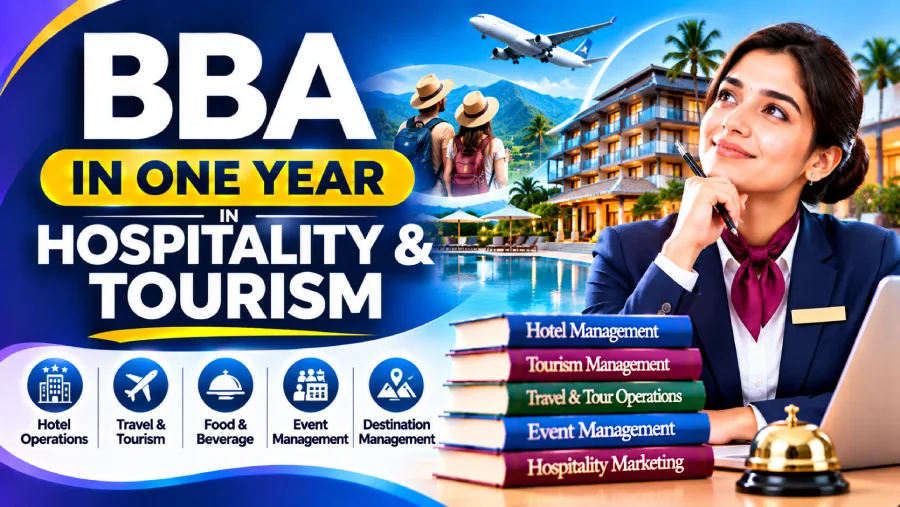
The hospitality and tourism industry connects people, destinations, cultures and businesses. Hotels, resorts, restaurants, airlines, travel agencies and tourism organisations all depend on skilled professionals who can manage services, coordinate operations and deliver memorable customer experiences.
As travel and tourism activities continue to evolve, the industry needs professionals with knowledge of business management, customer service, hospitality operations and tourism planning.
A BBA in one year in Hospitality & Tourism is a programme option that may interest students and working professionals who want to develop business administration knowledge alongside hospitality and tourism management skills. The specialisation introduces important areas such as hotel management, tourism operations, event planning, customer relationship management, travel services and hospitality marketing.
Before choosing a one-year programme, students should understand the actual duration and recognition requirements. A standard BBA is generally structured as a three- or four-year undergraduate programme, depending on the university and applicable framework. A one-year completion claim should only be considered where a valid, officially permitted pathway applies to the student’s qualifications and academic credits.
This guide explains the course structure, eligibility, subjects, benefits, career opportunities and important factors to consider before selecting a university.
What Is BBA in Hospitality & Tourism?
A Bachelor of Business Administration (BBA) in Hospitality & Tourism is an undergraduate programme that combines business management education with the principles and practices of the hospitality and tourism industry.
The programme focuses on how hotels, restaurants, travel companies, resorts and tourism organisations operate. Students learn about guest services, accommodation management, travel planning, tourism marketing, event coordination and business operations.
Along with hospitality-specific knowledge, the programme introduces general management concepts such as marketing, finance, human resource management and organisational behaviour.
Common areas of study include:
- Hospitality management
- Hotel and resort operations
- Tourism management
- Travel and tour operations
- Food and beverage management
- Front office and guest services
- Event management
- Hospitality marketing
- Customer relationship management
- Sustainable tourism development
BBA in Hospitality & Tourism: Course Overview
The following table provides a general overview of the programme. Exact details may vary by university and approved course structure.
| Course Detail | Description |
|---|---|
| Programme Name | Bachelor of Business Administration in Hospitality & Tourism |
| Degree Level | Undergraduate |
| Specialisation | Hospitality and Tourism |
| Standard Duration | Generally 3 or 4 years, depending on the programme |
| Mode of Study | Regular, online or distance, where officially permitted |
| Eligibility | Generally Class 12 or equivalent |
| Main Subjects | Hospitality, hotel operations, tourism, marketing and customer service |
| Career Areas | Hotels, resorts, travel companies, airlines and event management |
| Further Education | MBA, hospitality management and tourism-related postgraduate programmes |
Can You Complete a BBA in Hospitality & Tourism in One Year?
Students searching for a BBA in one year in Hospitality & Tourism should understand the difference between a standard undergraduate degree and an approved accelerated or degree-completion pathway.
In India, a standard BBA programme is generally structured over three or four years. The UGC’s 2025 undergraduate and postgraduate framework provides for Accelerated Degree Programmes (ADP) under specified conditions. However, this does not mean that every student can complete a regular three-year BBA in just one year.
For example, under the relevant framework, the permitted reduction for a three-year undergraduate programme is limited to one semester, subject to institutional implementation and applicable requirements.
Some universities may also discuss credit-transfer or degree-completion pathways for students with previous academic qualifications. The availability and validity of these options depend on the student’s academic record, eligible credits, university regulations and applicable recognition requirements.
Before enrolling, check:
- Whether the university is recognised and authorised to award the degree.
- Whether the specific programme and mode of study are permitted.
- Whether an accelerated or degree-completion pathway is officially available.
- Whether your previous qualifications make you eligible for credit transfer.
- Whether the final qualification will meet your employment or further education requirements.
Always request written confirmation of the programme duration, credit requirements and degree-awarding institution before paying admission fees.
Eligibility for BBA in Hospitality & Tourism
Eligibility requirements vary by university and admission route. For a standard BBA programme, applicants generally need to meet the following conditions.
1. Educational Qualification
Students should generally have completed Class 12 or an equivalent qualification from a recognised board.
2. Minimum Marks
Some universities specify minimum marks in the qualifying examination. The required percentage depends on the institution’s admission policy.
3. Academic Stream
Many BBA programmes accept students from commerce, science and humanities backgrounds. Students should check whether their preferred university has any specific subject requirements.
4. Admission Process
Admission may be based on Class 12 marks, an entrance examination or another selection process, depending on the university.
5. Requirements for Credit Transfer
Students applying through a completion or credit-transfer route may need to submit previous academic transcripts, certificates, credit records and other supporting documents.
Subjects Covered in BBA Hospitality & Tourism
A BBA in Hospitality & Tourism generally combines core business administration subjects with specialised modules related to hotels, travel and tourism operations. The following are examples of subjects that may be included in the curriculum.
1. Principles of Management
This subject introduces students to the foundations of management, including planning, organising, leadership, coordination and control. It helps students understand how organisations operate and how managers make business decisions.
2. Introduction to Hospitality Management
Students explore the hospitality industry, its major sectors and the services offered by hotels, resorts, restaurants and other accommodation businesses. The subject introduces the principles of hospitality operations and guest satisfaction.
3. Hotel Operations Management
This subject focuses on the different departments and activities involved in managing a hotel. Topics may include front office operations, housekeeping coordination, guest services and hotel administration.
4. Tourism Management
Tourism management introduces students to travel and tourism systems, destination planning, tourist behaviour and the organisations involved in the travel industry.
5. Front Office and Guest Relationship Management
Students learn about guest reservations, check-in and check-out procedures, customer communication and service standards. The subject focuses on creating a positive guest experience.
6. Food and Beverage Management
This subject introduces the management of food and beverage services in hotels, restaurants and other hospitality businesses. Topics may include service operations, menu planning, cost control and customer satisfaction.
7. Travel and Tour Operations
Students explore travel planning, tour packages, itinerary development, booking procedures and coordination with travel service providers.
8. Event Management
Event management focuses on planning and coordinating events such as conferences, exhibitions, weddings and corporate functions. Students learn about budgeting, scheduling, vendors and event operations.
9. Hospitality Marketing
This subject explores how hospitality businesses promote their services and attract customers. Topics may include digital marketing, branding, customer segmentation, promotional strategies and online reputation management.
10. Sustainable Tourism Management
Students learn about responsible tourism practices and how destinations and businesses can reduce negative environmental and social impacts. Topics may include community involvement, resource conservation and sustainable destination development.
Benefits of Studying BBA in Hospitality & Tourism
A BBA in Hospitality & Tourism can help students develop a foundation in business administration while gaining knowledge of the hospitality and travel industries.
1. Understanding of Hospitality Operations
Students learn how hotels, resorts, restaurants and travel businesses manage their daily activities. This knowledge can help them understand the operational requirements of the industry.
2. Develops Customer Service Skills
Hospitality is strongly connected to customer satisfaction. Students explore guest communication, service quality, problem-solving and relationship management.
3. Exposure to the Tourism Industry
The programme introduces students to tourism operations, destination management, travel planning and tourism marketing.
4. Builds Management and Leadership Knowledge
Core BBA subjects help students understand team coordination, business planning, marketing, finance and organisational management.
5. Opportunities Across Multiple Sectors
Hospitality and tourism knowledge can be relevant to hotels, airlines, resorts, restaurants, travel agencies, event companies and tourism organisations.
6. Foundation for Higher Education
After completing a recognised BBA, students may consider postgraduate programmes such as an MBA in Hospitality Management, Tourism Management or general management, subject to admission requirements.
Career Opportunities After BBA in Hospitality & Tourism
Graduates may explore entry-level opportunities in hotels, resorts, travel companies, airlines, restaurants and event management organisations. Job titles and responsibilities vary depending on the employer, practical experience and additional skills.
1. Hotel Operations Executive
Hotel Operations Executives support the daily activities of a hotel. Their responsibilities may include coordinating departments, monitoring service standards and assisting with guest-related operations.
2. Front Office Executive
Front Office Executives handle guest interactions, reservations, check-in and check-out procedures, enquiries and other front desk activities.
3. Guest Relations Executive
Guest Relations Executives focus on customer satisfaction by assisting guests, responding to feedback and helping resolve service-related concerns.
4. Travel Consultant
Travel Consultants help customers plan trips, select destinations, arrange travel services and understand available tour packages.
5. Tourism Executive
Tourism Executives support travel and destination-related activities. Their work may include coordinating tour arrangements, providing information and assisting with tourism promotions.
6. Event Coordinator
Event Coordinators help organise conferences, exhibitions, weddings and other events. They may coordinate schedules, venues, vendors, budgets and event logistics.
7. Food and Beverage Executive
Food and Beverage Executives support restaurant and food service operations. Responsibilities may include service coordination, customer experience and daily operational activities.
8. Resort Operations Executive
Resort Operations Executives assist with guest services, accommodation operations, recreation activities and coordination between departments.
9. Hospitality Marketing Executive
Hospitality Marketing Executives support promotional campaigns for hotels, restaurants, resorts and travel businesses. Their work may involve digital marketing, social media, branding and customer engagement.
10. Customer Experience Executive
Customer Experience Executives help organisations improve customer interactions and service quality. They may handle feedback, customer communication and service improvement activities.
Some specialist roles, including airline cabin crew, travel operations and certain hotel management positions, may have additional training, certification, language or employer-specific requirements.
Industries That Hire Hospitality & Tourism Graduates
Hospitality and tourism management knowledge can be useful across organisations that provide accommodation, food services, travel experiences and customer-focused services.
Potential employment sectors include:
- Hotels and Resorts: Guest services, front office, accommodation and hotel operations.
- Travel Agencies: Tour planning, reservations, customer support and travel coordination.
- Airlines: Customer service, ground operations and travel-related support roles, subject to employer requirements.
- Cruise Companies: Guest services, hospitality operations and onboard customer experience roles.
- Restaurants and Food Services: Food and beverage operations, service coordination and restaurant administration.
- Event Management: Conferences, exhibitions, corporate events and social functions.
- Tourism Organisations: Destination promotion, visitor services and tourism development.
- Online Travel Companies: Travel bookings, customer support and digital travel services.
- Theme Parks and Leisure Facilities: Guest experience, recreation operations and visitor services.
- Destination Management Companies: Tour coordination, local experiences and travel arrangements.
Skills to Develop Alongside a BBA in Hospitality & Tourism
Academic knowledge is important, but practical and professional skills can help students prepare for hospitality and tourism roles.
| Skill Area | Examples |
|---|---|
| Customer Service | Guest communication and service recovery |
| Hotel Operations | Front office and housekeeping fundamentals |
| Tourism | Destination knowledge and itinerary planning |
| Communication | Professional speaking and writing |
| Event Management | Scheduling, vendor coordination and budgeting |
| Marketing | Digital promotion and hospitality branding |
| Technology | Reservation systems and property management software |
| Teamwork | Department coordination and collaboration |
| Problem-Solving | Handling guest concerns and operational challenges |
| Languages | Foreign language fundamentals where relevant |
Students can also gain practical experience through internships, hotel visits, travel projects, event coordination and exposure to hospitality reservation systems.
Higher Education Options After BBA in Hospitality & Tourism
Students interested in further education may consider postgraduate programmes and professional learning opportunities after completing a recognised BBA.
1. MBA in Hospitality Management
An MBA in Hospitality Management focuses on hotel operations, service management, hospitality marketing, financial planning and strategic leadership.
2. MBA in Tourism Management
This programme focuses on tourism planning, destination management, travel business strategy and tourism development.
3. MBA in Marketing
Students interested in promoting hotels, resorts, travel services and tourism destinations may consider an MBA in Marketing.
4. MBA in International Business
Students interested in global hotel chains, international travel businesses and cross-border tourism may explore an MBA in International Business.
5. Postgraduate Programmes in Event Management
Students interested in conferences, exhibitions and large-scale events may consider specialised postgraduate programmes in event management.
6. Professional Certifications
Students may explore additional training in hotel operations, customer service, travel management, event planning, digital marketing and hospitality software. The most suitable certification depends on their intended career path.
Is BBA in Hospitality & Tourism a Good Choice?
A BBA in Hospitality & Tourism may be a suitable option for students who enjoy working with people, organising services, exploring destinations and managing customer-focused businesses.
The programme provides a foundation in business administration while introducing students to the operational and management aspects of hospitality and tourism.
| Student Interest | How the Programme May Help |
|---|---|
| Hotel Management | Introduces accommodation and hotel operations |
| Travel and Tourism | Covers tourism planning and travel services |
| Customer Service | Develops guest relations and service knowledge |
| Event Planning | Introduces event coordination and management |
| Hospitality Marketing | Covers promotion and branding of hospitality services |
| Business Management | Builds knowledge of finance, marketing and operations |
However, students should consider the practical nature of the industry, including customer-facing responsibilities, service schedules and the importance of professional communication. Internships and hands-on experience can be particularly valuable when preparing for hospitality careers.
How to Choose the Right University for BBA in Hospitality & Tourism
Selecting a university requires careful evaluation of the programme, its recognition and the academic support available to students.
1. Verify University Recognition
Check whether the university is recognised and authorised to award the relevant degree. For online and distance education in India, verify the institution and specific programme under the applicable UGC and Distance Education Bureau requirements for the admission session.
2. Review the Curriculum
Look for a curriculum that covers both business administration and hospitality management. Relevant subjects include hotel operations, tourism management, food and beverage services, event management and hospitality marketing.
3. Confirm the Programme Duration
Understand the official duration of the programme. If a university advertises a one-year completion option, ask for details of the approved pathway, credit requirements and eligibility conditions.
4. Check Practical Learning Opportunities
Hospitality is a service-oriented field. Look for programmes that include internships, practical assignments, industry exposure, hotel visits or event-related projects.
5. Understand the Fee Structure
Check tuition fees, examination charges, registration costs and any additional expenses before applying.
6. Explore Career Support
Review whether the university provides career guidance, internship opportunities, placement assistance or connections with hospitality and tourism organisations.
7. Confirm the Degree Awarding Institution
Understand which institution will issue the final degree and whether the qualification meets your intended employment or higher education requirements.
Frequently Asked Questions (FAQs)
1. Can I complete a BBA in Hospitality & Tourism in one year?
A standard BBA is generally a three- or four-year undergraduate programme. A one-year completion claim should only be considered if a valid and officially permitted pathway applies to your previous qualifications and academic credits. Verify the university’s regulations before enrolling.
2. What is the eligibility for BBA in Hospitality & Tourism?
Students generally need to complete Class 12 or an equivalent qualification from a recognised board. Minimum marks and other admission requirements vary by university.
3. What subjects are included in BBA Hospitality & Tourism?
Common subjects include hospitality management, hotel operations, tourism management, front office operations, food and beverage management, travel and tour operations, event management and hospitality marketing.
4. Is BBA in Hospitality & Tourism available through online or distance education?
Some universities offer BBA programmes through online or distance learning. Students should verify that the institution and specific programme are permitted for the relevant admission session. They should also check whether practical training or internships are required.
5. What jobs can I get after BBA in Hospitality & Tourism?
Graduates may explore roles such as Hotel Operations Executive, Front Office Executive, Guest Relations Executive, Travel Consultant, Tourism Executive, Event Coordinator and Hospitality Marketing Executive.
6. Is BBA in Hospitality & Tourism a good career option?
It may be suitable for students interested in hotels, travel, tourism, events and customer service. Career opportunities depend on practical experience, communication skills, professional training and employer requirements.
7. Can I pursue an MBA after BBA in Hospitality & Tourism?
Yes. Graduates with a recognised BBA may apply for an MBA in Hospitality Management, Tourism Management, Marketing or general management, subject to the institution’s admission requirements.
8. Does BBA in Hospitality & Tourism include hotel management?
Many programmes include hotel-related subjects such as accommodation operations, front office management, guest services and food and beverage management. The exact curriculum depends on the university.
9. Are internships important for hospitality students?
Internships can be valuable because they provide exposure to real hospitality operations, guest interactions and service standards. Students should review the programme’s practical training opportunities.
10. Which skills are useful for a career in hospitality and tourism?
Useful skills include communication, customer service, teamwork, problem-solving, time management, cultural awareness, event coordination and familiarity with hotel or travel reservation systems.
Conclusion
A BBA in Hospitality & Tourism combines business administration fundamentals with knowledge of hotel operations, tourism management, travel services, event planning and customer relationship management. It can provide an academic foundation for students interested in exploring careers in hotels, resorts, airlines, travel agencies, event companies and tourism organisations.
Before selecting a programme, students should verify university recognition, curriculum quality, admission requirements and the actual duration of the degree. Anyone considering a one-year completion option should obtain written confirmation that the pathway is officially permitted and applicable to their academic background.
With a recognised qualification, practical experience and strong communication and customer service skills, graduates can prepare for a range of opportunities in the hospitality and tourism industry.