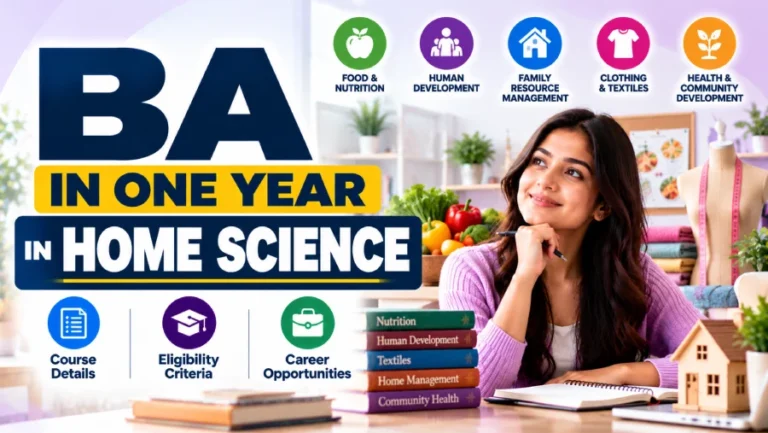
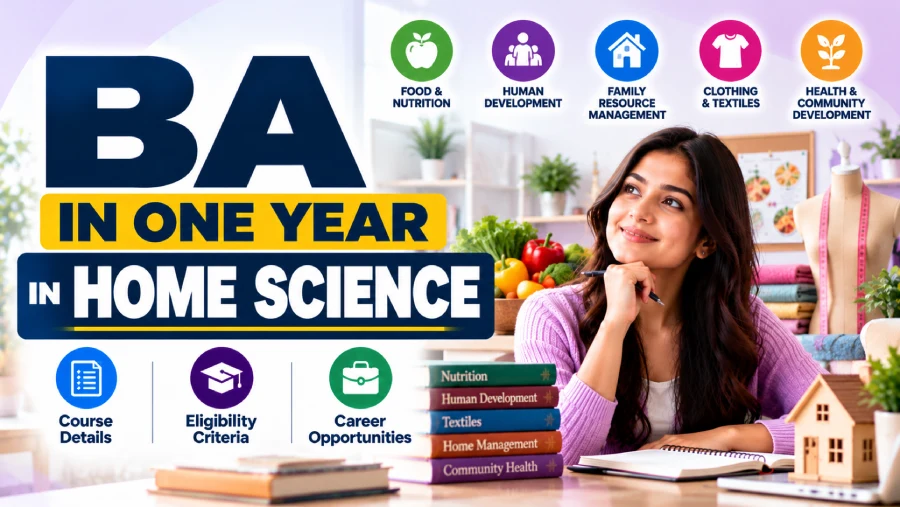
Home Science is an interdisciplinary field that focuses on improving the quality of life through scientific knowledge and practical skills. It combines subjects such as nutrition, food science, human development, family resource management, textiles, health, and community development.
A BA in One Year in Home Science is an option some learners may explore when looking for a shorter route to completing their undergraduate education. However, completing a bachelor’s degree in one year depends on the university, the student’s previous academic qualifications, and applicable regulations. Students should verify whether an approved credit-transfer or degree-completion pathway is available before enrolling.
This guide covers BA Home Science course details, eligibility requirements, important subjects, benefits, career opportunities, and factors to consider before choosing a program.
What Is a BA in Home Science?
A Bachelor of Arts in Home Science is an undergraduate program that explores the scientific and practical aspects of everyday living, family well-being, nutrition, health, and resource management.
The subject combines knowledge from different disciplines to help students understand individual, family, and community needs. Depending on the university’s curriculum, students may study food and nutrition, human development, clothing and textiles, home management, consumer education, and community health.
Home Science is not limited to household activities. It also has applications in nutrition education, social development, food services, textile industries, community outreach, and other professional areas.
A conventional BA degree generally follows the duration prescribed by the relevant university and applicable regulations. A program advertised as a one-year BA in Home Science may have different eligibility conditions or qualification structures. Students should verify whether it awards a complete recognized degree and whether their previous education qualifies them for the proposed pathway.
BA in One Year in Home Science: Course Overview
| Course detail | Information |
|---|---|
| Course name | Bachelor of Arts in Home Science |
| Duration | Depends on the approved program and applicable regulations |
| Main subject | Home Science |
| Study mode | On-campus, online, or distance learning, where officially permitted |
| Common subjects | Nutrition, human development, textiles, food science, and resource management |
| Suitable for | Students interested in nutrition, family well-being, community development, and applied sciences |
| Career pathways | Community development, food services, education, textiles, and related fields |
The exact syllabus, study format, and duration vary by institution. Verify the details of the specific program before applying.
Can You Complete a BA in Home Science in One Year?
Whether you can complete a BA in Home Science in one year depends on your previous education, the university’s admission rules, and the applicable regulations.
Students who have previously enrolled in a degree program or earned university credits may wish to explore approved credit-transfer or degree-completion options. Acceptance of previous study is not automatic and must be confirmed by the institution.
Before enrolling, consider the following:
- Previous qualifications: Check whether your academic background meets the admission requirements.
- Credit transfer: Ask whether previously earned university credits can be formally accepted.
- Approved duration: Verify the minimum permitted duration for the exact degree and admission category.
- University recognition: Confirm the institution’s recognition and the validity of the qualification.
- Practical requirements: Ask whether the course includes laboratory work, practical sessions, projects, or fieldwork and how these are completed.
- Future eligibility: Check whether the degree will meet the requirements of your intended postgraduate course, employment, or professional qualification.
For applicants in India, consult relevant official regulatory information, including applicable University Grants Commission (UGC) rules, and obtain written confirmation from the university before paying fees.
Eligibility for BA in Home Science
Eligibility requirements vary by institution and admission pathway. For a conventional BA program, common requirements may include:
- Completion of Class 12 or an accepted equivalent qualification from a recognized board.
- Meeting the university’s minimum academic requirements.
- Meeting any subject-specific requirements, if applicable.
- Submission of academic certificates, marksheets, and other supporting documents.
- Meeting any applicable entrance examination or admission requirements.
For credit-transfer or degree-completion pathways, the university may also review previous enrollment, transcripts, completed subjects, and eligible credits.
Students should check the official admission criteria for the exact program rather than assuming that all one-year degree offers have the same eligibility requirements.
Subjects Covered in a BA in Home Science
The syllabus varies by university, but BA Home Science programs commonly cover several of the following subjects.
1. Food and Nutrition
This subject introduces nutrients, balanced diets, food groups, nutritional requirements, and the relationship between food and health. Students learn how nutrition affects individuals at different stages of life.
2. Human Development
Human development examines physical, emotional, cognitive, and social development throughout life. Topics may include childhood, adolescence, adulthood, family relationships, and ageing.
3. Food Science
Food science explores the composition of food, food preparation, preservation, storage, hygiene, and quality. It helps students understand the scientific principles behind food handling and processing.
4. Clothing and Textiles
This subject covers fabrics, fibres, textile properties, clothing construction, garment care, and basic design concepts. It may also introduce the relationship between textiles, fashion, and consumer needs.
5. Family Resource Management
Family resource management focuses on the effective use of time, money, energy, and other resources. Students learn about budgeting, planning, household organization, and responsible decision-making.
6. Community Nutrition
Community nutrition examines nutritional needs and challenges across different population groups. It may include nutrition education, public awareness, food security, and community-based nutrition initiatives.
7. Health and Hygiene
This subject introduces personal hygiene, sanitation, disease prevention, healthy environments, and basic health awareness. It highlights the importance of maintaining healthy practices in families and communities.
8. Child Development and Care
Students explore children’s growth, learning, behaviour, emotional development, and care requirements. This knowledge can be relevant to childcare, early childhood education, and community programs.
9. Interior Design and Home Management
Depending on the curriculum, students may learn about space planning, functional interiors, household organization, colour concepts, and efficient use of living spaces.
10. Consumer Education
Consumer education focuses on informed purchasing decisions, product quality, consumer rights, budgeting, and responsible consumption.
11. Extension Education
Extension education introduces methods of sharing knowledge and skills with communities. Topics may include awareness campaigns, educational activities, communication, and community participation.
12. Research and Project Work
Some programs include practical assignments, surveys, research projects, or fieldwork. These activities help students apply theoretical knowledge to real-world situations.
Benefits of Studying BA in Home Science
1. Develop practical life skills
Home Science combines scientific understanding with practical knowledge related to nutrition, health, family management, and everyday resource use.
2. Understand nutrition and healthy living
Students gain knowledge of food groups, nutrients, dietary requirements, and food safety. This can help them understand the role of nutrition in overall well-being.
3. Learn about human development
Studying human development helps learners understand the needs of children, adolescents, adults, and older individuals.
4. Explore different professional fields
Home Science covers several areas, including nutrition, textiles, food services, community development, and education. This interdisciplinary foundation can support different career directions.
5. Build communication and organizational skills
Projects, presentations, and practical assignments can help students improve communication, planning, teamwork, and problem-solving abilities.
6. Create opportunities for further education
A recognized BA in Home Science may provide a foundation for postgraduate study in relevant areas, subject to the admission requirements of the institution offering the next qualification.
Career Opportunities After a BA in Home Science
A BA in Home Science can support several career directions. Actual opportunities depend on an individual’s skills, experience, location, additional qualifications, and employer requirements.
1. Community Development Assistant
Community development professionals support awareness programs, educational activities, and initiatives focused on family and community well-being.
2. Nutrition Education Assistant
Graduates may assist with nutrition awareness activities, educational materials, and community outreach programs. Professional dietitian or clinical nutrition roles generally require additional specialized qualifications.
3. Food Services Assistant
Food services professionals may work in institutions, catering organizations, educational establishments, and food service operations. Responsibilities can include coordination, food safety practices, and service management.
4. Childcare and Early Childhood Support Professional
Home Science knowledge related to child development can be useful in childcare centres, early learning environments, and child-focused organizations. Specific roles may require additional training or qualifications.
5. Textile and Apparel Assistant
Graduates with an interest in clothing and textiles may explore roles in garment production, textile businesses, product coordination, quality support, or fashion-related services.
6. Home Management Consultant
Professionals may provide guidance related to household organization, resource management, space planning, and efficient use of household resources, depending on their training and experience.
7. Research Assistant
Research assistants may support surveys, data collection, documentation, and projects related to nutrition, family studies, textiles, or community development. Some positions may require further education.
8. Educational Content Developer
Graduates with strong communication and subject knowledge may help create learning materials, articles, presentations, and educational resources related to health, nutrition, family well-being, and Home Science.
9. Social Welfare Program Assistant
Home Science knowledge can be relevant to organizations working on family welfare, community awareness, women’s development, child welfare, and public education.
10. Entrepreneur
Graduates may explore small businesses in areas such as clothing, textiles, food services, educational content, or other fields related to their interests and skills. Business success requires market research, planning, practical knowledge, and suitable regulatory compliance.
Important: A BA in Home Science alone does not automatically qualify graduates for regulated professional roles such as clinical dietitian, nutritionist in certain healthcare settings, or specialist counsellor. These positions may require additional recognized qualifications, supervised training, or professional credentials.
Industries That Value Home Science Graduates
Home Science knowledge can be relevant across several sectors, including:
- Food and hospitality services
- Nutrition education and community health
- Textile and apparel industries
- Childcare and early childhood services
- Education and training
- Social welfare organizations
- Non-governmental organizations
- Family and community development
- Research and academic services
- Consumer education and product development
The most suitable industry depends on your interests, practical skills, academic background, and career objectives.
Higher Education Options After BA in Home Science
Students who complete a recognized BA in Home Science may consider further education based on their interests and eligibility.
Potential options include:
- MA or MSc in Home Science, subject to the institution’s eligibility rules
- Postgraduate study in food and nutrition
- Human development and family studies
- Community development and social work
- Textile and clothing-related programs
- Food science and related disciplines
- Early childhood education
- Relevant education and teacher-training qualifications
- Research-oriented programs in related fields
Some postgraduate programs may require specific undergraduate subjects or practical credits. Always check the entry requirements before applying.
Is a BA in Home Science a Good Choice?
A BA in Home Science may be a suitable choice for learners interested in nutrition, health awareness, human development, textiles, family resource management, and community well-being.
The subject offers an interdisciplinary learning experience and can develop practical, analytical, and organizational skills. However, the value of the program depends on your career goals, the recognition of the institution, the curriculum, and the practical experience you gain.
Before selecting a program, consider:
- Recognition: Verify the institution and the exact qualification.
- Curriculum: Review the subjects and practical components offered.
- Study mode: Confirm whether the course is on-campus, online, or distance learning and whether that mode is permitted for the qualification.
- Practical training: Check whether laboratory sessions, fieldwork, or projects are required.
- Career plans: Research the additional qualifications needed for your intended profession.
- Further education: Check whether the degree meets the entry requirements of your preferred postgraduate programs.
- Total cost: Review tuition fees, examination charges, and additional expenses.
If you specifically need to complete your degree within one year, obtain written confirmation of the approved pathway and verify that the resulting qualification will be valid for your intended purpose.
BA in Home Science vs. Other BA Specializations
| Feature | BA in Home Science | Other BA specializations |
|---|---|---|
| Main focus | Nutrition, human development, textiles, and resource management | Depends on the chosen subject |
| Key skills | Practical knowledge, planning, communication, and problem-solving | Varies by specialization |
| Potential career areas | Community development, food services, textiles, education, and related fields | Depends on the subject and additional qualifications |
| Further study | Home Science and related interdisciplinary programs | Postgraduate programs related to the chosen discipline |
| Best suited for | Learners interested in family and community well-being and applied sciences | Learners interested in another academic field |
The right specialization depends on your interests, strengths, career plans, and the qualifications needed for your chosen profession.
How to Choose the Right BA in Home Science Program
Follow these steps before applying.
- Verify the university: Confirm its recognition and official status.
- Check the qualification: Understand whether the program awards a complete BA degree or offers another academic pathway.
- Confirm the duration: Obtain written details about the approved duration and any claim that the degree can be completed in one year.
- Review eligibility: Check academic requirements and any subject-specific conditions.
- Examine the syllabus: Look for nutrition, human development, food science, textiles, and resource management.
- Check practical requirements: Confirm whether laboratory work, projects, or fieldwork are included.
- Confirm the learning mode: Verify whether the institution is authorized to offer the qualification through the advertised study format.
- Review total fees: Understand tuition, examination fees, and other charges before making a payment.
Frequently Asked Questions
1. Can I complete a BA in Home Science in one year?
It depends on the university, your previous academic qualifications, and the applicable regulations. Do not assume that a full BA degree can be completed in one year. Verify any advertised credit-transfer or degree-completion route with the institution and relevant regulatory authority.
2. What is the eligibility for BA Home Science?
For a conventional undergraduate program, applicants commonly need to have completed Class 12 or an accepted equivalent qualification. Specific requirements vary by university.
3. What subjects are taught in BA Home Science?
Common subjects include food and nutrition, human development, food science, clothing and textiles, family resource management, community nutrition, health, and hygiene.
4. What jobs can I pursue after a BA in Home Science?
Potential career paths include community development support, food services, textile-related roles, educational content development, childcare support, and research assistance. Specialized roles may require further qualifications.
5. Can I pursue postgraduate studies after BA Home Science?
A recognized BA in Home Science may provide access to relevant postgraduate programs. Admission depends on the university’s eligibility criteria and the subjects covered in your undergraduate degree.
6. Is BA Home Science useful for a career in nutrition?
Yes, it can provide a foundation in food and nutrition. However, professional dietitian and clinical nutrition roles may require additional specialized qualifications and supervised training.
7. Can I work in the textile industry after BA Home Science?
Yes. Subjects related to clothing and textiles may provide a foundation for exploring garment, apparel, textile, product coordination, and related support roles. Practical experience and specialist training can improve career prospects.
8. Is an online BA in Home Science valid?
Validity depends on the institution, the qualification, and whether the program and delivery mode are appropriately recognized or permitted. Verify these details through official sources before enrolling.
Conclusion
A BA in One Year in Home Science may interest learners looking for a shorter route to undergraduate completion, but the validity of the pathway must be verified carefully. BA Home Science programs generally develop knowledge of nutrition, human development, food science, textiles, family resource management, and community well-being.
These areas can provide a foundation for career opportunities in education, food services, community development, textiles, and related sectors. Before applying, confirm the institution’s recognition, approved duration, exact qualification, and eligibility requirements for your admission route.
Explore the programs offered by MCM Academy to learn about available study options, admission requirements, and guidance for selecting a suitable qualification.